Tirana Examiner Staff Report | Cernobbio and Tirana
Prime Minister Edi Rama used his first appearance at the Ambrosetti forum in Cernobbio on Saturday to restate his case for the gradual integration of candidate countries into the European Union, to say that he does not believe 2027 will “happily await” Albania with veto rights, and to argue that Serbia belongs at the European table even as Serbian state institutions and officials take part in honours for the convicted war criminal Ratko Mladić.
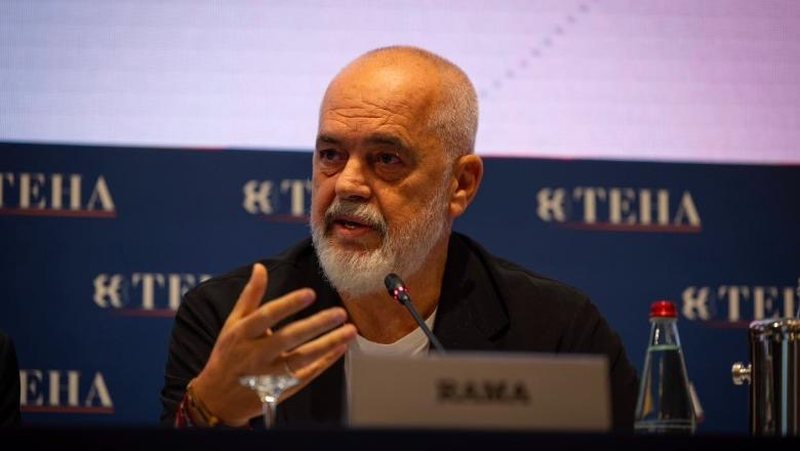
Rama spoke on 5 September at the 52nd TEHA Forum at Villa d’Este, organised by The European House Ambrosetti, in the session “Il Mediterraneo allargato” (“The Wider Mediterranean”), part of the day’s “Agenda for Europe” programme. He appeared alongside Croatian Prime Minister Andrej Plenković, who also holds the presidency of the MED9 group, in a discussion moderated by former Italian prime minister Paolo Gentiloni, president of the EIB Global Advisory Council. Mario Monti and Enrico Letta were among those in the room. The Prime Minister’s office published a full transcript of his remarks and the question session the same day; the quotations below are rendered from it.
“The Titanic is not making the turn”
Rama opened by separating his position from Plenković’s. “He said we are in the club. We are still outside the club, trying to get in,” he said. On one hand, he said, the Western Balkans felt encouraged by “this new moment and this new atmosphere, for which unfortunately we have to thank first and above all Vladimir Putin”. On the other, “there is another Mario who insistently tells us that things are not going the way they should”, so that “it feels a bit like hearing a wonderful melody while the Titanic is not making the turn and the iceberg is still in front of us”. He did not name the second Mario.
He listed the figures behind the warning: only four of the 50 largest technology companies are European; no EU university is in the world top 20 and only four are in the top 50. He said he had read “a very strong document”, which he did not name, with passion to find where his country stood and found the Western Balkans “not included at all”, calling the omission “a luxury decision, to leave us out”.
Copper, raw materials, “the Western Taliban”
Rama tied the point to the EU’s strategic-autonomy goal on critical raw materials. “In our part of Europe, in the Western Balkans, we have a very important, very important quantity of raw materials, and we are practically outside the common approach in this direction,” he said. Europe, in his reading, “cannot achieve its own autonomy in critical raw materials within its own borders and within the timeframe it has set” unless the region is brought in through existing EU instruments.
“Albania has a very large copper reserve, and meanwhile we are practically turning away the Chinese and other potential investors while waiting for Europe to come,” he said, “because of our unconditional love for Europe and for the West as Albanians. By the way, we Albanians are the Western Taliban, the ones who have no relationship with Russia.”
He then gave the line that drew laughter. “I think it is the only country in Europe, certainly, but also in the world, which since 1960 has had no Russian official arrive to visit us and no plane leave Tirana for Moscow, and we don’t miss it. We are not waiting impatiently for it to happen. We are the only country in Europe where there is no genuine Chinese investment, and strangely we don’t miss it.” He broke off: “Putin is calling.”
Nationalism at the centre, “the call of someone in love”
Rama described himself as “a strong supporter” of Europe and said his remarks were “the call of someone in love”. The extraordinary problem for unity, he said, was what Gentiloni had raised in his introduction: “the quite nationalist and inward-looking tendencies in many countries of Europe which not long ago were in fact the beacon of what the European Union should be.”
“For us of course this is very disheartening, because we were the nationalists, we were the dangerous lunatics of the continent, and all of a sudden we became so much in favour of the very cultured way of looking at life that it is very disheartening to see them push us back,” he said. He said it was disheartening “to see moderate democratic governments that are not fully in charge of the movement, because in fact the policy for a stronger and more united Europe is conditioned by the extremes and by the fear of those extremes, or by the need to contain those extremes one way or another”. From there, he said, “comes the question of gradual integration”.
“2027 will not happily await us with our veto”
“Honestly, I do not believe there will ever be a place for us in the European Union if something does not change inside the European Union,” Rama said. “I do not believe 2027 will happily await us with our veto power. I don’t believe it. I do not believe some capitals will have the ability to go and tell the public: people, we are taking Albania in with its veto power.”
The Albanian government’s stated target is to conclude accession negotiations by the end of 2027 and complete the subsequent accession and ratification process in time for membership by 2030.
“That is why I believe gradual integration is the only way to get us into the European Union and to start from the real, genuine part, which is the common market, being part of the single Europe of universities, of science and all the other very important elements,” he said.
He said he counted seven candidate countries, “Ursula’s seven children”, and recalled telling the Commission President: “When you were raising your children you had them around the table, at home. You did not tell them go out there in the neighbourhood and then come to the table.”
“So we do not need the veto power to sit around the table,” he said. “As a European I am against it.” The debate, he said, was not with Plenković, “who is already EU”, but with other leaders in the Balkans. “They tell me ‘why, Edi, why do you say we don’t need the veto. We all need the veto.’ And I tell them ‘no, as a European I don’t want you to have a veto, because imagine having seven other lunatics sitting around that table. It would be impossible.’ So it would be better for Europe, it would be better for us, and it can happen this way. Otherwise it will not happen.”
“Let me say it bluntly. The problem is not Italy,” he continued. “I don’t see France having two thirds of the parliament. They don’t even have two thirds themselves. Imagine with us. Imagine them saying, welcome Albania, or Montenegro, or whoever it is. We are told, come, you are part of Europe, now you can veto against us. It will never happen!”
The veto, he said, “is not the only thing, but at least psychologically the veto is an obstacle that can be removed”, so that candidates “will grow up with us, will learn to behave well, and will never take this table hostage”.
“They don’t need to come with missiles”
Rama closed his opening statement on the young generation. While Europe’s “enlightened thinkers” gathered to look at the future, he said, “in a part of this reality, which is this reality here, the young generation is drifting away day by day from all of this and crashing into an ocean of hatred, division and aims that are completely at odds with the values, principles, dreams and everything that has to do with the European Union”. That, he said, is “where the ‘enemy’ is for all of us”, producing “all sorts of proposals, all sorts of personalities able to pull people after them, fragmenting our societies more and more”.
“The centre is disappearing and in every cycle we see more extremes, extremes, extremes, and I don’t know how such a thing will be fixed,” he said. “While we are paying money we don’t have, and let me be clear, I am not the one saying this, the other Mario says it, we do not have enough economic growth for this spending, and while we are pouring so much money into spending to protect Europe from missiles, we are completely unprotected in our minds, in our brains, and all the enemies of democracy, all the enemies of Europe have a very easy road. They don’t need to come here with missiles, because they are already mixing with the minds of our children and already taking the young generation hostage.”
There would be no young generation “able to follow all the great dreams, all the enlightened thoughts of the Ambrosetti forum”, he said, “if all of us together do not think about a shield, about that space where the enemies are meanwhile stirring their minds”.
When Gentiloni thanked him for a “non-diplomatic, realistic, perhaps slightly pessimistic” perspective, Rama replied: “Not pessimistic, tragically optimistic.”
Questions: the EU budget, Italian universities, a divided Ukraine
Three questions followed. One asked whether the EU needed a much larger budget than the current proposal, for existing and future members alike. A second, from a woman who said she knew Albania very well and had travelled it end to end, urged more bridges with Italian universities and research institutions and shared data structures in climate and health, arguing that young people do not see EU membership as a value in itself. A third asked both panellists whether “a divided Ukraine” would ever join the EU, or whether there would be a place for it “at Edi Rama’s special table”.
Kohl at Potsdamer Platz
Rama took the Ukraine question first. “It is not about my special table. It is about whether Europe, and I’ll start with Germany, has the courage to find its new Helmut Kohl moment,” he said. “When Helmut Kohl went to Potsdamer Platz and the wall had fallen, he did not tell his East German compatriots, ‘now you are free, but there are some 33 chapters you have to pass before we unite’. He told them, ‘we are together’.”
“So at my table things would be very simple,” he said. “All the countries, Ursula’s seven ‘children’, have to fulfil every criterion according to the rules. They have to follow the rules for every chapter and they have to withstand the whole neurotic process of the ‘machinery’ of 35,000 women and men, which is the most merciless bureaucratic machinery humanity has created, because you have to get a driving licence, a permit, and that is not given to someone just because you like them. But what has to change is the order of action. Not first 33 chapters and then the political decision. No.”
“First, all seven, including Ukraine, must come and sit around the table like Ursula’s children, but as children they must listen to ‘father and mother’, Germany and France, and then to the ‘aunt’, Italy, and then to all the rest, and then they must behave well, but they must be there in the Council of the European Union around that table, and while they meet the criteria under the rules, every chapter they close makes them members within the framework of that chapter.”
Turning to the questioner who knew Albania well, he said: “Congratulations, I don’t know Albania that well, yet.” Closing the chapter on science, culture and education, he said, would make a candidate “a member for that, with the same rights, and it should continue like that. And so whoever wants to take more from the table gives more to the table, but they have to be present there.”
Serbia and the Mladić honours
It was at this point that Rama turned to Belgrade. “I know Serbia is a very interesting and strange kind of ‘animal’ in the ‘jungle’ of the Balkans,” he said. “But what is better? To have it sitting around the table and to tell it ‘no, you cannot hold a state funeral for a butcher’, or to leave it out there in uncertain waters and create a completely schizophrenic situation between Europe, China, America, Russia and I don’t know who else, Vietnam!”
“This is my approach and it has to happen now,” he said. “What is this atmosphere? Atmosphere, or whose atmosphere? Of those who tomorrow may hide behind the extremes. What is this? ‘We are not in the mood.’ For what? To tell people the Titanic is sinking, we have to face the competition. Yes, we have a common market. But how many things have happened today in each of the states that in fact show there are 27 markets. Where are Europe’s capital markets? Where are Europe’s financial capacities in themselves?”
The remarks came on the day a commemoration for Mladić, the former Bosnian Serb army commander sentenced to life imprisonment by the UN tribunal for genocide and crimes against humanity, who died on 27 August, was held at the Dom Vojske Srbije in Belgrade. Serbia’s justice minister, Nenad Vujić, attended alongside Republika Srpska president Siniša Karan and other officials, Tanjug reported. Speakers described Mladić as a “great leader”, a “top professional” and an “honourable officer”; the Russian historian Jelena Guskova said his biography would be studied “in schools, at universities”. The ceremony followed Enlargement Commissioner Marta Kos’s decision on Friday to cancel a planned visit to Serbia over what she called the glorification of Mladić.
Data, databases, “occupied by the Russians”
On the data question, Rama said: “When it comes to Albania, please come and take all the data. We have nothing to hide from Italy. Our bad luck was that instead of being occupied by you, we were occupied by the Russians. But that is another story.”
Italy, he said, citing someone in the room he declined to name, has “19,000 separate databases that do not communicate with each other. Imagine now how many there are in Europe.” The official transcript then records Rama as saying: “We want to create a powerful artificial-intelligence base with 90,000 databases. I am not talking about Albania, because in Albania every Albanian is a database of his own.” He did not say what the 90,000 figure refers to.
4,300 euros against 138, and the Roman Senate
On the budget, Rama deferred to Plenković but offered one comparison: “Anyone around us who is a member of the European Union receives from the European Union 4,300-odd euros per head. We in the Western Balkans receive 138 euros per head.” He did not give the basis or period of the figures.
He ended with Rome. When the empire’s end came “and the atmosphere was somewhat the same”, he said, the Senate “was made up of politicians, not influencers, not people who depended on follows and likes on Instagram, and not politicians who proposed to change the world with a magic wand by closing the borders”. The debate then, he said, was whether only Romans within Rome’s borders should lead, or whether citizenship should be extended to everyone within the empire’s sphere, “and the debate was very big because there were also people of colour there, different colours and cultures outside these borders”. The Senate, he said, “decided it had to give citizenship to all those within the perimeter of the Roman Empire, if they wanted to still have soldiers. With whom will Europe fight the next war? With drones? Because with soldiers it would not be possible.”
The broad extension of Roman citizenship to free inhabitants of the empire came under Emperor Caracalla’s Constitutio Antoniniana in AD 212, rather than through a late-imperial Senate decision.
He apologised for running over time, “which is in fact the typical Sicilian-Albanian tradition: what they don’t give you, you take. I know it is not very European, but as long as we are not in Europe, we enjoy being similar to the Sicilians. At least it is more fun than the rest of the boredom.”
Gentiloni closed by calling the Roman conclusion coherent with the forum’s message of a European superpower.
Reactions
Opposition leader Sali Berisha responded on Saturday evening. He said Rama had adopted “Europe is to blame” as the motto of his speech, rejected the Prime Minister’s remarks on Russia and Putin, accused his government of building a “narco-state”, and concluded that Rama’s departure was “the condition of all conditions for the restoration of the rule of law in Albania and secure advancement”.
In Serbia, Aleksandar Vučić addressed the Main Board of his Progressive Party at the National Theatre in Niš on Saturday, as the Mladić commemoration was taking place in Belgrade. “We Serbs fear God, not Marta Kos,” Serbia’s president said, adding: “And today they threaten us with alliances, Prishtina, Tirana, Zagreb.” He said Serbia would preserve peace, military neutrality and its independence while strengthening its ability to defend itself.