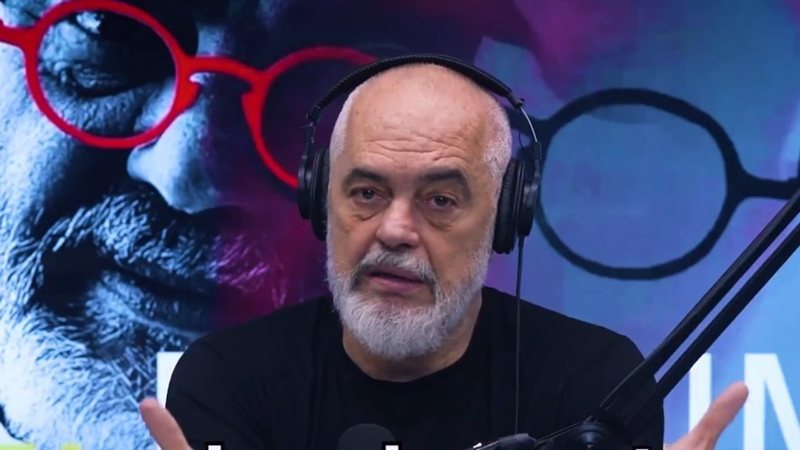
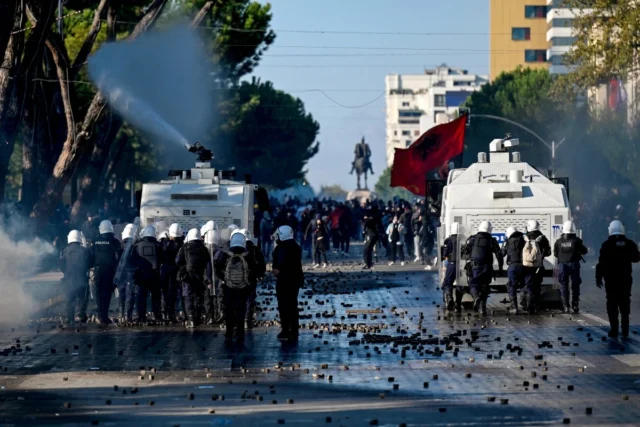
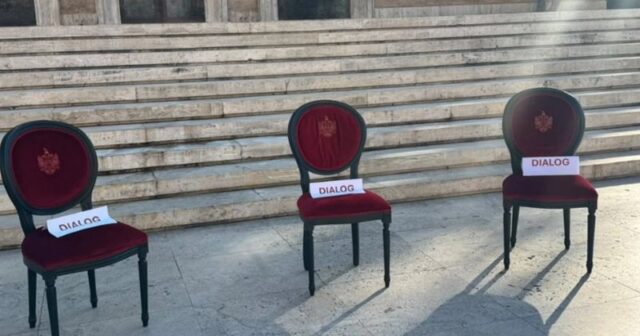
Prime Minister Edi Rama used the twenty-third episode of the sixth season of his weekly podcast, Flasim, to address several policy and governance matters: a prefatory reflection on what he described as troubling symptoms accompanying the ongoing protests against the Zvërnec coastal development project, including tourism booking cancellations, online bullying of dissenting voices, and what he characterised as a fascist component within the protest movement, followed by remarks on the 35th anniversary of the Socialist Party and Albania’s current position at the most advanced point of its European path. Below is an edited transcript of the weekly address, reconstructed and condensed for clarity from the original recording.
I want to open these notes with a prefatory reflection on several symptoms that concern me and that should concern everyone who is interested in things going better in Albania, not going worse.
I believe that even among those who are protesting, a part want things in Albania to go better and are genuinely concerned about how the development of the investment in Zvërnec will unfold. While it is not that another part, the dominant part, does not want things to go better, absolutely not, but the way they want things to go brings the worst outcome for Albania.
And here I have in mind those small parties that remained small or that grew old. Here I have in mind those who have been brought in from other territories: what connection do they have with this matter, which concerns Vlora, and which has caused no protest whatsoever in Vlora itself, because Vlora massively wants the development there. That is a question I do not want to answer, but I will leave it as a question.
And moving toward Vlora, I want to dwell on a very problematic symptom that is growing day by day: the cancellation of bookings for the season by foreign tourists.
I have received many messages, but naturally I cannot come out and use this to have it said: “You want to stop the protest because your heart burns for the hotels.” But on the other hand I cannot stay silent about the fact that in both Vlora and Durres there have been protests by tourist operators, awareness protests. In Vlora, around 95 percent of those who own hotels, restaurants, and bars joined the awareness protest, asking for understanding that the season not be damaged, because it is a direct damage to the family economy of many people connected to tourism and a direct damage to the local economy and to the national economy as a whole.
In other words, if we stop the money that would normally enter Albania with a calm tourist season from entering, then I do not know in whose favour that goes.
If there is a protest agenda to obstruct Albania from all four sides, and through obstruction to create frustration and then make people say “come on, let us get rid of this government, just leave us in peace,” then that is an agenda that is not new. It is an agenda that has been used in other countries, it is an agenda that has been used here as well, by the Molotov throwers, but it will not work. The damage will certainly be large and unnecessary, in my view.
Another very repugnant symptom is the bullying of people on Facebook and Instagram. I have watched with great sadness how a singer like Ylli Limani, a singer loved by a large number of people, who is not my favourite singer, I belong to another generation and live with other musical desires, but who is a very respected and very beloved singer who gave an extraordinary concert in Tirana, has been massacred with insults, pressure, and threats to cancel the concert and deny people the pleasure of having a beautiful moment of music, because people should be focused on the protest.
And this is happening to many people, including those who simply hold a different opinion and write a post and receive abuse and threats, which speak to what I said from the first day. In this conglomerate, in this mosaic where there are people from all walks of life, where there are certainly people with only good intentions, there is also a fascist component, a fascist spirit. And the fascist spirit does not need uniforms or weapons. The fascist spirit is the spirit that says Albania belongs to Albanians, meaning all others outside are not welcome. Just as Germany was for Germans and became the black sheep of Europe for years and years afterward. Greece is for Greeks, said the animals of Golden Dawn, who became a problem for Greece, and so on and so forth.
The fascist spirit is when you say: I want to speak, I want to say what I think, I want to protest, I want to stand on the boulevard, but I do not want and I do not accept that others hold a different opinion or position. Others must get up from their cafes, others must not go to concerts, others must not go to the beach, others must not work, others must not receive the material benefits of their labour, because they must be part of this thing. The fascist spirit is when you do not want to know anything at all. And this is certainly a very dangerous component of the protest.
These symptoms are directly connected to two things that are non-negotiable for a democratic society and for Albanian society and for the country: the need for economic growth, the need for more income. And tourism is such a large and important source, and this year was forecast to be the most successful season ever, but if this situation continues and if the cancellations continue, this will not be a successful season. This will be a season sabotaged by ourselves, by ourselves, something unimaginable, but which can actually happen, and the symptoms are there.
And the other point: it is intolerable that a group of people, a force of people, a party or a conglomerate of parties, or whatever you wish to call it, imposes itself on the rest by saying either you think like me or I will cripple you, bully you, threaten you. That is fascist, it is scandalous, and it must be stopped. And it is stopped by not retreating before these kinds of pressures and before these kinds of animals. This must be stopped.
Turning to the weekly notes, the 35th anniversary of the Socialist Party. A celebration planned long in advance, which was crowned on June 12, at a special moment, because it is not simply a birthday and an anniversary, but a moment that finds Albania better than Albania has ever been in every respect, and this thanks to the Socialist Party and its governments. While on the other hand it is also a moment of reflection and commitment, because Albania is better than it has ever been, but Albania must become much better still than it is. And only the Socialist Party can do this. Only this great state-building force can do it, with all its difficulties and all its shortcomings.
Ironically, this 35th anniversary, or more precisely, through a coincidence that is perhaps also an important sign to pause for a moment, to draw breath, and to understand what we must learn from this wave of protests that coincided with this 35th anniversary, and from this spirit, a spirit that is, so to speak, tense but fortunately peaceful, which has taken over the public space in recent days.
A spirit fed also by the fact that, connected to this initial subject, to this issue that became the issue that initiated the protest, naturally as the result of a scandalous act, which was immediately condemned both legally and institutionally, there stands the family of the President of the United States. And this means that all those who oppose the President of the United States are interested in this protest, that Albania becomes a platform where very large forces clash, where the American opposition clashes with the American president, where European opposition clashes with the American president, where other interests that want Albania repositioned differently clash, and it becomes a crossroads where in fact the original opposition turns into something entirely different. And Albania is flooded by an explosion of all channels of misinformation, disinformation, and half-truths that become ever greater lies, hour after hour, and which in fact push facts into the corner and fantasy into the centre.
Of course protest is the hallmark of a democratic country. Of course it is the democratic health of a country to have a protest that is born and takes shape not around parties, not behind parties. Even though now all the parties have inserted themselves there, some throwing stones while hiding their hands, while others, such as the loudmouths, are right there in the open.
But it is equally important that we not lose the ability to distinguish between debate and hysteria, between criticism and slander, between passionate argument and bullying, threats, pressure, and the denigration of others. Albania cannot move forward by being paralysed by fear of a great change, of a great project, of an investment that is the largest in the history of our country.
And we will of course move forward, listening to what we need to hear, learning from what those who disagree with us tell us, but continuing to build, to build Albania with the force of the Socialist Party, which is the force that has undertaken reforms, that has taken on difficult reforms, that has pushed forward processes that have often been opposed, but which today have radically changed both the condition and the position of Albania. And for this it is enough to turn our heads back, not more, just ten years, to see where we were in relation to the world, in relation to the economy, in relation to institutions, in relation to everything. And in fact there is no stronger symbolism than the fact that this 35th anniversary found us also at the most advanced point of our European road. A few weeks ago we entered the final phase of accession negotiations, which is the phase of closing chapters, drawing closer than ever to that historic and strategic objective that Albanians have pursued for decades and which we have as our fixation day by day, day by day, day by day.