On the protest’s fifteenth night, the march reached the road to the airport. What happened there was a question of conduct, and two answers met on the same asphalt.
By Aurel Cara (Tirana)
Edi Rama called it a mob steered by evil minds and bad hands, a crowd that no longer had anything to do with Zvërnec or the flamingos of Narta. Set the words aside and look at what actually happened on the road to Rinas, because the night is better understood through conduct than through adjectives.
For fifteen nights the police had done almost nothing, and that nothing was a choice. Night after night the crowds marched the boulevard, filled Skanderbeg Square, chanted for the government to go, and the state let them. The protest earned its tolerance the ordinary way, by staying peaceful, and it was met with the tolerance a peaceful protest is owed.
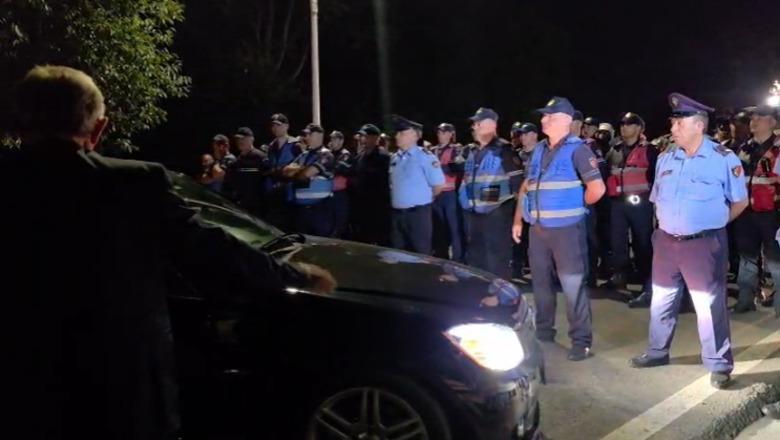
On the fifteenth night the march changed shape. It moved off the boulevard and onto the motorway toward Durrës, then turned up the road to the country’s only international airport. Somewhere short of the terminal the police were waiting. They formed a line. Behind them stood the water cannon, engines running, and they were never used. The officers told the crowd the road could not be blocked, held their position, and waited. After a time the protesters sat down, sang that the police belonged to them and not to the Prime Minister, and then turned back toward Tirana, promising to return in greater numbers. No baton was raised. No gas was fired. No one was arrested at the airport. A line was held, and then a crowd was allowed to go home. That is what restraint looks like when it wears a uniform.
The march that reached that line had crossed into different conduct. The decision exposed divisions inside the movement, and no one can say who chose Rinas. The organizers split over it in real time, and the recriminations are still circulating. Blocking the single road to the nation’s one air link has no organic connection to a threatened lagoon, and a tactic that severs a country’s only door to the world is not pressure on a government, it is pressure on every traveller who had nothing to do with the quarrel. Eight flights depended on a road that was no longer reliably passable in the hours after midnight. An ambulance was held up in the gridlock the blockade created. That detail, more than any slogan, marks the place where a protest stops asking to be heard and starts deciding who may pass.
None of it touches the legitimacy of the cause, and that distinction is the whole point. The coast is worth defending. The lagoon is worth defending. The right to stand on the boulevard and demand both, night after night, is worth defending, and for fifteen nights it was exercised and protected without a hand laid on anyone. Conduct is not the same as cause. A grievance can be entirely just and the means of pressing it can still cross a line, and the line is not annoyance or inconvenience. People stuck in traffic is the ordinary price of assembly in a free country, and a democracy pays it without complaint. An ambulance that cannot move and an airport that cannot be reached are a different order of thing.
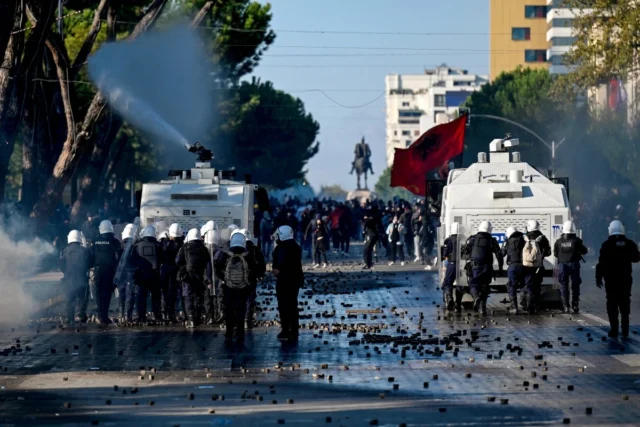
The standard Albania says it wants to live under draws the line in the same place. A democracy must put up with disruption. Strasbourg has held for years that the inconvenience of a public gathering is a cost the state simply absorbs, that blocking traffic stays peaceful even when it is unlawful, and that the line falls only at deliberate, serious obstruction that puts the rights of others at risk. A blocked street is tolerated. A blocked ambulance is not. By that measure the fifteen tolerated nights were the system working as designed. The cordon at Rinas was a lawful and proportionate defence of an airport and an ambulance route. And the water cannon left idle behind the line was the proof of the proportion, the clearest evidence that the response was measured to the threat and no further.
So the night offered a contrast, and it was a contrast of conduct, not of slogans. One side structured an escalation it could not own, aimed at the one piece of infrastructure a country cannot afford to lose, and left an ambulance idling in the dark. The other side stood across the road, held without striking, and opened it again when the crowd turned back. The cause that brought everyone onto the boulevard remains as legitimate as it was on the first night. But a cause is carried by the discipline of the people who carry it, and on the fifteenth night the steadier discipline on the road to the airport belonged to the line that held, not to the march that walked into it.