Prime minister announces consultation and longer school hours; People’s Advocate identifies failures in police treatment of detained children; Justice Ministry proposes procedural safeguards; Education Minister says schools are back to normal
Tirana Examiner Newsroom
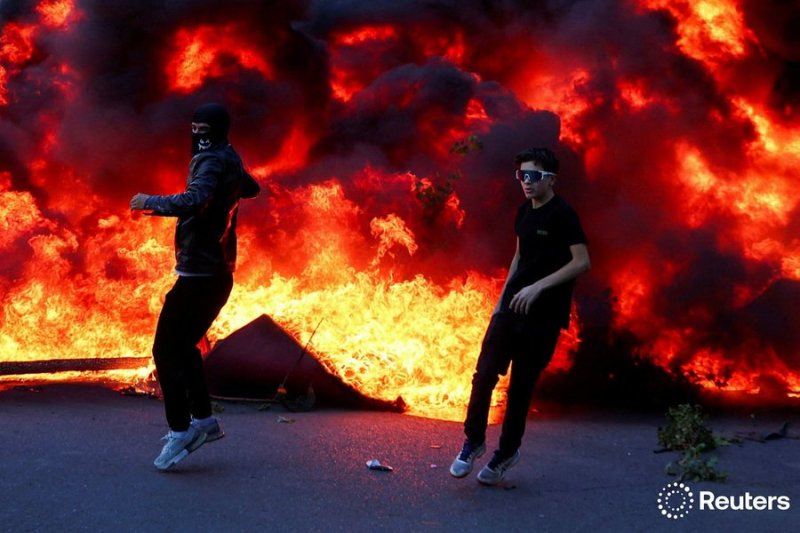
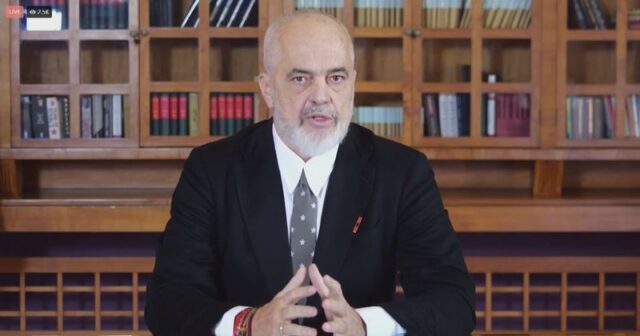
Prime Minister Edi Rama told the National Council for the Rights and Protection of Children on Friday, 30 October, that the government will open a consultation on restricting minors’ access to social media and will extend the school day to 17:00 from 2027, after what he described as a disturbing number of minors taking part in the violent protests outside his office. At the same meeting, convened by Rama after the events of recent weeks, People’s Advocate Endrit Shabani said police had violated the procedural rights of detained minors, including minors found in police stations with unexamined signs of violence.
Four ministers also spoke. Justice Minister Toni Gogu proposed four procedural safeguards for minors who come into contact with law enforcement. Education Minister Mirela Kumbaro said pupils had faced pressure from groups outside schools to boycott lessons and that all schools had returned to normal. Health and Social Welfare Minister Klodiana Spahiu called for closer institutional cooperation on child protection. Interior Minister Ervin Demo announced a Europol-developed platform for children facing abuse online.
Rama said the protests had exposed a troubling picture of how violence is being relativised. “We have become witnesses to a disturbing panorama of the approach of a part of society towards a taboo for all democracies, for all paths of coexistence in democracy, which is violence. We have seen how violence has been relativised, justified and glorified, while all those who attacked institutions, schools, the freedom and right of everyone to attend lessons, public and private property, have received civic legitimacy and media immunity as carriers of an admirable effort to overthrow a system,” he said (“Kemi parë sesi dhuna është relativizuar, justifikuar dhe himnizuar”).
He singled out the participation of minors. “What has been another disturbing surprise has been the participation, significant in number and extremely disturbing in form, of many minors. Minors whom, before we consider them guilty, we must consider children who need help. Before we think about how they should be punished, we must think about how to neutralise the sources from which they are fed with the spirit and the lure of violence,” Rama said. “Before we explain and find out who used and misused them, we must explain and find out how their families should be helped to bring them back to a sense of coexistence and respect for others.”
He drew a distinction between adults and minors. For an adult, he said, the deserved punishment and isolation from the rest of society under the law completes the state’s mission in relation to security and the protection of the freedoms and rights of others. For a minor, “it simply puts on the table that the mission begins there.”
Rama said the violence could be turned on anyone. “Violence at some point can be used against the teacher, the lecturer, against the school, the university, against the owner of a business, it can be used against anyone who may be seen as an obstacle, who may infringe on the freedom of the other.”
Social media
Rama said social networks had fostered a dangerous isolation among young people and blurred the line between the real and the virtual. “It is very clear that social networks have stimulated a loneliness of a nature very dangerous for democratic coexistence in a shared social space, and have stimulated a crossing of the boundaries between the real and the virtual to the point where psychologists have concluded that many of these minors consider such an opportunity as an opportunity to physically enter a PlayStation,” he said.
He said the debate must be opened on how and when to restrict minors’ access to social networks, and up to which age, 16 or 18, “so that they no longer have any possibility of having their own individual social networks.” The consultation, he said, will follow the model used when the government restricted TikTok. “We will begin a discussion with teachers, with parents in all schools on restricting social networks for minors, something that is now an identifiable trend in a series of democratic countries.” No age limit has been adopted; the announcement is of a consultation.
School until 17:00
Rama announced that from 2027 children will remain in school until 17:00, with a dedicated budget. “Extending children’s stay in school is something that will begin immediately next year. We have also set a special budget so that parents can continue to work and children are in the school environment until 5 in the afternoon,” he said.
The extended hours are to be filled with social, sporting and cultural activities developed jointly with civil society. He listed sport, culture, the stage, painting, crafts, art, film and photography among the activities to be expanded.
Intimidation of students
Rama said he had received dozens of messages from students and their parents about threats. “I never thought I would live in an Albania where the fear of speaking would be fed by the intimidation of those who protest to make Albania better. I protest to make Albania better, and if you do not agree with me, I intimidate you, threaten you and place you before a choice, which is a dramatic choice. Either you are with me, you do not come to lessons, or you are the target of my violence.”
“I have dozens of messages from students asking to remain anonymous because they are afraid. I have dozens of messages from the parents of these students pleading for help because they feel powerless towards their children, who are intimidated and threatened in a language that is criminal,” he said (“në një gjuhë që është kriminale”).
He appealed to the Council’s members and to those working on children’s and families’ welfare. “We expect help from all of you and from all those like you who are engaged on a silent but very useful front of daily work to address from different angles the quality of life, the upbringing and the need for help and support of children and families who must not be left alone before these very devilish currents that take their children with them.”
Education Ministry: pressure on pupils to boycott, schools back to normal
Education Minister Mirela Kumbaro told the Council that over the past two weeks pupils attending lessons normally had faced pressure to boycott classes and join gatherings during school hours.
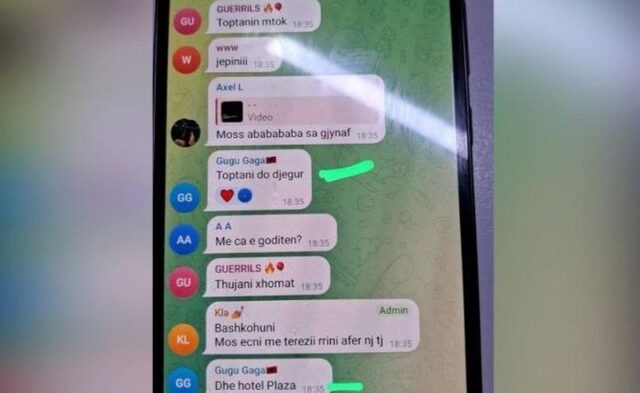
“Online manipulation has been very high. Pupils who were in lessons faced pressure from certain groups outside the schools, which called, including in violent forms, for a boycott of lessons and for going out to gatherings during school hours, without the knowledge of parents,” she said (“Manipulimi online ka qenë shumë i lartë”).
Kumbaro said the situation should serve as a moment of reflection on how children and adolescents handle conflict, peer influence and threats, and their ability to understand the consequences of their actions. “Behind every discussion about school, rules, safety and children’s rights are concrete children and concrete families, with concrete needs and sensitivities. Our responsibility is to ensure that every child feels safe, heard, accepted and supported,” she said.
She said the ministry had worked closely with the Ministry of Justice, the Ministry of Interior and the Agency for the Rights and Protection of Children to manage the situation, while education structures had briefed school directors, strengthened the psychosocial service and increased communication with parents, with the aim of preventing similar cases.
Kumbaro said the situation in the education system had fully normalised. “The normalisation of the situation is important and I can confirm to you that all schools, especially the secondary schools where we had problems in Tirana and Kamëz, have already returned to normality, as has the rest of Albania,” she said.
People’s Advocate: police failed detained minors
People’s Advocate Endrit Shabani told the Council that the police had not guaranteed the procedural rights of minors taken into custody during the protests.
“In some cases, minors were not held in separate rooms, were interviewed without the presence of parents or psychologists, and were questioned outside legal hours. Likewise, minors were found in police stations with signs of violence which had not been examined,” Shabani said (“në komisariate janë gjetur të mitur me shenja dhune, të cilat ishin të paekzaminuara”).
He welcomed the fact that the police had reacted after his institution’s reports, but said the violations must be addressed by identifying those responsible and taking measures so that they are not repeated.
Shabani said the police must preserve their integrity and public credibility, so that they are not seen as a body to be feared but as the guarantor of public safety. “This battle between the violence of the street and the force of the state can be won by force in the short term, but in the long term it is won only by legitimacy, and for that the force must be necessary and proportionate,” he said.
Justice Ministry: four procedural safeguards for minors
Justice Minister Toni Gogu proposed four measures to strengthen procedural guarantees for minors who come into contact with law enforcement:
- a written form of rights, in language children can understand, handed to the minor before questioning;
- a lawyer without delay for any minor being questioned, under the guarantees provided by law;
- early notification of the child protection worker;
- shared inter-institutional data on how these guarantees are applied in practice.
Gogu presented the measures as part of the government’s response to the violence of recent weeks. “Peaceful protest is protected. Violence carries responsibility. In this response, the Ministry of Justice holds a particular part: the child,” he said (“Protesta paqësore mbrohet. Dhuna ka përgjegjësi.”).
He said the draft Intersectoral Strategy on Justice for Minors 2027–2030, prepared with UNICEF technical assistance, is in public consultation until 22 November, and proposed that children themselves be heard in the consultation around 20 November, the Day of Children’s Rights.
The ministry is also working on transforming the institute for minors towards a model built on education, rehabilitation and return to the family, and is drafting school prevention plans together with the Ministry of Education, the Ministry of Interior and the Ministry of Health and Social Welfare.
Gogu linked the work to what he called the ministry’s social justice approach. “Justice must reach the child, even when his family has no lawyer, no connections, or does not know where to knock,” he said. “The child who has erred must come out of the encounter with justice with school, with a profession and with the family beside him, not with one more file” (“jo me një dosje më shumë”).
Health Ministry: a shared responsibility above politics
Health and Social Welfare Minister Klodiana Spahiu said recent events had obliged institutions to examine not only the measures taken so far but how they work together.
“The recent events have placed before us the need to assess not only the measures undertaken, but also the way our institutions cooperate to prevent and handle situations that harm the safety and wellbeing of children,” Spahiu said.
She said the meeting offered a shared space to discuss the current situation, institutional responsibilities and the measures to follow, and that child protection must remain an absolute priority standing above any agenda, division or political interest. “Let us see this meeting not only as a reaction to recent situations, but as an opportunity to identify the gaps, to improve our mechanisms and to strengthen shared responsibility,” she said.
Spahiu said the responsibility for protecting children is shared by institutions, parents, teachers, mentors, leaders and every citizen, and that its weight demands closer cooperation among all of them to guarantee the safety, wellbeing and healthy development of children in Albania.
Interior Ministry platform
Interior Minister Ervin Demo told the round table that his ministry is setting up the Help for You platform, developed by Europol, for children under 18 who face abuse online. “Children have no place among violence and causes. Their protection and safety are non-negotiable for everyone. I consider the protection of every child a non-negotiable obligation, regardless of who took them onto the street,” Demo said. The platform, he said, is informative and preventive in character for the digital environment.
Earlier on Friday, Demo published footage of masked protesters who had carried out violence, said they had been identified, and announced body cameras for the Tirana police.
Other reactions on Friday
The EU Delegation condemned the violence at the protests, saying grievances belong in institutions and not in the destruction of public and private property; Ambassador De Sousa said young people should be taught the rules of the game in a democracy.
The US Embassy in Tirana warned American citizens ahead of Saturday’s protest in the capital to remain vigilant and avoid areas near government institutions.
Earlier in the day Rama renewed his invitation to protesters for dialogue, with the stone table set up again in front of the Prime Minister’s Office.