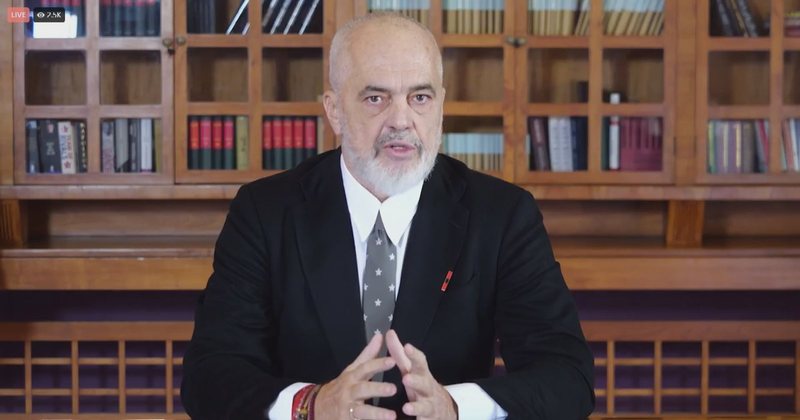
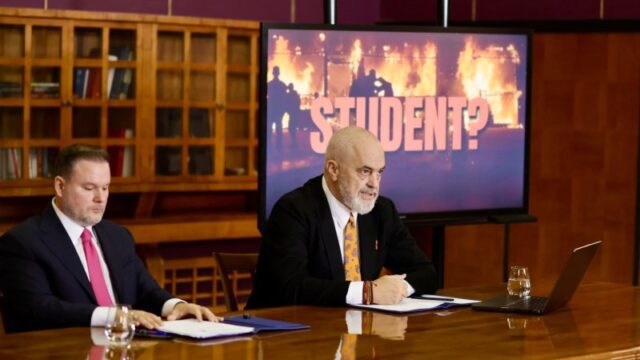
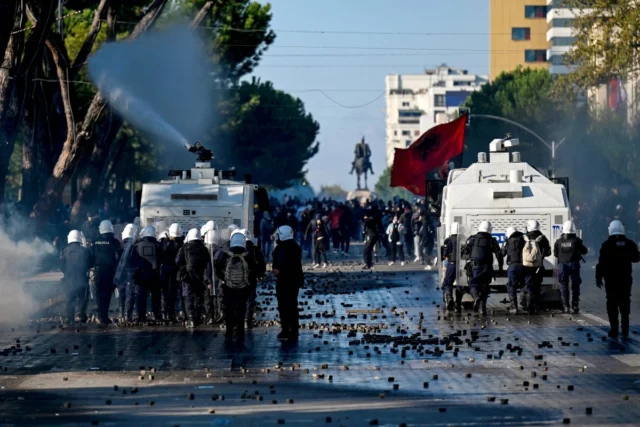
Prime Minister Edi Rama used his Sunday address to present a six-part legal package against what he called urban violence and anarchy, drafted with European experts and modelled on recent French and Italian measures. The package covers immediate state compensation for small businesses damaged in the Tirana protests, a “who breaks, pays” liability law, amendments to the 2001 Law on Assemblies, an electronic register of persons under investigation for public-order offences, a teachers’ code of ethics barring the mobilisation of pupils under 18, and a set of Criminal Code amendments. He accused the Democratic Party of turning its headquarters into a shelter and supply point for Saturday night’s violence, spoke of paid “mercenaries from Spain” among the crowd, and promised that the 2027 draft budget, to be presented early in the week, would answer what he called the legitimate demand of ordinary families for a fairer share of growth.
Below is a full transcript of the Prime Minister’s address.
Dear fellow citizens,
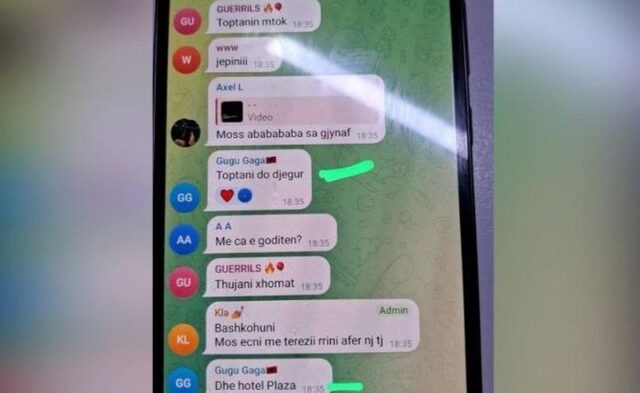
I wish you a quiet Sunday, after another wave of violence last night in the centre of Tirana, where the Democratic Party stepped out from the rear and placed itself at the very front of the exercise of urban violence, and its building was turned into a political shelter and a supply point for explosives for the thugs gathered last night from all four corners and all the sources of this anti-democratic plague.
Be certain that this plague of unnatural misfortune, too, we shall put out without fail.
On the one hand, with patience and resolve in the face of the thugs, who have no chance of dictating to Albania the rotten salad of a doddering old man who has reduced the Democratic Party to a mask of violence, of the Antifa extremists who glorify violence everywhere in Europe, and of the foreign hands that do not want Albania in the European Union and that egg on the masks who claim to represent the students but who in fact, more than students, represent organised crime itself.
And on the other hand, by addressing the legitimate demand of the ordinary people of this country, who quite rightly expect more fairness in the redistribution of the income from economic growth, and more guarantees that merit will count at work.
The draft budget for 2027, which we will present in the first days of the week, comes with a full set of positive innovations aimed precisely at ordinary families, at services for citizens, and at young people and students as well.
Meanwhile, after intensive work with European experts, and in close coordination with our Italian and French partners, drawing on the model they recently adopted in the face of the same anti-democratic plague, and relying also on the case law of the European Court, we have ready the legal package of measures against violence and urban anarchy.
This package rests on a very clear principle: peaceful protest is protected, violence is punished, and the damage is paid for by whoever caused it.
Every proposed measure has been aligned with Article 47 of the Constitution of the Republic of Albania, Article 11 of the European Convention on Human Rights, the case law of the Strasbourg Court, and the Venice Commission and ODIHR guidelines on freedom of peaceful assembly.
Responsibility is always personal, any restrictive measures are temporary and reasoned, and every significant restriction is subject to judicial review.
The package consists of six instruments that complement one another.
A normative act for the immediate compensation of small business, a special law on the repair of damage, a number of amendments to the Law on Assemblies, a Special Electronic Register of urban offenders, an amendment to the Teachers’ Code of Ethics, and a set of proposed amendments to the Criminal Code of the Republic of Albania.
First instrument: the normative act for the immediate compensation of small business
This act comes as immediate financial support for those harmed by the break-ins, the looting and the fires.
Under this act the state will cover from 100 percent of material damage for the smallest businesses down to a minimum of 70 percent for the larger ones, on the basis of well-defined criteria and always within the band of businesses with an annual turnover of up to 140,000 euros.
In this way, the businesses that have already filed their applications with the General Directorate of Taxation, with the documentation of their damage attached, will not wait years for court proceedings to be compensated.
On the other side, those who took part in these acts, who broke, destroyed, burned and damaged businesses, and whose arrest the court has found lawful, will each pay their own share of the fine for the damage caused.
For damage caused by minors, responsibility for covering that share of the damage passes to the parents.
Second instrument: a new law on the French model, “who breaks, pays”
If the normative act addresses the damage of the recent past, the new law we have drafted “on the repair of damage caused by acts of violence and damage to property during assemblies” lays a durable foundation for the future, on the simple principle that whoever causes damage pays for it, so that the burden no longer falls exclusively on taxpayers and the state budget, as it has until today. The law applies to all assemblies in public places, whether notified, banned or spontaneous, including sporting, cultural and festive gatherings, where material damage to property results.
Naturally and beyond any doubt, no one pays for damage because they protested or were present at a gathering of any kind.
This liability to pay for damage caused arises only from a person’s own conduct, and this law does not restrict freedom of assembly and expression. But on the other hand, any person who takes part in a violent assembly and does not leave after police warnings will answer financially.
That is, whoever chooses to remain in a crowd or a group, knowing that around him stones are being thrown, fires are being set and property is being broken and destroyed, will answer administratively through a fine, together with those who carry out the violent acts, and the fine will go up to 500,000 new lek.
Exempt from this rule, of course, are journalists, medics, observers, officials on duty and passers-by.
For the participation of minors over 14 in a violent protest, the fine will be paid by the parents or guardian, in line with the provisions of the Civil Code, and this fine is an enforceable title that takes effect immediately.
Third instrument: amendments to the Law on Assemblies
The Law on Assemblies dates from 2001 and provides nothing on the digital technology that has today become a fundamental component of protests.
The amendments give the police preventive capacity for public and more sensitive sites, the ability to react to the phenomenon of calls to violence on social networks, and the possibility of sanctions, which at present are symbolic compared with the measures other European countries have taken and are taking in response to this new reality of urban violence and anarchy.
Concretely: security perimeters around sensitive sites.
Where there is a real and imminent risk of violence, the police may restrict assemblies for up to 72 hours within a defined perimeter around educational, health and state institutions, places of worship and cultural heritage sites.
Calls to violence on social networks.
When the police identify a call to violence in connection with an assembly, they send the account holder a notice to delete the post immediately and not to repeat it, offering psychological support where needed.
If the post is not deleted or the conduct is repeated, the police act under the legislation in force, including criminal prosecution on the basis of existing offences and of those proposed for the Criminal Code under the new European norms.
Identification of masked persons.
Today, under the existing law, concealing one’s identity at a protest is prohibited, but we will bring this prohibition into the Criminal Code as a criminal offence identical to that of the 27 European countries, following the French model.
Sanctions provided for.
It does not happen in any democratic country of the European Union that a group of people or a given crowd exercises the freedom to protest arbitrarily, denying others freedom of movement in the city and obstructing their work, their school, their plans for the day.
Participation in an unauthorised assembly and disobedience to orders to leave will be fined from 10,000 to 100,000 new lek per participant; disobedience to a dispersal order and concealment of identity will be fined up to 500,000 new lek per participant; while blocking traffic will be fined 5,000 new lek per participant.
Fourth: the Special Electronic Register
By decision of the Council of Ministers, a Special Electronic Register is created of persons referred or under investigation for criminal offences against the state, public order and public security.
The register is administered by the State Police and contains the identification data of these persons.
On the basis of this register, the Border and Migration Police will exercise, for every offender, the right given to it by Law no. 39/2025 “On the Control of the State Border” to refuse exit from the country to persons who seek to evade criminal prosecution, detention, arrest or the execution of a prison sentence for these offences.
The decision also provides for notifying the foreign authorities of the countries to which the person travels, as well as domestic and foreign accommodation providers, of the danger he presents to public security and order, including air, sea and rail transport companies.
Let every offender be certain, whether resident in Tirana or like those in white shirts and masks who had come yesterday from Spain, as paid mercenaries to exercise violence, flexing their muscles on the street outside the Ministry of Education, that whoever commits violence in Albania will find trouble re-entering or staying quietly in Europe before he has first settled accounts with justice here in Tirana.
Fifth: the Code of Ethics for pre-university teachers
School must remain a safe space for children, and the Code of Ethics provides that no teacher may use his authority to bring children under 18 to assemblies of any kind, against their interest and the expectations of their parents.
Teachers will be suspended or dismissed when they exploit their state or professional authority to incite, organise or coordinate the participation of pupils under 18 in assemblies, against the best interest of the child.
The measure naturally does not affect the right of teachers to express themselves and to protest themselves. It prohibits only the use of the teacher-pupil relationship to take children along for adult motives.
Sixth: amendments to the Criminal Code
The Criminal Code amendments follow the best practice of EU countries, France and Italy in particular, and rest on the case law of the European Court of Human Rights.
These provisions punish violence, incitement to it, threats and stalking, whether physically in public spaces or through social networks. They expressly exclude from punishment peaceful protest, political criticism, satire and journalism.
Violence during assemblies.
Remaining amid violence after warnings: only someone who continues to remain at an assembly after police warnings, knowing that violence is being used or property damaged, is criminally punished. Organising an assembly banned by lawful decision is also punished. Anyone caught with weapons or other dangerous objects is punished with up to two years in prison.
Wearing a mask to commit violence. Covering the face is criminally punished only where there is violence or a concrete risk of violence at the assembly, with a fine or up to six months in prison. Anyone who covers the face for health, religious or professional reasons is not punished, nor is anyone who uncovers it as soon as they hear the police order.
Destruction of property during assemblies is punished more severely than at present, and up to double when it affects schools, institutions, public services or cultural monuments.
Violence with a concealed face carries a penalty for striking police officers and citizens that rises by up to one third when the perpetrator is masked.
Incitement to violence, including on social networks. This is a new criminal offence: anyone who publicly calls, including on social networks, for violence, looting or destruction during an assembly is punished when the call creates a real and imminent danger.
The penalty is heavier when the call is addressed to children, or when violence follows it.
Calls to protest, political criticism and journalism are in no case punished.
Protection of every citizen from threats and stalking, including online. Online or public threats are punished as a broader offence. Today the Criminal Code punishes online threats only where there are ethnic, racial or religious motives.
Online stalking and the “right to normality” lead to the creation of an offence for continuous threatening messages and the monitoring of someone’s whereabouts, as well as the following or stalking filming of a person near their home, at work or in daily life, when these force the person to change their way of life.
Publishing an address to put someone in danger is also punished. Anyone who publishes data that encourages or enables a person or their family to be located, so as to expose them to attack, becomes subject to the law.
Videos falsified with artificial intelligence, and their distribution without consent using a person’s falsified image or voice, become a criminal offence when they deceive the public and cause harm to the person.
Satire and parody marked as such are not punished.
Protection of MPs, officials and public figures. Threats against officials and their families, and threats against public figures and their families, are criminal offences. They are protected from threats online as well, with a harsher penalty set.
Blackmail and pressure to influence decisions: punishment for anyone who personally threatens, assaults or blackmails an MP to force him to vote in a certain way, a public official to take or not take a decision, or a public figure to do or not do something.
Criticism, protest and petitions do not fall under this and are not punished.
Protection of children. Endangering a child through negligence: the parent, guardian, teacher or educator who leaves a child under 14 unsupervised in real danger to life or health answers for it. The penalty scales with the consequence, up to ten years when the child loses their life, God forbid. The court may reduce the sentence when the parent has lost the child themselves.
Dear friends,
This package contains no home-grown Albanian invention, as the saying goes. There is not a single point or article in it that conflicts with the freedoms and rights of the citizens of the Republic of Albania. On the contrary, this package carries in its spirit and its letter a very simple truth:
The freedom of each ends where the freedom of others begins, and everyone’s rights stop where the rights of others are infringed.
Whoever does not like the government, or wants me out of office not today but yesterday, is within his freedom and his right to think it, say it, campaign for it and turn that demand into a protest.
Up to that point it is my duty and the government’s to guarantee that the protest of anyone who wants another government and another prime minister takes place without any pressure.
More than that, I am ready to sit down and listen to anyone who wants to express his opposition to me face to face, and to put to me the demands he believes the government should take into account. Because I believe that whoever demands my resignation is wrong to think he can impose it by violence or by any other means, but I do not think that everything he says and demands is wrong.
But beyond that line, I have a duty to protect the country and its people from every attempt to turn Albania back, while the state has a duty to put in his place anyone who raises his hand against public and private property, who threatens public order and security.
This is our legal and institutional answer to the urban violence and anarchy fed these days by all manner of crooked hands, and carried out by a mob of thugs whom all of Albania can now see for who brings them to the centre of Tirana, inciting, paying and orchestrating them, not for a better Albania but to turn Albania back again from the road of its historic trust, and exactly when we are closer than ever to the destination, and when the flag of Skanderbeg and Ismail Qemali has been raised higher than ever.
But this time they will not succeed, because the one who breaks, burns and destroys the centre of Tirana, and through corrupted screens terrorises Albania, is not the Albanian people. It is neither the majority nor the minority of the people of Albania; the latter may be against the government, but it is never for violence and destruction.
To the majority that gave me the mandate to lead Albania, and to the minority that did not vote for me but that, like the majority, expects more fairness in the redistribution of the income from economic growth, I will speak in the first days of the week about the positive innovations of the 2027 draft budget, as soon as it passes through the government, so that it is clear to everyone that what I share with you will not be mere words or pledges, but concrete decisions.
Patience and courage. We had to get through this too, it seems, because not everyone wants Albania’s success, peace and security. It is their last attempt before we seal the final page of the history of Albania’s accession to the European Union. Their noise is loud, their chances are zero.
Thank you, and never forget: whether you voted for me or not, I have not betrayed the mission for which the majority of Albania and of Albanians gave me their trust, and I will never betray the trust of any Albanian who wants a better Albania and who wants the flag of Ismail Qemali and Skanderbeg in line with the other flags of the states of the European Union.