Albatros Rexhaj
Last night on Sokol Balla’s Real Story I said the Socialist Party is in the middle of a civil war. Today Elisa Spiropali put her name to it. I am grateful. For a year this war was fought under pseudonyms, through portals, through “sources close to”, through former officials speaking on behalf of others. Now it has a name and a signature. It is the first honest thing to happen in that camp.
Because the war did not begin yesterday, and not with the railings. It began last autumn, when it was said in Brussels and Berlin, in corridors and over dinners, that Edi Rama is finished and that Elisa must now be backed. And since I know the circumstances from both sides of the fence, I know this too: those words were not the Europeans’ words about Elisa. They were Elisa’s words about herself, and the Europeans repeated them. Just like that. As if Albanians were a herd and foreigners pick the shepherd. We have seen this film. In 1914 they brought us Prince Wied, with a crown and a protocol, and six months later he left by ship. Albania did not accept a leader chosen by others then. It has no reason to accept one now.
But I want to be precise, because last night I was not. When I said “civil war”, I was generous. A civil war takes two sides. It means Elisa represents something close to half the party. Does she?
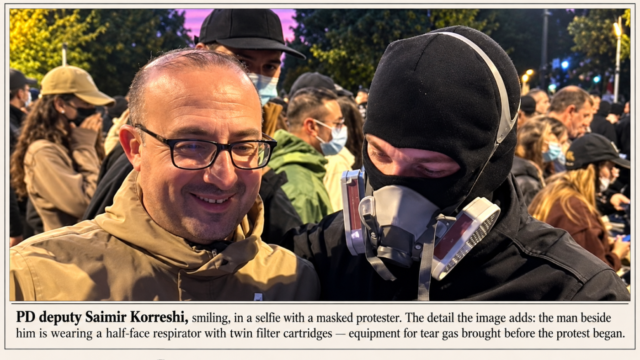
How many branches stand behind her? How many structures? How many mayors, how many MPs, how many youth organisations? Or is it a handful of former officials, each with an investigative file over his head, who broke with the party the day the office door closed? And are there among them people who have paid, and promised to pay, to have their files closed? If so, there is no civil war. There is a group of people protecting themselves and calling their self-protection democracy. And I said it last night and repeat it today: the masked group that came out of the Socialist Party’s own ranks does not have only former officials behind it. It has organised crime groups too, with reasons of their own to want a different government.
After them come the former officials of the Albanian government who have bought access to Berlin’s China Club and from there speak, without authorisation, in the name of the German government. A dinner on Behrenstrasse is not a mandate. Yet these people attribute to Berlin a part in a plot to change power undemocratically in a NATO member state. That is a grave accusation against Germany, not against Rama. And we will follow it to the end, to the Chancellor’s office, because Berlin has a right to know who speaks in its name in Tirana, and on what ticket they got in.
Elisa’s letter asks many questions. Before asking them, she should take a breath. Tirana burned. Citizens and police officers were injured. Shop windows were smashed, businesses looted, cars set alight, stones thrown down the boulevard. In her letter the violence appears as the natural consequence of “power that does not listen”. No. Violence is the choice of the one who uses it. Whoever seeks change by open letter cannot make apologies for those who seek it with Molotov cocktails. The two do not go together.
With her government experience, Elisa could also answer something else. Why did the OSCE and the UN office in Tirana hurry to issue a statement offering mediation? Mediation between whom and whom? Albania is a NATO member. It is an EU candidate closing chapters. It has a parliament, courts, elections. Two organisations in which Russia has a big say offer mediation as if this were Bosnia in 1995. Who invited them? Who told them there are two sides in conflict here that need a third? If Elisa knows, let her say so. If she does not, let her ask herself why the mediation came shortly before her letter.
Now, a last word on Edi Rama.
According to the legends coming out of the exponents of this war inside the Socialist Party, Rama is a dictator. He has endless gangs behind him. He commands organised crime. If that is so, then Edi Rama is truly a great fraud. Because a dictator with gangs behind him does not keep the gangs in the garage while his capital burns. He brings them out. Vučić brought his out, in front of the whole world, and nobody was surprised. Rama did not bring his out. The others did, in masks. And a dictator with gangs does not keep in his party someone like Elisa, who remembered democracy only after she lost her position.
Either Rama is a dictator with no gangs and no dictatorship. Or those who say so are lying. There is no third option.
Thank you, Elisa, for helping us ask the question.