On day three the police held one boulevard and lost the city. The targets, the formation behind the masks, the photograph the EU Delegation gave the party posing with them, and the lie aimed at the police.
By Drizan Shala (Security Desk)
A protest has a grievance and a place to put it. By the third day in Tirana the grievance was fees and dormitory conditions, and the places being attacked were banks, phone shops, a puppet theatre and the dormitories themselves. The distance between the two is the measure of what Albania is dealing with.
On Thursday the police held Dëshmorët e Kombit Boulevard from the morning and the government quarter was not reached. The groups did not disperse. They went where the police were not. The side door of the Ministry of Economy was torn off at noon and set alight at twenty to nine; a door of the Education Ministry was forced; the Municipality was attacked twice; the Puppet Theatre lost its windows and the House of Leaves its entrance. Then the banks: a Credins branch at the 9-katëshet gutted and its files burned on the pavement before the first officer arrived, second-tier branches at Shallvaret, Rruga e Elbasanit and beside the Bank of Albania, another opposite the US embassy at dusk. Two phone shops were emptied. Kiosks, bus shelters and a newsstand on the boulevard burned. At 22:55 masked men attacked the dormitories at Qyteti Studenti with stones and iron bars, broke doors and windows and went inside while students were in the rooms. “We are very afraid,” one of them told Report Tv. In Durrës the post office was wrecked and the court suspended criminal hearings. The list is the state’s institutions, its financial system and the homes of the students in whose name the thing is being done. Nobody protesting fees chooses that list. Somebody choosing it wants the state to look unable to protect anything.
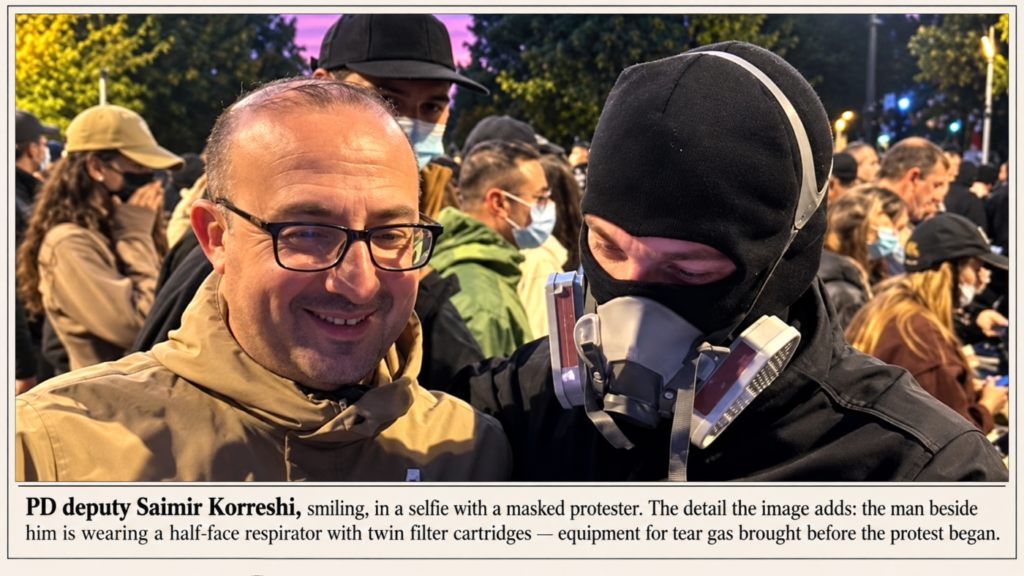
The owner of a bar wrecked in three minutes told Shqiptarja she had marched herself, and the Vlorë students who threw eggs at their town hall were asking for lower tuition. Those were the students. Report Tv filmed the others: protesters at the Education Ministry pulling glass bottles from a stack left ready on a kiosk roof, some of them plainly minors; masked men at the Environment Ministry signalling each other to close up and filling bags and pockets with paving stones; iron railings torn out and thrown at police. In Durrës the call to boycott classes at Aleksandër Moisiu University came, in Shqiptarja’s words, from an external organising group that did not belong to the university. The mayor of Kamëz spoke of fifty schoolchildren incited by manipulation on social networks. Korçë detained 14-year-olds; the health ministry’s afternoon count had two minors at the Trauma hospital. By evening a Democratic Party deputy, Saimir Korreshi, was posing on the boulevard with one of the masked men, both smiling, the deputy in his glasses and the man beside him in a balaclava and a twin-cartridge respirator, the kind you buy before you leave the house because you already know there will be gas. Two days earlier the same crowd had driven a group of Democratic Party deputies away. On Thursday it kept one. Children in front, masked men with filters on their faces and stones in their bags behind them, external organisers calling the boycotts in the provinces, and a member of parliament smiling for the camera beside the mask: that is a formation, not a crowd.
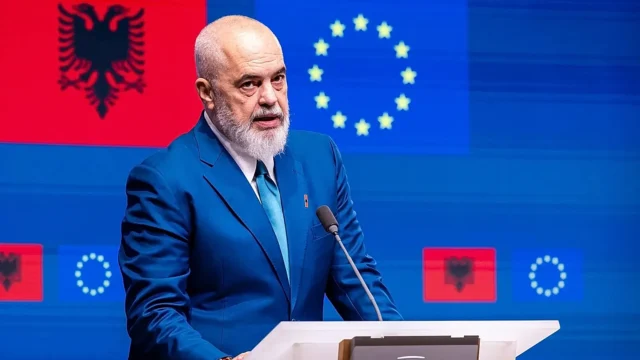
The party in that photograph had already been given a better one. On Wednesday, the second day, while the Education Ministry was still smoking, the head of the EU Delegation, Sofia Moreira de Sousa, received the Democratic Party’s Jorida Tabaku for an hour and published the picture and the readout herself. At 12:55 the same day the Delegation’s reply to Report Tv, reissued at 14:00 as an official statement, addressed its instructions to the police and the state and said nothing to the men who had burned a ministry and two banks the night before. Tabaku had the frame she needed and used it: the EU was watching the government. On the street the reading was simpler, and the crowd behaved accordingly. By Wednesday night masked men with metal bars were moving through the centre with the confidence of people who believe the embassies are behind them. The Delegation corrected course on Thursday morning with a statement that strongly condemned the violent escalation and asked the protesters for restraint; Newsbomb, no friend of the government, headlined it “Yesterday they backed the protest, today the EU Delegation asks the students for restraint.” The correction arrived twelve hours after the licence and did not catch up with it. Thursday is what a crowd does with a day’s head start and a photograph.
Three consecutive days in the capital, each with its own route. Thursday added Durrës, Shkodër, Elbasan, Korçë, Kukës, Vlorë, Divjakë and Kamëz, with molotovs at a school in Korçë and the Shkodër march chanting “Albania for the Albanians, death to traitors” on its way to break the door of the local Democratic Party office. Forty people were injured on the day, twenty-six of them police; a Shkodër officer, Fasli Rama, was operated on for a head wound; the deputy police director of Durrës was among the injured there. After two days of this the prosecution had opened three proceedings with three prosecutors. The state was absorbing casualties faster than it was producing cases.
Abroad, the same hours were manufactured as collapse. Tanjug and Kosovo Online carried straight copy; above them Srpski telegraf ran “Albania burns for the third day running,” B92 “State of war in Tirana,” Informer “This is a war zone,” and Sputnik Srbija’s 14 October headline put a “flag of Greater Albania” over riots in an article that never mentions a flag. Above that, falsehood: Informer’s spine is the @YourAnonTV post about a student’s broken leg and a blocked ambulance, which the Trauma hospital’s emergency chief had already contradicted; Izvestia, relayed across the Russian-language web and by Belarusian state television, had protesters gutting the Central Election Commission, torching the prime minister’s office and the Finance Ministry and wrecking parliament and the Justice Ministry, none of which the Tirana record shows; the English-language account @runews, with some 389,000 followers, ran the day under “Dictator Rama refuses to resign” and “Albania on fire: Dictator Rama must go.” The audience for all of it is in Belgrade, Moscow and Minsk, and the product is a NATO member and EU candidate that cannot hold its capital. Where the facts did not deliver that product, the top layer adjusted them.
Inside the country the message was aimed at the police. The first arrests were made at 10:24. Within hours Albanian feeds carried a text from a man presenting himself as a police officer, claiming Serbian mercenaries had been brought in on the prime minister’s orders; a chat claiming two young people had been shot and kidnapped by Serbian mercenaries; a video of a protester taken off a motorbike captioned as Serbian police abducting girls; a version in which the arresting officers spoke Serbian and no Albanian. Under Shqiptarja’s own live file a reader explained the week by “the UDB chief for Albania.” At 00:35 the State Police answered that only its own officers were deployed, as at every protest, and that the spread of these entirely false and malicious claims aimed to exploit nationalist feeling, create a climate of conflict and damage citizens’ trust in the police.
The police established that the lie was false. The record shows what it was for. It appeared when arrests began. It was aimed at the one institution between the masked core and the government quarter, at the hour that institution was taking casualties. And it offered a crowd that had spent three days stoning its own police the single story that would make the stones righteous: a young man who hesitates to hit an Albanian policeman does not hesitate to hit a Serbian mercenary. Whoever wrote it knew which emotion in this country overrides every other, and knew that a sixteen-year-old with a bottle in his hand would not stop to check.
The prime minister told Reuters he saw the opposition behind the violence and “forces at home and abroad” opposed to Albania’s European course. He named none, and this column does not name them for him; who posted first is a question for the investigators who have the accounts. It does not have to be answered for the rest to stand. Over three days an organised core, moving minors in front and ammunition behind, attacked the state’s institutions, its banks and its students’ beds in eight cities while the state’s police were pinned to one boulevard; the party posing with the masks had been handed, by the Union’s own mission, a photograph and a statement that read on the street as consent; a foreign information layer sold the result as collapse and invented the parts that fell short; and a domestic lie with an ethnic trigger was pushed into the crowd at the moment the police began to act. Each of those is a fact in the record. Put together they are the components of a hybrid assault, every one of them working on Thursday, and the day they ran on was the one the internationals licensed.