Albania aligned, complied, and extended its hand to Belgrade, and paid for the gesture in Prishtina and at home. Serbia refused alignment, produced Banjska, destabilized three neighbors, and filed a charge defining the discovery of its victims as damage to the state. One candidate answers for everything. The other has never answered for anything.
by Ardit Rada (Tirana)
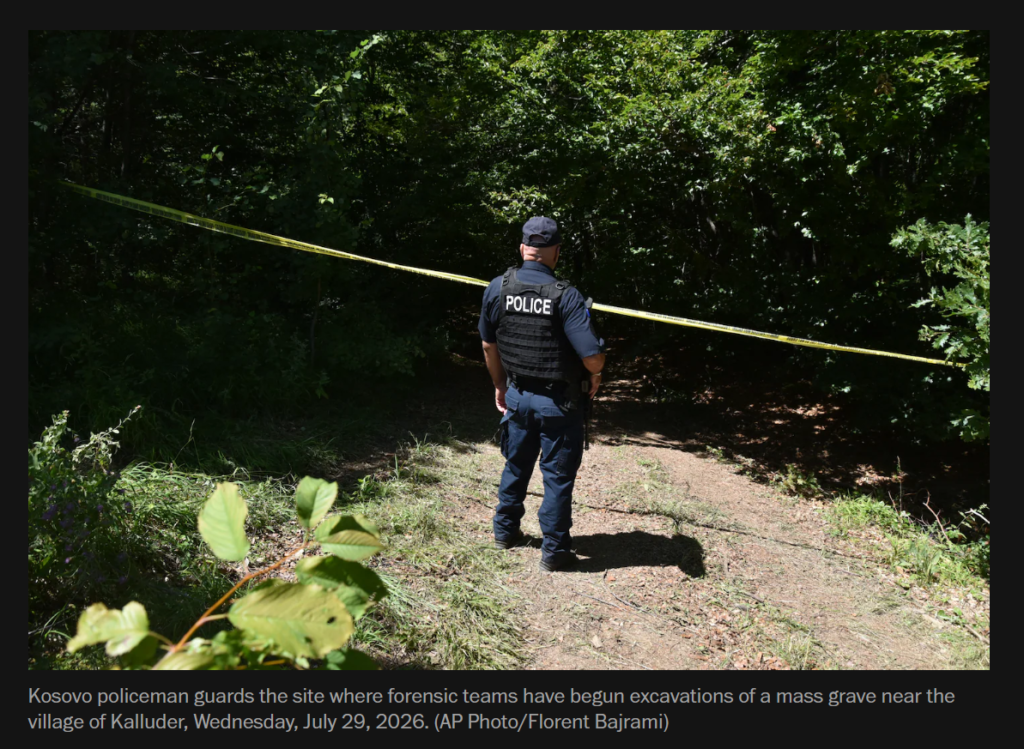
The last week of July produced four official documents about one trench in the municipality of Zubin Potok. On 28 July, an order of the Basic Court in Prishtina, issued on the request of Kosovo’s Special Prosecution, sent excavators into a valley near Kalludra e Vogël (Mala Kaludra), and the ground began returning the remains of civilians killed in April 1999. In Tirana, the Ministry for Europe and Foreign Affairs published a statement calling the trench a testimony that speaks for itself and closed it with one sentence, pa të vërtetën nuk mund të ketë pajtim të qëndrueshëm, without truth there can be no durable reconciliation. On 30 July, Serbia’s interior ministry filed the third document, a charge sheet in Kraljevo. And in Brussels sits the fourth, dated the same month: the European Commission’s recommendation to open Cluster 3 of Serbia’s accession negotiations, with the overall balance of the process certified as ensured.
We will state the finding at the outset and then document it, because it survives documentation: in the enlargement process as actually administered, as opposed to the process described at anniversaries, punishment is a service reserved for the compliant. Albania is enrolled. Serbia has never been enrolled. The week of the trench did not create the two standards. It photographed them side by side, in the region’s least deniable light.
The record of the trench first, because everything else stands on it. On 19 April 1999, near Kalludra e Vogël, twenty-three Albanian civilians fleeing on foot toward Montenegro were stopped, robbed and shot. The account is not folklore; it is a statement given to UNMIK investigators in 2003 by a Serb from a neighboring village, under his own name, in detail, and it records what the Serbian police did on arriving to find twenty-three bodies. They arrested no one. They issued an order to the men in front of them: bury those you killed. In the twenty-seven years since, the number of proceedings any organ of the Serbian state has opened into the killing is zero. The number opened into the concealment is zero. The number opened into the telling is one, and it is three days old.
The man from Istog arrested in Kraljevo on 30 July holds the presumption of innocence in full; what holds no presumption at all is the text Serbia’s interior ministry published about him, which names, as the damage his alleged disclosures caused, the arrest of persons of Serbian nationality by the institutions in Kosovo. Those arrests are, in the Kosovo Police’s own description, arrests on suspicion of murdering civilians and concealing their bodies. An espionage charge must specify an injury to the state, and this one specifies a war crimes investigation. A state cannot prosecute the betrayal of a secret it never possessed. On 30 July 2026, in a legal instrument signed by its own police, its intelligence agency and a public prosecution, Serbia recorded that the location of its victims was state property and that finding the dead is damage to Serbia.
Attach the law before anyone reaches for the word legacy. Under the convention Serbia ratified in 2011, enforced disappearance continues as a crime for as long as the fate and whereabouts of the victims remain concealed, and Serbia’s president renewed the underlying commitment personally, under EU facilitation, in the Declaration on Missing Persons of May 2023. The concealment of the dead of 1999 is therefore not an outstanding bilateral issue or a difficult past. It is current conduct of a candidate state, carrying last Thursday’s date, staffed this quarter, with a man in a cell as its most recent line of output.
Now the rulebook, which Brussels wrote and likes to recite. The negotiating framework the member states adopted for Serbia in 2014 moved the rule of law chapters, 23 and 24, to the front of the process and armed them with a corrective clause: when they lag, progress everywhere else can be withheld. The same framework built a chapter that exists for no other candidate, Chapter 35, making Serbia’s conduct toward Kosovo a condition running through the entire negotiation. The revised methodology of 2020 gave the doctrine its slogan, fundamentals first, and the Commission’s own annual reports have recited Serbia’s war crimes and missing persons deficits for a decade, in the same numbered paragraphs, with the same adjectives. The instrument that converts all of this into consequence is the balance assessment. In July 2026, the Commission performed that assessment on the record described above and returned its finding: balance ensured, Cluster 3 recommended.
Against that finding we are entitled to enter Albania into evidence, not as a grievance but as the process’s own test case, the demonstration of what the standard does when it is actually applied. The record is itemized and public. Alignment with the Union’s foreign policy: complete, every declaration, every sanctions decision, through four years of war, at measurable cost to a small economy. The fundamentals milestone: passed. The negotiating clusters: opened at a pace the Commission itself calls unprecedented. And the conditionality is not ceremonial. At Brussels’ and Washington’s insistence, Albania built a special prosecution structure independent enough that this summer it indicted a sitting Deputy Prime Minister on eight counts, and the government’s response was to absorb the blow inside the process rather than burn down the institution that delivered it. The Enlargement Commissioner demanded of Albania’s prime minister, by name, the repeal of the strategic investment statute and its 2024 amendments, the legal floor under committed projects counted in billions, and received engagement, not defiance. Whether each demand is wise is a debate we conduct elsewhere, on the merits, without sentiment. The point of the itemization is narrower: on Albania, the standard has a docket number, a cabinet seat and a balance sheet. It costs things that can be counted, and Albania pays and stays at the table.
Then Albania performed the item the appeasers of Belgrade never price, because they are never the ones charged for it. It extended its hand, and the extension has a documented record a decade long. In 2014, Albania’s prime minister traveled to Belgrade, the first Albanian head of government to do so in sixty-eight years, and told Serbia’s leader to his face, on Serbian soil, that Kosovo’s independence is an irreversible reality. This July he sat for Belgrade’s own television and said it again, in Belgrade’s own vocabulary: the phrase Kosovo and Metohija no longer describes anything that exists. Between those two dates lie the regional initiatives, the summits, the partnership he himself calls difficult, and, whatever one makes of the man, a register that did not vary under provocation: when a Belgrade minister supplied this month’s, he declined to join what he called the hysterical chorus. That is the measured register the European Union spends its communiqués begging this region to adopt. One government adopted it.
The invoice for the adoption arrives in two capitals, and neither of them is Brussels. In Prishtina it arrives as real friction, from a government that has argued loudly that Serbia has not changed and that the extended hand meets a fist. In Tirana it arrives as a nickname with a paper trail. The label Vučić’s brother has circulated against the prime minister since at least 2020, manufactured, as he put it himself, in the political fabrication factories and distributed on the networks. In December 2021 it graduated from the networks to the street: the opposition’s leader marched on the government building against Vučić’s visit to Tirana, denouncing a Belgrade-Tirana-Skopje alliance of Vučić and his vassals, elsewhere upgrading the kinship to Siamese brother, and framing every handshake since as the service of Serbian hegemony. The charge is renewed on schedule; this July’s instalment arrived within days of the Belgrade interview, with the refusal to join the chorus itself entered as evidence of the friendship.
So tally the position Albania’s government occupies for doing exactly what the Union asks. In Prishtina it is accused of naivety toward Belgrade. In Tirana it is accused of brotherhood with Belgrade. In Belgrade its prime minister says, on air, that Kosovo is irreversible, which is more than several member state governments manage in their own parliaments. Nobody in Belgrade pays anything for shaking the extended hand; the cost of the handshake is billed entirely to the hand that offered it, in two currencies, in two capitals. This week the ground at Kalludra e Vogël filed its own submission in both arguments, and in neither did it land on Tirana’s side.
So open the other candidate’s file and run the audit properly, item by item, with the only question an audit asks. Serbia declined, year after year, to align with the sanctions on Russia. Cost: nothing, no benchmark moved, no cluster paused. On 24 September 2023 at Banjska, an armed and armored formation crossed into northern Kosovo and killed a Kosovo police sergeant, Afrim Bunjaku; the man who publicly claimed responsibility has lived free in Serbia since. Cost to Belgrade: nothing. The measures the Union did impose in that file it imposed on Kosovo, in 2023, for the manner in which Kosovo asserted authority in its own north, which produces the arithmetic that should end every conversation about balance: the victim of Banjska spent longer under EU measures than the author of Banjska has spent under any.
A coup plot prosecuted in Podgorica reached toward Belgrade’s orbit. Cost: nothing. Belgrade sponsors the assembly that declares the Serb nation one body across four borders and shelters the secession project in Republika Srpska. Cost: nothing. It financed and staffed parallel structures in Kosovo for two decades, and the structures were classified as leverage to negotiate rather than conduct to sanction. Cost: nothing. Its head of state ran the campaign against the UN resolution on the Srebrenica genocide; its Church decorates the investigating judge whose Reçak finding the tribunals buried; its defense minister describes licensed guides at a monastery as a security operation; its officer corps is commissioned to speeches about unfinished business. Four items, one shared entry in the cost column: nothing. And now the tenth item, no longer an inference from twenty-seven years of conduct but a filed position of the Serbian state: the concealment of mass graves, defended by criminal charge. Ten items. The cost column is blank ten times, and the column has a name in every language of the region. Appeasement is the polite one.
Now follow the money, because Belgrade does; the money is the one text it reads without a translator. Under the Reform and Growth Facility for the Western Balkans, Serbia’s envelope is 1.58 billion euros of the six, for 2024 through 2027. The pre-financing has been paid. The first release was approved on 12 January of this year while assessments of the previous summer’s reform steps were still pending, and independent monitoring later counted six of thirty-four end-2025 steps actually implemented. And here the file yields its most instructive document, because this spring Brussels did freeze the payments, promptly and in public, over the January judicial laws the Venice Commission faulted in April, with the money withheld until their reversal.
Study what that freeze proves. The mechanism exists. The trigger works. The money can be stopped in weeks when Brussels wants it stopped. It has been stopped exactly once, for legislation that damaged the Union’s own rule of law machinery, and never, not once in this Facility or the decade of instruments before it, for Banjska, for the non-alignment recited annually in the Commission’s own reports, or for anything in the audit above, because the conditionality matrix contains no line item at all for war crimes accountability, for the archives, for the missing, or for the Declaration Serbia’s president signed and ignores. That absence is not an oversight to be corrected in the next revision. It is the tariff schedule, and Belgrade has read it correctly for years: the money is indifferent to the graves, so the graves are free. The Union is not failing to punish this conduct. It is remitting for it, on schedule, and the next instalment sits in procedure alongside the cluster.
On the calendar we will be exact, because exactness is where this indictment lives. The Commission’s recommendation may have been drafted before the Kraljevo charge; institutions write ahead of events, and we do not convict anyone of foresight. Nothing after 30 July enjoys that cover. The charge is public. Belgrade’s own text names the damage. Every day the recommendation stands unqualified, without amendment, without even a sentence acknowledging that the Commission’s finding of balance and Serbia’s finding of treason now describe the same facts, converts an assessment into an endorsement. The stock defenses are already audible and each collapses on contact with the file. Engagement moves Belgrade further than pressure? The Kaludra file is the yield of twenty-seven years of engagement: zero proceedings and one treason charge. The cluster is technical, the fundamentals travel separately? The member states welded those tracks together in 2014, in writing, precisely so that no official could ever speak that sentence. The region needs Serbia anchored? Ask the 1,607 families still waiting what the anchor rests on, and ask every remaining holder of an answer, on either side of the line, what they understood from the Kraljevo footage about the going rate for speaking. What Brussels files under stability is the maintenance fee on Belgrade’s impunity, invoiced to everyone else in the region. This week the invoice reached a trench with twenty-three men in it.
There is a word for a system that bills the compliant and excuses the dangerous, and the word is not merit. The process prices its candidates by the cost of their anger, and it has taught the region the opposite lesson to the one it was founded to teach: that the fundamentals are a tax on governability, refunded in full to whoever threatens the neighborhood. Every capital from Podgorica to Skopje has learned to read both account statements.
What should happen next is short, and it belongs to the member states, because a recommendation is not a decision. The Council should decline to open Cluster 3, and the reason fits in one sentence: a state that prosecutes the discovery of mass graves as espionage has no balance to certify. The Commission should be asked in writing whether a continuing enforced disappearance, prosecuted as recently as Thursday, is compatible with the fundamentals of accession, and held to an answer that can be quoted. The EU facilitators of the Joint Commission on missing persons, whose mandate the Kraljevo charge attacked in its first operational test, should put the contradiction to Belgrade and publish what comes back. And the benchmark at the door of any future cluster, and of the Reform and Growth Facility, should carry a docket number rather than an adjective: the army archives requested in June 2023, produced; the Kaludra file, opened; the doctrine that telling is treason, repudiated in the case of the man who now sits inside it. A conditionality matrix that prices court procedure but not concealed graves is not incomplete, it is calibrated, and it should be recalibrated in writing before the next euro moves.
Albania will keep meeting the standard, because the standard is right, and we would not see it lowered by a millimeter for Tirana’s convenience. That is exactly what purchases the closing question, and we put it in the ministry’s own grammar. Without truth there can be no durable reconciliation. Without consequence there is no standard at all, only a fee schedule for the compliant. The trench at Kalludra e Vogël is open. The charge in Kraljevo is open. The recommendation in Brussels is open, and the disbursement calendar, alone among the region’s timetables, runs on time. The families have waited twenty-seven years to learn where their dead lie. The region has waited nearly as long to learn whether merit in this process is a measure or a euphemism, and it would be a mistake in Brussels to assume the two waits are still being counted separately.