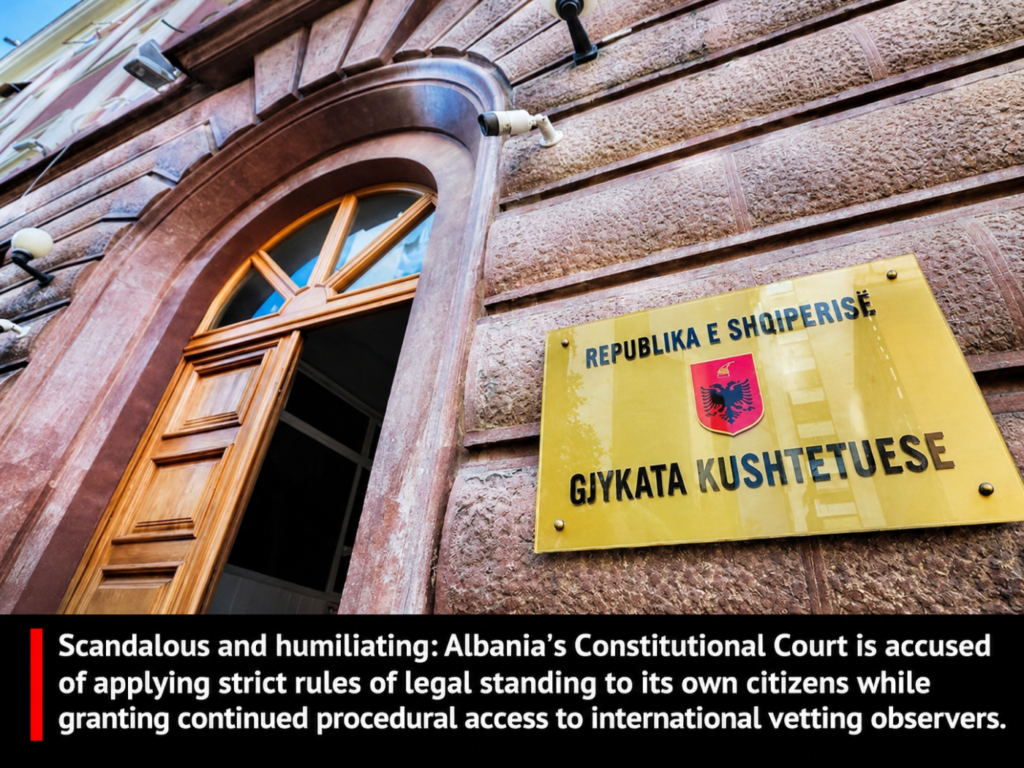
Albanians must prove their legal standing down to the millimetre. The International Monitoring Operation needs only a court regulation and a foreign passport.
By Ylli Manjani (Tirana)
Editor’s note: Vetting is the re-evaluation of every Albanian judge and prosecutor for assets, integrity and competence, introduced by the constitutional amendments of 2016. The International Monitoring Operation (IMO) is the body of foreign observers, led by the European Commission, that the same amendments attached to the process. The mandate of the vetting bodies expired on 17 June 2026.
On 2 November the Constitutional Court adopted, by seven votes to one, an annex to its rules of procedure for the vetting cases that now come before it: those in which the European Court of Human Rights has found a violation, and those in which the persons vetted ask for review. The annex keeps the IMO observers in these proceedings. They see the case file, may submit written findings and opinions, and are present at every stage, the deliberation room included. They do not vote, and their opinions are not evidence. Strasbourg has so far found the dismissals of four magistrates and one legal assistant disproportionate. This piece first appeared in Albanian on 16 November 2026. We publish the argument as the author’s own reading of the Constitution.
The paradox in Albanian constitutional justice is extraordinary.
The Constitutional Court has refused to examine applications from Albanian citizens, members of parliament, officials and constitutional institutions, on the solemn ground that they lacked legal standing.
So Albanians are asked to prove, down to the millimetre, their right to come before the Constitutional Court.
But when it comes to the International Monitoring Operation, standing seems to flow from another source: a foreign passport!
The IMO was installed in Albania as part of an extraordinary, temporary and constitutionally debatable process called vetting. A mechanism in which a few foreign jurists were given unusual powers over the careers and professional fate of Albanian judges and prosecutors.
Well paid, beyond the reach of Albanian public accountability, and often behaving like brigands who had come to civilise the natives.
But vetting ended. Its bodies completed their mandate. And with the end of this extraordinary mechanism, the extraordinary role of the IMO should have ended too. Because a temporary mandate is not a possession for life. Least of all a possession of foreigners.
Yet our Constitutional Court, judging by how it has regulated the IMO’s participation in its proceedings, seems to have found an original solution: to give this mechanism a second procedural life!
And by internal regulation, at that!
This is where the legal absurdity begins.
A court’s regulation cannot create new constitutional actors. It cannot extend mandates that have ended. It cannot give an international body powers that the Constitution and the law do not grant it.
Standing is not a gift of hospitality. It is a legal condition!
And if the IMO is recognised as a party in constitutional proceedings, then the Court must explain from which article of the Constitution or of the law this right derives. Article 179/b of the Constitution and Article B of its Annex are there for all of us to read. They say the IMO’s mandate has already ended. It ended on 17 June 2026, when the last of the Mohicans at the Special Appeal Chamber, the final vetting body, saw their own mandate run out.
So the Court must show us the article of law, not its own regulation. Because a regulation organises how the court works. It does not rewrite the Constitution.
The situation becomes more grotesque still when these proceedings involve judges and prosecutors who have won their cases in Strasbourg.
So instead of the Albanian state concentrating on implementing the judgments of the European Court of Human Rights, we risk creating the impression that we must also hear the opinion of vetting’s international pensioners! As if Strasbourg were not enough without the IMO’s blessing as well!
Do you see it or not?
Should we perhaps propose a new convention to the Council of Europe, one that places the IMO above the Strasbourg court?
Heaven help us!
In truth, I understand the troubles of these internationals. One may have a loan to pay off. One may have found the love of his life in Albania. Another may have expenses that a Western pension cannot cover.
These are human troubles. Entirely understandable, even. But the Constitution of the Republic of Albania is not a pension fund, nor an employment agency, nor an asylum shelter for international jurists!
We cannot keep an extraordinary mechanism alive only because some people enjoyed the power they exercised in Albania. Above all, we cannot use the Constitutional Court to give legal life to a mandate that has ended.
The question here is not whether the IMO did well or badly during vetting. That is another matter.
The question here is far more elementary: does the Constitutional Court have the right to recognise a standing that derives from neither the Constitution nor the law?
If the answer is no, then no regulation can turn it into yes.
Otherwise, we have arrived at a situation where the Albanian citizen must prove his right to enter his own Constitutional Court, while the international need only prove that he was once an international!
What an absurd privilege!
A court that shuts the door on the citizen of the Republic for lack of standing, but opens it to an international mechanism whose mandate has ended, is no longer protecting the constitutional hierarchy.
It is turning that hierarchy upside down.
And this is far graver than one wrong decision. Because the Constitutional Court exists to limit power by the Constitution, not to hand out power beyond the Constitution.
A court that treats its own regulation as a source of constitutional powers has forgotten the reason it exists.
Our Republic needs a Constitutional Court, not an office for legalising international privileges.
And if we have come this far, the word shame is far too small to describe it.