Ardit Rada
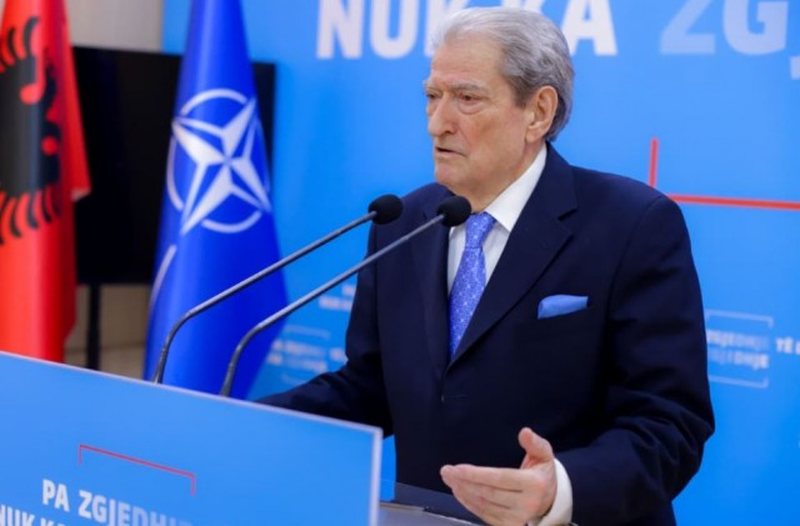
On May 10, in a press conference in Tirana, Sali Berisha was given the opportunity to clarify, soften, or institutionally reframe his Europe Day attack on Ambassador Silvio Gonzato. He declined the opportunity in a specific and deliberate way. The construction he chose deserves to be read closely, because it now sits on the public record as the Democratic Party chairman’s considered second position, and because it cannot, institutionally, be held.
The formula was as follows. Berisha expressed respect for the European Commission and for the ambassadors of the member states. He maintained the substance of his attack on the resident EU ambassador. He stated that his accusations rest on two or more sources and that he will not stop denouncing what he considers to be wrong.
The construction is an attempt to separate Ambassador Gonzato from the institutional category in which the European Union, on May 9, had placed him.
The May 9 collective response was specifically designed to deny that separation. The diplomatic corps of EU member states accredited to Albania, through its Dean, expressed full confidence in the Ambassador and his team. The Brussels institutions reinforced with a statement strongly condemning the personal attacks on Europe Day and reaffirming full confidence in the Ambassador and in his work. The point of the collective response was institutional: an attack on the resident EU ambassador is treated by the Union, and by every member state ambassador in Tirana, as an attack on the institution they collectively represent. The Ambassador stands inside the category of “the European Commission” and “the ambassadors of the member states” that Berisha now claims to respect. The institution itself, in its own voice and on the public record, placed him there.
The chairman of the Democratic Party cannot now extract him from that category by declaration. The institutional record forecloses the move. The “respect for the Commission and for the ambassadors of the member states” formulation, juxtaposed with the maintained accusation against the Ambassador who is part of both, is not a sustainable construction. It requires the European institutions to publicly distinguish themselves from one of their own representatives in order to accommodate Berisha’s reformatting. They will not do so, because they have already done the opposite.
What the May 10 press conference accomplishes, in institutional terms, is the closure of any plausible off-ramp from the May 9 position. Berisha has had the opportunity to walk back, to qualify, to introduce a framing that would allow the European institutions to set the matter aside. He has chosen not to take it. The attack stands. The position from which it now stands does not.
The institutional record stands. Berisha now stands against it.