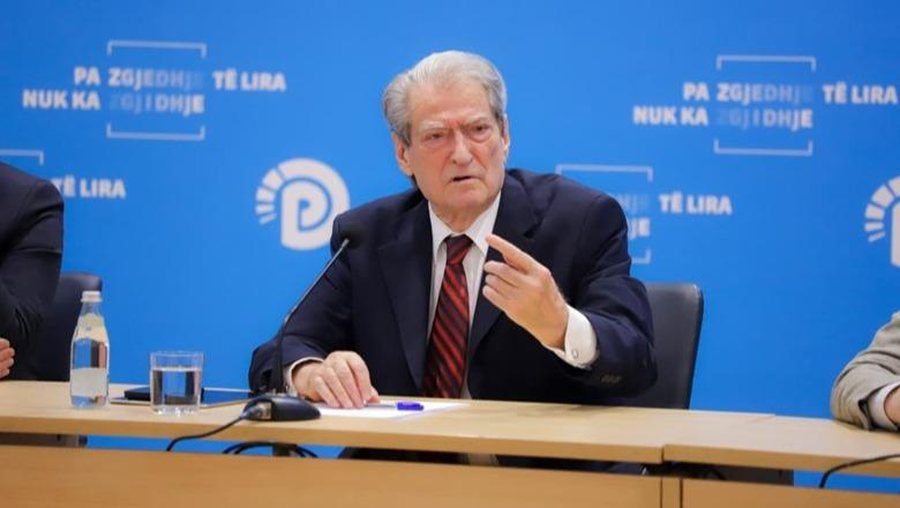
Sali Berisha used Europe Day to attack the European Union’s ambassador in Tirana. Brussels responded the same day. The pattern is now legible.
Ardit Rada
There is a question that has hovered over Albanian politics for the better part of a year, and for some observers for considerably longer. It is not a question of strategy or of tactics or of electoral arithmetic. It is the simpler and harder question of what Sali Berisha actually is, beneath the rotating arguments and the rotating enemies and the rotating self-presentations. On May 9, on Europe Day, in a livestream he chose to broadcast himself, the chairman of the Democratic Party answered the question. The answer is on the record. It deserves to be read closely.
Consider, first, the day on which it was given. May 9 is the date the European Union has chosen to commemorate the Schuman Declaration, the foundational moment of the European project. In every member state and every candidate state, the day is observed with a certain ceremoniousness, because the substance of the day is itself ceremonial: a small republic of values reaffirming, once a year, what it claims to stand for. In Tirana, Ambassador Silvio Gonzato attended the official commemoration alongside the Prime Minister and characterized the European Commission’s recommendations on Albania’s accession path as positive. He was performing his function. He was, on Europe Day, representing Europe.
Within hours, Sali Berisha opened a livestream and accused him of fabricating against the Albanian opposition in Brussels. The resident EU ambassador, Berisha said, behaves as if he were Edi Rama’s ambassador. The resident EU ambassador, Berisha said, has transmitted to Brussels “the most untruthful fabrications” against the Albanian opposition. The resident EU ambassador, Berisha said, has “completely unified” with the Prime Minister. These are not, by any reading, the words of a politician disagreeing with a policy position. They are the words of a man accusing a serving European diplomat of partisan dishonesty, on the diplomat’s own ceremonial day, in the country to which he is accredited.
It is worth pausing on what this kind of statement requires. It requires, first, a willingness to attack the institutional representative of the union one claims to want to join. It requires, second, a willingness to do so on the day that union has set aside for its founding values. It requires, third, a willingness to dress the attack in the language of those very values, because in the same livestream Berisha lamented “the destruction of the European dream” and warned of the replacement of “European values, standards, norms and criteria” with those of what he called the narco-state. The man calling Europe’s representative a liar was, in the same breath, presenting himself as Europe’s defender. The contradiction is not subtle. It is the structure of the speech.
The European institutions answered with two statements on the same day. The diplomatic corps of EU member states accredited to Albania, through its Dean, issued a joint statement of full confidence in the ambassador and his team. A Brussels spokesperson followed with a stronger formulation: “Such statements are unacceptable. The EU strongly condemns the personal attacks made on Europe Day against the European Union Ambassador in Albania.” Two layers, both within hours, both unambiguous. There is no plausible reading in which Berisha’s intervention was understood by the institution he claims to want to join as anything other than what the institution called it: an unacceptable personal attack.
This is the first thing the day revealed. The European credentials Berisha has spent decades claiming, intermittently and selectively, are credentials the institutions themselves responded to in terms sharply at odds with the European identity Berisha claims. He may continue to invoke them, and his domestic audience may continue to accept the invocation. The institutional record of May 9 stands.
The second thing the day revealed is older and more consistent, and it is what gives the May 9 episode its weight. The pattern of attack Berisha deployed against Ambassador Gonzato is the pattern he has deployed, with adjustments for target, against every institution that has at some moment failed to align itself with his preferences. The Special Prosecution Against Corruption and Organized Crime, when it opened a case against him, became in his telling a political instrument of the Prime Minister. The courts, when they rule against him or against figures close to him, become extensions of the executive. The European Union, on May 9, joined the list. The list grows; the analytical lens does not change. Whoever crosses him is unified with Edi Rama. There are no institutional disagreements. There are only personal betrayals.
A politician who treats every external check on his power as a personal enemy is not, in the end, a politician with a difficult relationship to institutions. He is a politician who does not recognize the legitimacy of institutions that do not defer to him. The distinction matters. The first describes a temperament; the second describes a worldview. In Berisha’s case, the consistency of the pattern across decades, across governments, across the Albanian judiciary, across the country’s anti-corruption architecture, and now across the European Union itself, suggests the worldview reading is the correct one.
There is a third thing the day revealed, and it is the one that requires the most candor to name. Berisha did not deliver this attack in private. He delivered it in a public livestream, on a national stage, with full awareness that it would be heard by his party, by the press, and by the diplomatic community he was insulting. He delivered it knowing the EU would respond, and the EU did respond. He delivered it, that is, as a calculated choice. The calculation was not, evidently, that the attack would persuade Brussels. The calculation was that the attack would consolidate something at home. The Democratic Party’s internal leadership vote is scheduled for May 23. The attack served an internal purpose. The ambassador’s standing was the cost.
That is who Sali Berisha is. Not in the sense of a final psychological verdict, which is not the business of this analysis. In the sense of what he has chosen to do, repeatedly and consistently and most recently on May 9, when he was given a clear and ceremonial occasion to stand with the European project he claims to defend, and chose instead to attack its representative for the convenience of a domestic vote two weeks away.
The Albanian public has every right to draw its own conclusions. The European institutions have, in their measured language, drawn theirs.