Bamir Topi’s diagnosis of Albanian politics is damning. The problem is that he helped build what he is describing.
by Arsejda Gjyli (Tirana)
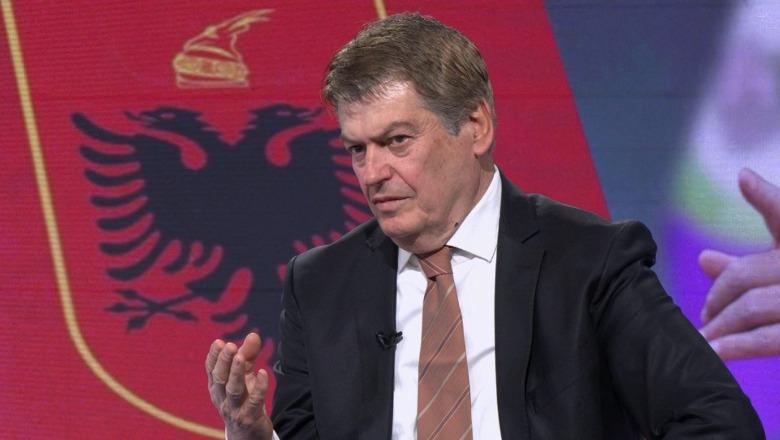
The insider who names the machinery he once operated carries a different kind of authority than the scholar who studies it from a distance. It is quieter, and more unsettling. Bamir Topi, Albania’s president from 2007 to 2012, sat before Report TV’s cameras on Wednesday evening and delivered what sounded, on the surface, like political commentary. It was something closer to a confession by proxy.
His central claim was blunt: Edi Rama and Sali Berisha are not adversaries. They are partners. The confrontation that Albanian voters have watched for two decades, the theatrical fury, the parliamentary walkouts, the competing rallies, is managed theater above ground and coordinated business below it. “It is not necessary for these individuals to meet physically,” Topi said, “but they have the channels of communication.” He put the number at one thousand. He said this as a man who, for five years, occupied the highest office in a system run by both of them.
The thesis itself is not new in Albanian political conversation. Topi’s willingness to state it on camera is. When he says that Berisha and Rama, “being owners of the political parties, are owners of political life in the country, owners of many important benefits, of properties, of businesses,” he is not theorizing from the outside. He is narrating from memory.
Which is why Wednesday’s interview deserves more than the usual half-attention Albanian political television receives.
The constitutional question as decoy
The immediate occasion for Topi’s appearance was the current negotiation between the ruling Socialist Party and the Democratic Party over constitutional amendments, principally a proposed reduction in the number of parliamentary seats. Topi supports the reduction. He also, with deliberate precision, explains why it does not matter.
Even if you cut parliament to sixty deputies, he said, nothing changes. The MPs who remain would still be doing nothing except sitting and raising their hands “on signal, by message.” They are, he said, less useful than a traffic policeman. At least the traffic policeman operates under real pressure, managing a flood of cars at a junction without traffic lights. The parliament, by contrast, has been reduced to a signaling mechanism, and its members have “brought it to its darkest day.”
The timing is not incidental. This argument is being made at exactly the moment when the constitutional negotiation risks absorbing all available political attention. While the debate focuses on numbers, the underlying architecture, party lists controlled entirely by their leaders, the colonization of institutions, the informal governance running alongside the formal one, remains untouched and undiscussed. Topi is explicit about where this leads: “the most important thing is changing the system. This system is not changing. Rama will concede nothing.”
What he does not address, and what the interview does not press him on, is that this system was fully operational during his own presidency. The sixteen years of duopoly he describes with clinical disapproval, and he gives that figure explicitly, began precisely in the period when he served as head of state.
The witness and his limits
Topi speaks with the authority of proximity and the convenience of elapsed time. He was close enough to observe the machinery; he has been outside it long enough to describe it without, apparently, feeling the need for self-implication.
He is particularly sharp on Berisha. The opposition leader’s posture of resistance is, Topi says, “folkloric by now.” Berisha “no longer knows anyone, beyond a narrow group” that sustains him through “hate speech, mudslinging, and the tough guy approach.” His political stoicism is performance. The man who presents himself as Rama’s implacable opponent is, in Topi’s account, the person who cooperates with him most. The need for concealment, Topi adds, is precisely what binds them: “the need to hide makes them be together.”
The sharpest single accusation concerns the expulsion of Salianj from the Democratic Party. For Topi, this act was clarifying rather than surprising. Berisha, he said, “has conducted himself in that kind of metamorphosis as a democrat, and in the very end has ended up again as a communist.” The charge is not merely rhetorical. It is structural: a party leader who removes members by personal decree, who tolerates no internal dissent, who rules through a narrow loyal circle, is exhibiting the organizational logic of the system he claimed to have replaced.
The uncomfortable question the interview leaves hanging is a simple one. If the system has functioned this way for sixteen years, and if Topi observed it from the presidency for five of them, what did he do about it then, and why is the diagnosis arriving now?
What the diagnosis actually says
Set Topi aside for a moment and ask the question on its own terms.
Is the Rama-Berisha relationship better understood as genuine competition or managed coexistence? The structural evidence is not negligible. The two-thirds parliamentary threshold required for constitutional change creates a formal dependency: Rama cannot alter the constitution without Berisha, or without the portion of the opposition Berisha controls. That dependency is architectural. It means that whatever their private relationship, they need each other for the one class of decisions that would change the rules of the game entirely. Topi’s argument is that this mutual need has long since become mutual comfort, extending well beyond constitutional arithmetic into property, business, and the quiet management of what he calls “taboo” zones that neither side touches.
“There are taboo matters where no one can enter,” he said. “This is the power in the prime minister’s courtyard.”
The verdict
Serious structural argument is not common currency on Albanian political television. Topi supplied it on Wednesday, which is worth acknowledging before noting what he withheld.
The constitutional reform debate will continue. A number will be agreed upon, announced as progress, and absorbed into a system it does not touch in any meaningful way. Topi has described this outcome in advance with reasonable accuracy.
The more uncomfortable question, the one Wednesday’s interview carefully skirted, is what it would have taken to prevent it. And whether the man now naming the room was ever, when it mattered, willing to leave it.