In a system built on ambiguity, Braçe remains a rare political fact: named, accountable, and forever incompatible.
Ardit Rada | Tirana Examiner
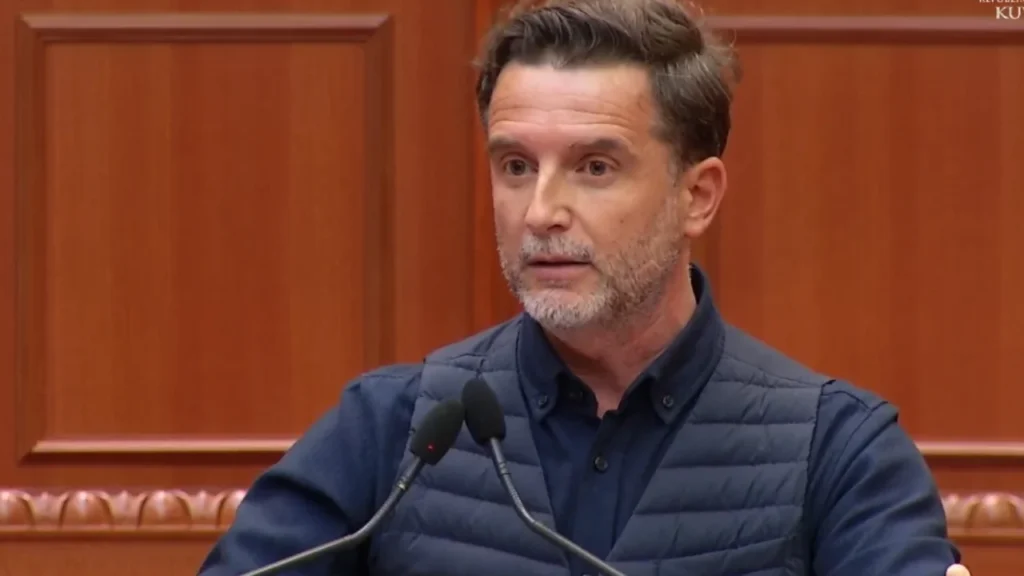
Albanian political commentary has developed a reliable reflex when confronted with internal party dissent: it reaches for the most dramatic available frame. In recent days, that frame has been applied to Erion Braçe with considerable enthusiasm. The narrative writes itself almost too neatly: a senior Socialist deputy breaks with the official line on the mayoral candidacy, raises his voice against the direction of party leadership, and the commentariat begins cataloguing the tremors inside Edi Rama’s political house.
The problem is not that the story is wrong. It is that the story is incomplete in ways that matter.
Braçe is not an eruption. He is a permanent condition.
To understand what his candidacy announcement actually represents, and what it does not, it is necessary to understand the kind of political figure he is, not as commentators have recently described him, but as three decades of observable conduct define him.
The long record
Braçe joined the Socialist Party in 1992, in the earliest and most uncertain years of Albanian democratic transition. He came through journalism, as writer and later editor-in-chief of Zëri i Popullit, the party’s own newspaper, for fifteen years. It is a biographical detail that is easy to overlook and should not be: the man spent the first decade and a half of his political life as a communicator, as someone whose professional function was to shape how ideas reached people. He did not learn politics as a backroom calculation. He learned it as a public argument.
He has been elected to parliament eight consecutive times, not appointed, not slotted, not placed on a closed list by the grace of leadership. Elected, on the open list, consistently among the highest vote-getters in Tirana. He makes this distinction himself, plainly and without ceremony. In a party environment that has steadily collapsed the distance between those two categories, the distinction carries weight.
He served as Deputy Prime Minister until Rama removed him in September 2021. He was given no role in the subsequent government. He introduced himself on his social media profiles, with characteristic directness, as “NOW FREE.” He did not resign. He did not defect. He sat down at his parliamentary desk and continued.
The texture of his dissent
What distinguishes Braçe from the common type of party rebel is not the content of his criticism but its method. He operates entirely in public, entirely in his own name, and entirely without abandoning his foundational identity as a Socialist. These three things together constitute something Albanian political life has rarely seen sustained over so long a period.
When Rama removed him from his campaign management role in Tirana’s Unit 5, Braçe’s response was to write a direct message to colleagues that same evening, reject the decision openly, and then go to Unit 5 anyway and campaign street by street. He did not seek opposition microphones. He went to the constituency where he had been told he was no longer needed, shook hands with Socialist voters, and worked. His explanation was entirely consistent with everything he has ever said: “I’m simply not these people. I’m a socialist.”
When he publicly disagreed with Rama’s handling of the Veliaj dismissal, he said so on national television, predicted the Constitutional Court would vindicate his reading, and when it did, he did not use the vindication to deepen the attack. He noted that he had been right and stopped there. On Balluku, his position was similarly precise: the responsibility for her dismissal belonged to the Prime Minister, justice institutions should not be interfered with, and he said this under his own name on camera while she remained in office.
This is not the conduct of a man stirring trouble. It is the conduct of a man who has decided, over a very long time, that the only form of internal dissent he is willing to practice is the form that requires him to be personally accountable for every word.
The mayoral candidacy
Braçe’s announcement has been read, in some quarters, as an act of ambition dressed as principle. It is more accurately read as an extension of everything he has done for thirty years.
He was explicit about his reasoning, and explicit about where it began: not in a studio, not in a media appearance, but in the SP assembly in Unit 5, where he tried to get ordinary party members to speak about what they were seeing. He found a full hall of people with concerns they had not been given permission to raise. He decided to raise them.
His candidacy, he has said, is not primarily about whether he becomes mayor. It is about forcing a conversation inside the Socialist Party about how decisions are made, how nominations are produced, what happens to a party that has reduced all of its internal life to announcements posted on a wall. He framed it as an act of loyalty to an institution he believes is drifting toward a condition he does not want and will not watch quietly. He named specific problems in Tirana, construction without civic standards, a municipal police that appears only to collect fines, a governance structure that concentrates decisions without distributing accountability, and he named them as problems under a Socialist administration, without any apparent concern that saying so might be inconvenient.
This is what three decades of a particular kind of political formation produces: a man who can criticize the construction standards in his own party’s flagship municipality without it occurring to him to soften the point.
The contrast that clarifies
In recent commentary, Braçe’s name has appeared alongside that of Elisa Spiropali as though the two figures represent a similar political phenomenon. They do not.
Spiropali’s recent intervention arrived through a small number of carefully calibrated social media posts. She named no names. She maintained plausible ambiguity about what exactly she was criticizing and from what position. One post, widely circulated and praised for its elegance, functioned as a scanner of the party’s condition while leaving the reader entirely uncertain about what Spiropali intended to do about that condition.
This is a recognizable political technique. The laconic statement that carries reach precisely because it commits to nothing. The diagnosis delivered at safe altitude, where the words can mean what the reader needs them to mean. The dissent that forecloses no future accommodation, that preserves every exit, that performs concern without incurring its cost.
Braçe has never operated this way, not in thirty years. He has never used ambiguity as a vehicle. He has never offered a reading of a problem that would allow the person he was criticizing to decide he had not been criticizing them.
The difference between the two figures is structural, not moral. Spiropali’s dissent functions as a signal whose meaning is determined by whoever receives it. Braçe’s dissent functions as a fact. It is datable, quotable, and it comes with his name attached. Students of European social democracy will recognize the type: the Steinmeier to Schröder’s transformation, the figure inside the machine who keeps saying what the machine no longer wants said, who outlasts the era not by positioning himself against it but by refusing to disappear into it. The parallel is imperfect, as all parallels are. It is useful because it names the political species: the loyal internal critic who derives his authority precisely from never having left.
What is actually at stake
The question that follows from everything Braçe represents is not whether he becomes mayor of Tirana. The party apparatus will almost certainly close that path, as it has closed paths for him before. He knows this. He has said so.
The deeper question is what his persistence inside the party reveals about what the Socialist Party is becoming. A political party is not simply an electoral vehicle. It is, at its functional best, an organism capable of internal argument, self-correction, and the renewal that comes from friction between competing readings of its own purpose. Braçe has supplied that friction, reliably and openly, for thirty years. He has done it without defecting, without grandstanding, without converting his dissent into personal leverage.
What remains of that organism when the friction is removed is not a stronger party. It is an administrative shell, efficient at producing announcements and candidates and managed assemblies, but hollowed of the internal life that allows a political organization to read its own condition before the voters do it for them. The cost of that hollowing is not immediately visible. It accumulates quietly, in the widening gap between what the party says about itself and what its own members, in a full hall in Unit 5, are actually thinking.
A party that cannot accommodate Erion Braçe has not solved a problem. It has postponed a reckoning.