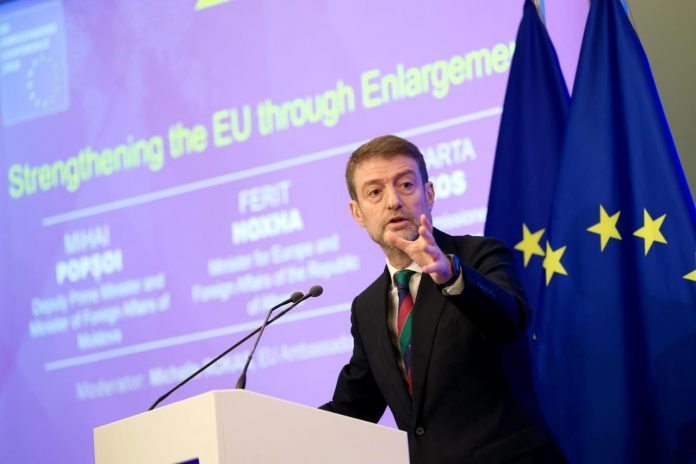
Albania’s new Foreign Minister spent his career inside the institutions the country now seeks to join. But as EU enlargement enters its most demanding phase, a parliamentary vote shields his former deputy prime minister from arrest, his prime minister co-signs a European initiative with a man who declared war on Albania days later, and Brussels watches in careful silence, we ask Ferit Hoxha whether Albania’s record can speak for itself — and whether his government is letting it.
by Ardit Rada (Tirana)
Introduction
Ferit Hoxha is, by any measure, the right diplomat for this moment.
For more than three and a half decades he has operated at the intersection of the institutions that define Albania’s strategic horizon — NATO, the United Nations, the European Union. He chaired the UN Security Council. He represented Albania in Paris, Brussels, and New York. He arrives at the Foreign Ministry not as a political appointee rewarded for loyalty, but as a career diplomat elevated because the moment demands credibility.
The moment is genuinely demanding.
Albania has opened all negotiating clusters with the European Union and set 2030 as its membership target. The justice reform launched in 2016 has produced something remarkable: a specialized prosecution structure, SPAK, that has arrested a sitting mayor, indicted a deputy prime minister, investigated a former president, and convicted ministers. The EU Commission has acknowledged, in its own language, that SPAK has consolidated results in high-level corruption cases.
And yet the same weeks that produced this record also produced a parliamentary vote of 82 to 47 rejecting SPAK’s request to arrest former Deputy Prime Minister Belinda Balluku. A prime minister who responded to Western embassy statements by accusing critics of speaking through what he called the “Molotov Association of Tirana.” A proposed amendment to Article 242 of the Criminal Procedure Code that would limit courts from suspending senior officials under investigation. And a joint op-ed in the Frankfurter Allgemeine Zeitung co-signed with Serbia’s Aleksandar Vučić — followed, forty-eight hours later, by Vučić announcing on Serbian state television that Albania, Kosovo, and Croatia are forming a military alliance to attack Serbia.
The European Union’s office in Tirana did not stay silent on the Balluku vote. It warned that rhetoric sowing mistrust in the judiciary is “counterproductive.” The British Embassy issued a statement — minutes before the parliamentary session began — saying immunity should not be an obstacle to equal accountability before the law. The European Commission declined to comment at all: “It is up to the Parliament of Albania to handle requests for lifting the immunity of its members.”
In this edition of HARD TALKS, we press Ferit Hoxha on whether Albania’s judicial record is strong enough to withstand the government’s own friction with it, whether the FAZ initiative was a strategic gain or a gift to Belgrade, and whether the Foreign Minister is prepared to defend all of it simultaneously.
The Interview
Tirana Examiner: Minister Hoxha, Albanian jurist Kreshnik Spahiu has argued that the Socialist government has lost every court case it has faced — ministers convicted, the mayor of Tirana arrested on camera, the deputy prime minister indicted. His conclusion: the judiciary must be genuinely independent, because a captured court does not produce this record. Does that argument survive the events of March 12?
Ferit Hoxha: I truly believe it does, and the Special Court’s conduct after March 12 confirms it. Parliament voted; the result is known. The court then declined to lift the existing security measures, and SPAK continues its investigation. That sequence — parliament exercising a constitutional prerogative, the courts maintaining their independent assessment regardless, and SPAK doing its job — is precisely what judicial independence looks like when it is functioning.
Tirana Examiner: Then let’s examine that sequence directly. The vote was 82 to 47. The UK and German embassies issued statements that day — the British one minutes before the session began — saying immunity should not be an obstacle to equal accountability before the law. Your prime minister’s response was to accuse critics of speaking through what he called the “Molotov Association of Tirana” and to insist parliament had done what “any democratic European parliament” would do. The European Commission said nothing. How does a Foreign Minister defend Albania’s reform record in European capitals the week after that sequence?
Ferit Hoxha: If there is one point to emphasize, it is that we never stop engaging with our partners in Brussels and across European capitals. We constantly exchange views and perspectives — perhaps now more intensively than ever — but always by being precise about what actually happened in Albania and about the broader institutional context. The government has been clear: the vote does not prevent further investigation. Parliament simply concluded that the legal threshold for the specific measure requested had not been met. SPAK’s work continues unhindered. Some of our Western partners have expressed different expectations or interpretations. We hear them. It is my job — and our job — to explain calmly and consistently that this is a specific case and not a systemic signal. The fundamentals remain intact because we are building institutions, not dismantling them; strengthening accountability, not weakening it.
Tirana Examiner: The prime minister did not help you make that argument. He did not say parliament had carefully applied the Criminal Procedure Code threshold. He attacked the embassies. He dismissed critics as ventriloquists for opposition politics. That is not the language of a government confident in the legal soundness of its position. Do you stand behind what he said?
Ferit Hoxha: I am not sure I share the characterization that the prime minister attacked the embassies. We do not attack anyone — least of all our close partners. That does not mean we must always see eye to eye, although frankly, if I were to choose, I would prefer more work and effort in the quiet than public declarations. But I will gladly acknowledge that the prime minister speaks frankly and directly. I stand behind the constitutional argument. As for the political language surrounding it — that is not for me to comment on. The prime minister is the head of government. That is all I will say.
Tirana Examiner: That is a careful distance. Now Article 242 — the proposed amendment limiting courts from suspending senior officials under investigation. Introduced after a court suspended your deputy prime minister. The EU has flagged it. If it passes in its current form, what is the Foreign Minister’s answer when Brussels asks whether Albanian justice reform is reversible when it becomes politically inconvenient?
Ferit Hoxha: It is not distance. If I were to be distant from the prime minister, I would probably need to pack my bags — and, jokingly, in my case it would only be hand luggage.
On a more serious note, what you interpret as distance is a conscious effort to preserve foreign policy from the often muscular tone of domestic political debate. Throughout my career I have observed political dynamics closely. Now I find myself inside the arena, but my instinct is still to maintain as much professional distance as possible. I believe deeply that foreign policy should be kept as separate as possible from domestic political disagreements. Complete separation may not always be possible, but wherever I can help maintain that distinction, I will.
Now, to your question. The boundary between judicial process and executive authority is a legitimate constitutional question in every democracy. It is not an issue invented to protect this government from a particular prosecution. France, Germany, and other EU member states have resolved similar questions in ways that protect the functioning of government during legal proceedings without creating impunity once those proceedings conclude. Albania is working through the same constitutional balance.
What I will not accept is the suggestion that any adjustment to procedural law automatically constitutes democratic backsliding. I am profoundly convinced that no one will ever have a valid argument to apply that word to Albania. EU accession remains the country’s top strategic priority. It shapes and defines our reform agenda. The durability of the reform is demonstrated by what SPAK has achieved — a remarkable prosecutorial record that simply did not exist before 2016 and that continues to function independently, including after the immunity vote. Strengthening democracy and democratic institutions remains an ongoing process, as it is in every democracy.
Tirana Examiner: You cannot separate the constitutional argument from the political sequence that generated it. The amendment was not proposed during a period of calm institutional reflection. European partners are not obligated to read those two facts as unrelated.
Ferit Hoxha: Everyone will have their interpretation, and that is natural. We will continue to present our case. The amendment was proposed after the Constitutional Court could not reach a verdict, leaving the issue unresolved. In such circumstances, legislation becomes the appropriate institutional avenue.
What I would ask is that observers look at the broader picture. Today, in Albania — unlike only a decade ago — courts decide freely and prosecutorial work proceeds without interference. No one is above the law, and no one can any longer escape it. That is judicial independence in practice. That is the argument I make, based on facts and on the institutional record.
Tirana Examiner: Let’s move to the FAZ initiative. Prime Minister Rama co-signed a piece in the Frankfurter Allgemeine Zeitung with Aleksandar Vučić proposing phased Western Balkans integration into the EU’s Single Market and Schengen. Days later, Vučić appeared on Serbian state television claiming Albania, Kosovo, and Croatia were forming a military alliance to attack Serbia. Two registers, forty-eight hours apart. Did the Foreign Ministry anticipate that sequence?
Ferit Hoxha: We constantly monitor and analyze regional dynamics, including political discourse in Serbia. Our job is to anticipate developments, develop options, and be prepared to respond. At the same time, we must distinguish between messages aimed primarily at domestic audiences and genuine strategic policy positions. Prime Minister Rama recently described this dynamic with a single word — “nightmare.”
The pattern itself is not new; some would say it is a constant déjà vu. But what the broadcast changed — and what it did not change — is important. It did not change Albania’s strategic orientation. It did not affect our role as a consistent promoter of peace and regional cooperation, including by proposing ideas that move the region forward. And it certainly did not alter the substance of the proposal.
Tirana Examiner: That is a composed reading of a situation that produced international headlines about a NATO member being accused of planning a military attack. What was the Foreign Ministry’s actual diplomatic response?
Ferit Hoxha: In today’s media environment headlines are easily generated, especially in a region known for dramatic political rhetoric. But not every headline requires amplification. Croatia responded publicly. Prime Minister Rama dismissed the allegation in a single sentence. NATO’s Deputy Secretary General reaffirmed the Alliance’s position clearly. We maintain our bilateral channels. Not everything in diplomacy needs to unfold in public. Sometimes diplomacy works best with less noise.
Tirana Examiner: The opposition calls the initiative “Euro-Yugoslavia.” Wrong, or wrong only in degree?
Ferit Hoxha: Political reactions are part of democratic debate, but in this case many criticisms miss the point. The proposal does not alter Albania’s institutional trajectory. Our objective remains full EU membership. The idea is not an alternative to membership but a way to make the process more credible and more tangible at earlier stages. If I may use a metaphor: among the different trains heading toward Europe, Albania is ready to take the first one — regardless of the route — as long as the destination remains clear. The proposal also acknowledges a reality: the EU itself must adapt its internal procedures to remain effective as it enlarges. Transitional arrangements may therefore be necessary.
And most importantly — any such mechanism would apply to the entire Western Balkans, including Kosovo. Strengthening Kosovo’s statehood and accelerating its Euro-Atlantic integration remain key priorities of Albanian foreign policy. Any framework that brings the region closer to EU standards, policies, and funding mechanisms ultimately benefits Kosovo as well. Rather than a suspicious alliance, the proposal should be seen as a bridge helping the region integrate faster into European structures.
Tirana Examiner: Final question. After thirty-five years representing Albania abroad, what misconception do you most want to correct?
Ferit Hoxha: Actually, two misconceptions.
The first is the idea that Albania is a country where reforms are promised but not delivered. That perception may have belonged to an earlier chapter of our history, but it is no longer accurate. The justice reform alone has fundamentally transformed Albania’s institutional landscape. Before 24 February 2022 there was a famous saying in Brussels — not specifically about Albania but about the region: the Western Balkans pretend to reform; the EU pretends it will integrate them — an endless zero-sum game. A generation after the Thessaloniki promise, the region was still waiting outside the door. That narrative is now outdated.
The second concerns corruption. Of course there is corruption in Albania, but corruption exists everywhere — no society has completely eradicated it. The real question is how institutions confront it, limit it, and punish it. We may not have done enough, we may still need to do a great deal, but there should be better recognition of sustained efforts and an unquestionable resolve to fight it aggressively. My goal as Foreign Minister is simple: to ensure that our European partners see Albania as it truly is today — a country reforming, advancing, and moving steadily closer to the European Union, not a prisoner of outdated assumptions. It is not always an easy argument to make. But I will not stop, and the record will help me make it possible.
Closing Reflection
Albania’s Foreign Minister walks into his new role carrying an unusual advantage: he knows the rooms where decisions about his country are made, because he has spent decades in them.
That familiarity will only matter if the record holds.
The weeks around Hoxha’s appointment offered European partners a sequence that made his argument harder before he had fully begun to make it. A parliamentary majority voted 82 to 47 to protect one of its own from arrest. A prime minister attacked the embassies that questioned the vote. A joint European initiative produced a co-signatory who declared war on Albania on state television forty-eight hours later. Kosovo watched from an empty chair.
Hoxha’s answers to each of these are coherent. The courts held the line after the Balluku vote — the Special Court refused to declare the security measure lapsed, SPAK’s case continues. The FAZ initiative inserted Albania into a design conversation it was previously excluded from. The conditionality argument is stronger, not weaker, because Vučić demonstrated its necessity in real time. What Hoxha does not answer — Kosovo’s empty chair, the enforcement architecture for conditionality, the specific capitals where the stability argument does not land — the record will eventually have to answer for him.
The answers depend entirely on the institutions continuing to do what they have done so far — and on Albania holding the conditionality line when the moment comes to test it in Brussels rather than in a newspaper.
Ferit Hoxha can shape the narrative. He cannot substitute for it. The institutions he spent his career championing abroad are now the ones his government is being asked to defend at home — without equivocation, without legislative engineering, and without the kind of rhetoric that makes a Foreign Minister’s job harder than it needs to be.
Europe is watching the record.
So is Albania.