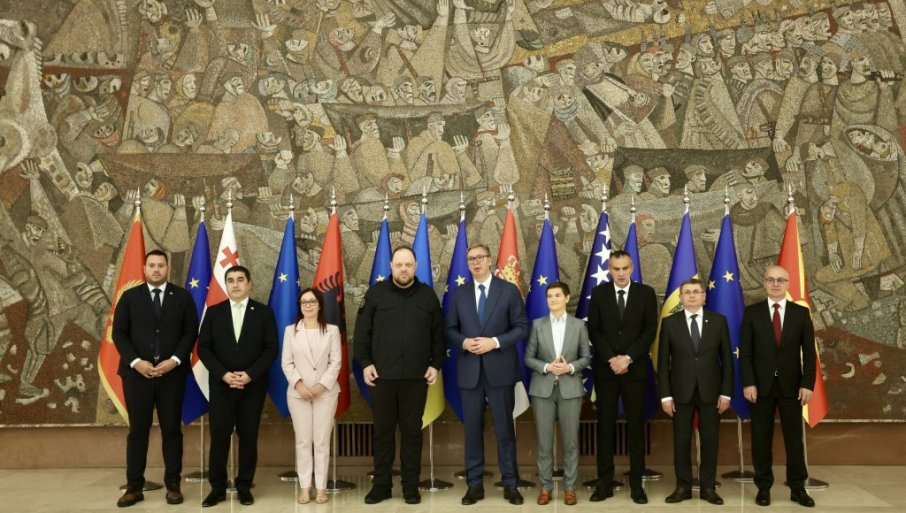
Ukraine sought another European partner in Belgrade. Within twenty-four hours, one Serbian minister had already assured Moscow where Serbia’s loyalties lay. The conference produced photographs; the contradiction was the strategy.
By Ngadhnjim Brovina (Pristina)
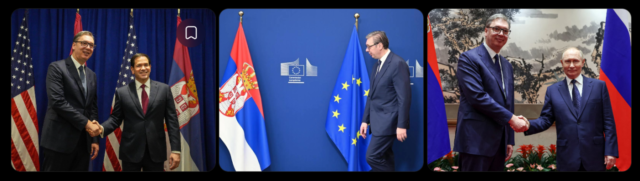
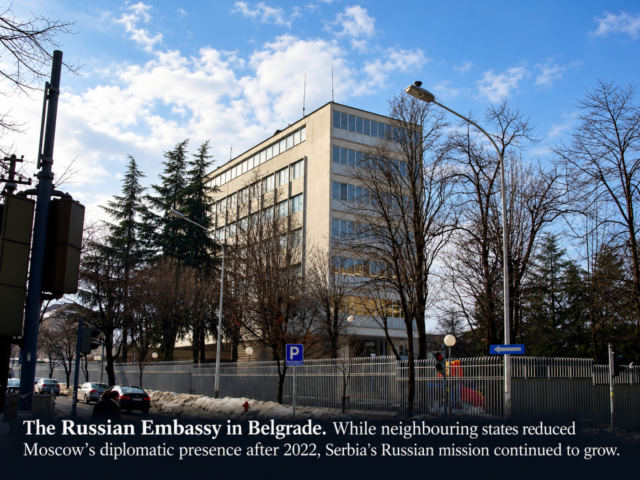
On Monday, at the Innoprom industrial fair in Yekaterinburg, Serbia’s minister for economic cooperation with Russia, Nenad Popović, told TASS what his government wanted Moscow to hear: Serbia knows who its true friends are, has never imposed sanctions on Russia, and never will, whatever the pressure, whatever the threats. On Monday evening, at Nikola Tesla Airport, Ana Brnabić waited on the tarmac to receive Ruslan Stefanchuk, the Speaker of Ukraine’s Verkhovna Rada, the first holder of that office to visit Serbia in fifteen years. By Tuesday noon the two were opening, together, the inaugural Conference of Speakers of Parliaments of EU Candidate Countries, a format their two chambers co-founded. The same government, within twenty four hours, pledged permanent loyalty to the aggressor in Yekaterinburg and hosted the aggressed in Belgrade. Both performances were sincere. Each was priced for a different audience.
I write from Prishtina, in a region that learned to read Belgrade’s gestures the hard way, and let one thing be said plainly at the outset: this is a critique of a speaker’s judgment, not of Ukraine’s cause. Those of us who remember 1998 and 1999 need no lecture on what Ukraine is enduring, and none on why its fight is ours to support.
Parliamentary diplomacy is not courtesy. A speaker’s visit is a legitimacy transfer, and legitimacy, unlike rhetoric, is a scarce wartime resource. The question is therefore not whether Stefanchuk meant well but what exchange rate he accepted. What did Kyiv believe it was purchasing, and what did Belgrade actually pay?
Kyiv’s case deserves its full strength. A nation at war counts every capital. Serbia condemned the invasion and has voted for Ukraine’s territorial integrity at the United Nations. Serbian-made ammunition has reached Ukrainian guns through intermediaries. Brnabić visited Kyiv in November, an act Stefanchuk publicly called courageous. A co-founded format gives Ukraine standing in a capital Moscow considers its own, and when Stefanchuk declared from the podium that neither Serbs nor Ukrainians are little Russians, he was contesting Moscow’s narrative on Moscow’s favorite terrain. The logic is real.
The audit is where it fails. Vučić used the conference he hosted to announce that no one should expect miracles or major enlargement in the coming years, deflating from his own podium the process the format claims to serve. According to Danas, citing Sputnik’s coverage, when Stefanchuk compared Putin to Stalin, his host replied that Serbia’s supreme evil was always Hitler and that it is hard to agree Stalin was worse, a sentence delivered beside a guest whose cities Stalin’s heir is shelling. And Sputnik covered the event with evident appetite, casting Stefanchuk as the provocateur, which tells us Moscow judged the spectacle containable, perhaps useful. Moscow could afford the indulgence; it had Popović’s Monday pledge in hand. Ukraine paid in rank and photographs, the hard currency of diplomacy. Serbia paid in words its own minister had already priced at zero, on Russian soil, the day before.
Suppose, though, that the object truly was European integration. Then the venue answers itself, because integration has an address, and it is not Belgrade. Montenegro has negotiated since 2012, has opened all thirty three chapters, has provisionally closed a dozen, and has set itself membership by 2028. Albania, the second frontrunner, has opened every cluster and moved at the fastest tempo in the region. Serbia has negotiated since 2014, has provisionally closed two chapters, and has watched its process stall for a year amid a domestic trajectory that has drawn unusually direct criticism from EU officials. A conference on accession convenes where the homework is being done. If Stefanchuk wanted a candidates format in the service of enlargement, its inaugural session belonged in Podgorica or in Tirana, not in the one capital moving backward, whose president talks the process down and whose cabinet contains a minister assigned, in a single portfolio, to Moscow’s economy and the church. Either the Speaker did not read the accession chart, or the chart was never the point. Neither answer flatters a wartime parliament spending scarce legitimacy.
The market priced the format immediately, and the price agreed with the chart. At actual speaker rank, three men attended: Stefanchuk, who co-founded it, Moldova’s Igor Grosu, and Georgia’s Shalva Papuashvili, whose ruling party has seen its own European process frozen. Below rank came everyone else. Albania sent a deputy speaker. North Macedonia sent a deputy speaker. Bosnia and Herzegovina sent the rotating chair of one chamber. Montenegro, the frontrunner, sent the secretary general of its parliament, an administrator. Turkey sent no one. The European Union itself was represented by the deputy head of its Belgrade delegation. The inaugural club of candidates convened, and the healthy candidates declined to join at rank, leaving a front row of the stalled, the frozen, and the besieged.
And if Serbia knows who its friends are, Ukraine owes itself the same clarity, because on this continent’s ledger of solidarity, measured against size and against risk, the accounting is not close. Albania stands first. It carried Ukraine’s case through its Security Council term, co-sponsoring the resolutions that named the aggression, it convened the first Ukraine and Southeast Europe summit in Tirana, and it aligned with every European sanction from the first week without hedging a single measure. Kosovo stands second, and here the ledger turns painful. Kosovo sanctioned Russia from the opening weeks of the war, sheltered Ukrainian journalists, offered refuge to Ukrainian families, and matched every EU measure in full. Its Security Force trained Ukrainian soldiers in demining, a skill our country paid for in its own fields, and its instructors serve in the UK led mission preparing Ukrainian recruits for the front. All of this it did, and does, for a country that does not recognize its existence. There is a name for helping someone who will not say your name, and it is friendship of the kind Popović’s Serbia performs only in press releases.
Instead, the format Stefanchuk co-founded is built on candidate status, which Kosovo alone in the Western Balkans is denied, so Belgrade now convenes a European parliamentary architecture whose door is the very status it labors daily to keep from Prishtina. The exclusion required no veto, only a definition. Belgrade sells Kyiv that non-recognition as principle, an equation of Kosovo with Donbas. The equation is false. A state born of a UN-supervised process after documented mass atrocity is not a province annexed by a neighboring army, and Ukraine’s own claim to exist rests on the principle that a neighbor’s refusal cannot define you.
So what did he hope to gain? Visibility, a co-founder’s title, one more capital on the ledger. What he bought was a stage whose host talked down enlargement from its own podium and whose guest list announced the format’s value more precisely than any communiqué. The question underneath the visit, whether Serbia might yet be won as a friend, had been answered before his aircraft touched down: Serbia knows who its true friends are, and said so in Yekaterinburg, on the record, with a whole cabinet portfolio built to prove it. Ukraine’s true friends said nothing that day. They did not need to. Their record speaks from Tirana and from Prishtina, and one of them is still waiting to be seen.
Ngadhnjim Brovina is a political scientist at the University for Business and Technology in Pristina, where his research addresses party systems, democratic consolidation, and transnational party organisation in postcommunist Europe.