Kosovo’s struggle centered on recognition. Montenegro’s centers on definition.
Ngadhnjim Brovina
On 12 May, the assembly of a municipality on the edge of Podgorica voted to annul the Republic of Kosovo. The municipality was Zeta. The vote was advanced by Milan Knežević’s Democratic People’s Party and carried by the eighteen councilors of the “For the Future of Zeta” coalition; it declared that Montenegro’s 2008 recognition of Kosovo would no longer hold within the municipality’s boundaries.
The vote carried no legal force. A municipality cannot conduct foreign policy, recognize states, or withdraw recognition from them; under Montenegrin law the conduct of external relations belongs to the central state alone. The councilors knew this. The declaration was not meant to operate in law.
Yet it was not meaningless. It illuminates a distinction that has organized two decades of Balkan politics without often being named: the difference between recognition and definition.
There are two ways to contest a state. One is to deny that it exists. An entity may satisfy every objective test of statehood, a territory, a population, a government, and still find its existence treated as conditional on the acknowledgment of others. This is the contest Kosovo has lived inside since 2008, fought abroad, through recognitions granted and withdrawn, membership bids advanced and blocked. The state’s standing is made to depend on the decisions of other governments.
The other way is to grant that the state exists and to contest what it is. Here the question is no longer whether the state exists. The question is whom the state exists for.
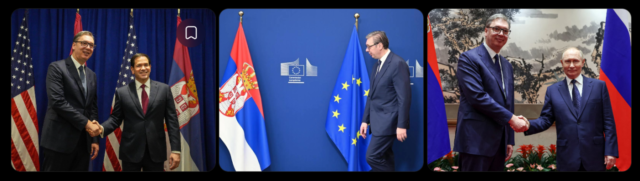
It is against this background that one should read the recent intervention of the Serbian analyst Boško Jakšić, who, appearing on Montenegrin television, described Aleksandar Vučić’s posture toward Montenegro as a project of derecognition, modeled on the Kosovo precedent and pursued through municipalities such as Zeta and Pljevlja. The description is instructive precisely because it is wrong in a revealing way. It applies the language of the first contest to a phenomenon that belongs to the second.
A municipality cannot derecognize a country. Zeta’s declaration changed nothing in the international status of Kosovo, and it changed nothing in the international status of Montenegro. What it borrowed was the vocabulary of recognition; what it pursued was the argument over what Montenegro is, whose community the state embodies, whose foreign policy it is bound to express. The act is recognition in its vocabulary and definition in its substance.
For Montenegro, the first contest is closed. Its seat in the United Nations is uncontested. Its membership in NATO cannot be reversed by any existing mechanism. Its statehood is secure in precisely the arena where Kosovo’s is not. And Belgrade does not pretend otherwise. When Vučić accused Podgorica of waging a hybrid war and the Montenegrin foreign ministry rejected the charge, the Serbian ministry’s reply conceded the decisive point: Serbia, it said, does not question Montenegro’s statehood and had recognized the country without delay after the 2006 referendum. Its objection lay elsewhere, in the claim that Montenegrin independence must not become a pretext for denying the Serbian identity, language, and faith of a large share of the country’s citizens. Belgrade has moved its own argument off the ground of recognition and onto the ground of identity. Jakšić’s word trails the policy he set out to describe.
The two contests differ not only in kind but in sequence, and the sequence is what makes Montenegro’s case new. Kosovo faced both at once. Its campaign for recognition ran abroad while a parallel struggle over definition ran at home, in the northern municipalities, the parallel institutions, the question of who governs whom on which street. Montenegro settled recognition first. The contest over definition therefore arrives not as a condition of statehood but as its sequel, in a state whose seat is already secure.
That sequence should temper any hope of resolution. A dispute over recognition can end: with a signature, a vote, a sufficient number of governments making up their minds. A dispute over what a nation is, who belongs to its political community, what its history obliges it to choose, has no comparable point of conclusion. It does not end. It recurs.
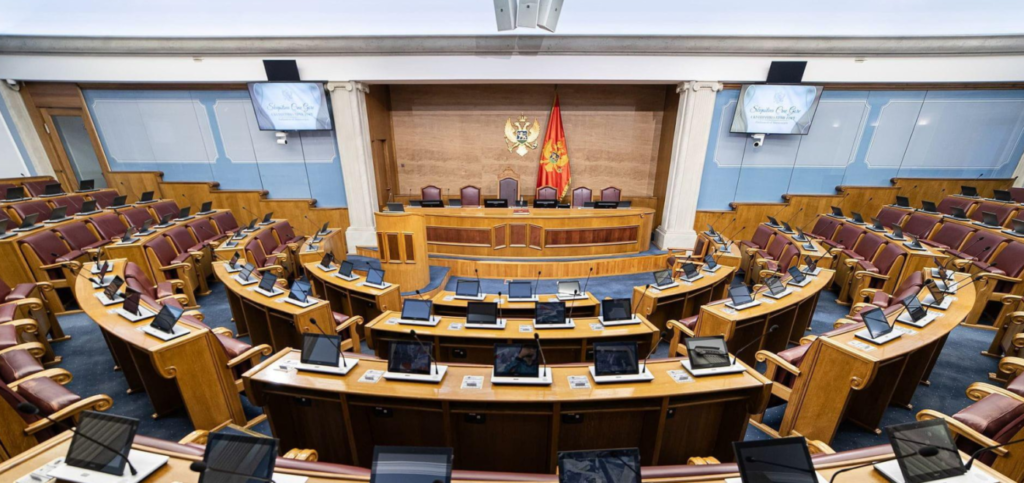
The Zeta declaration is the opening move of a strategy its author has described without concealment. Knežević intends to repeat the measure in every municipality his coalition controls, Pljevlja among those expected to follow, until a resolution reaches the Parliament of Montenegro demanding that the government reverse what it did in 2008.
The nominal object is Kosovo.
The functional object is Montenegro.
Each vote is a small assertion that the state’s sovereign choices are not settled, that they remain open to relitigation from below, one assembly at a time.
Jakšić saw something real and misnamed it. What he described is not an effort to unmake Montenegro in the eyes of the world but an effort to contest what Montenegro is in the eyes of its own citizens. The first can be answered in New York. The second can be answered only at home, slowly, and perhaps never with finality.
A larger pattern stands behind the particular case. The post-Yugoslav wars were fought over territory and recognition. The contests that have followed are increasingly fought over definition. States whose existence is no longer in question find themselves defending the meaning of that existence.
Kosovo’s struggle centered on recognition. Montenegro’s centers on definition.
One concerns the state’s seat.
The other concerns the meaning of the seat.
Ngadhnjim Brovina is a political scientist at the University for Business and Technology in Pristina, where his research addresses party systems, democratic consolidation, and transnational party organisation in postcommunist Europe.