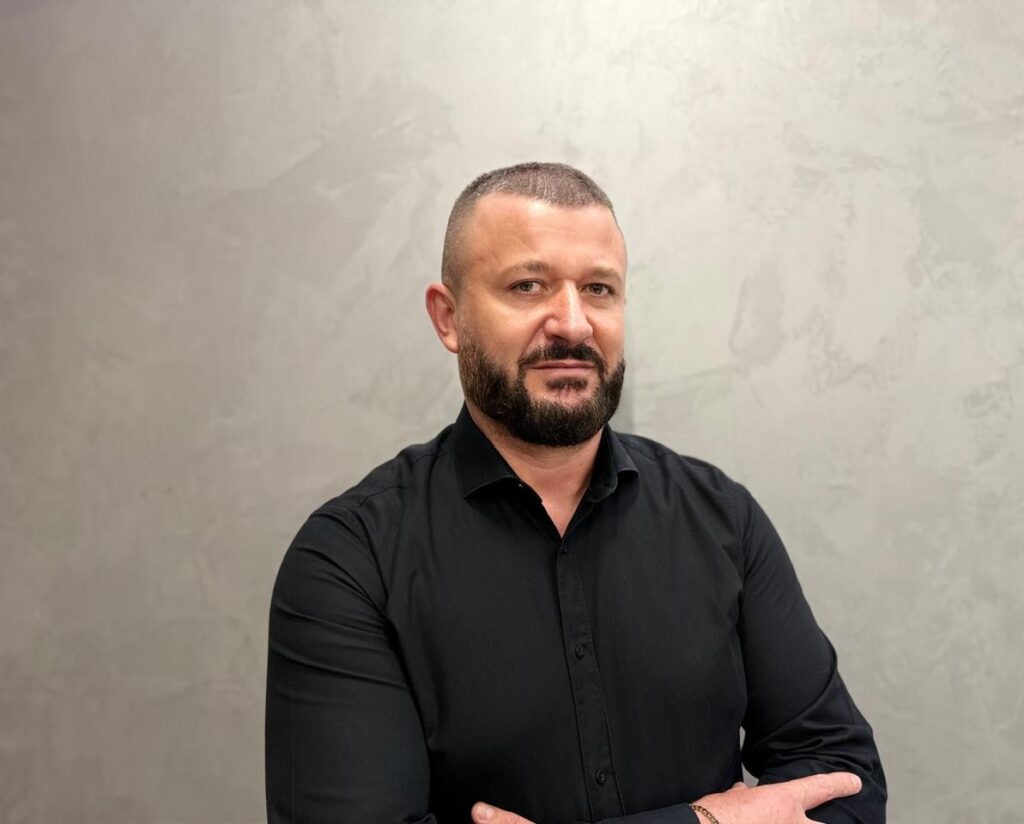
He built a publication in a language he does not fully speak, to cover a country the world largely ignores, with a team of volunteers working from laptops and smartphones. The idea came to him not in a Tirana office but in a hotel room in a distant country, reading a foreign magazine, thinking about what did not exist at home. Alban Bici argues the old vocabulary applied to Albania — emerging, reforming, catching up — is obsolete and dangerous. We ask whether a serious editorial project can survive the environment it is trying to describe, and whether its founder’s conviction is enough to sustain it.
This interview was conducted in Albanian. Bici speaks entry-level English. That did not stop him from building the Tirana Examiner in it.
by Aurel Cara (Tirana)
Introduction
Alban Bici comes from a political family in the fullest Albanian sense — branches on the left, branches on the right, the full spectrum of post-communist alignment represented across a single family tree. He grew up watching politics from the inside of both camps. He became an entrepreneur instead.
He has traveled extensively — the kind of travel that accumulates in long-haul flights and interchangeable hotel rooms in cities far from home. And it was in one of those hotel rooms, in a distant country, going through a foreign magazine, that the thought formed: Albania does not have this. Not a publication specifically, but the thing the publication represented — serious, sustained, internationally legible analysis of a country’s institutional life. The kind of journalism that treats its subject as consequential rather than marginal. The kind that a policymaker in Brussels or a diplomat in Washington might read and find useful.
The Tirana Examiner was built from that thought. Founded in 2026, it operates through two bureaus — one in Tirana, which leads; one in Clinton Township, Michigan, coordinated by Klea Ukaj, an Albanian-American writer and civic commentator embedded in the Albanian-American community. The stated audience is policymakers, diplomats, legal professionals, and investors who require disciplined analysis rather than political spectacle.
The operational reality is something else. The publication runs on volunteers — writers, analysts, editors working from home, from laptops and smartphones. There is no newsroom. There is no staff payroll in the conventional sense. There is a masthead, an editorial line, and a conviction that serious journalism about Albania is both necessary and possible without the infrastructure that serious journalism is assumed to require.
Bici himself does not speak English fluently. This interview was conducted in Albanian. That he built an English-language publication about Albanian institutional affairs without being able to read it at full register is either the most honest thing about the Tirana Examiner — a founder whose commitment to the idea preceded his command of its medium — or its most exposed vulnerability. The interviewer puts both readings to him directly.
The political family background adds a further dimension. A man who grew up watching the Albanian left and right operate from the inside, and chose to build something outside both, is not practicing neutrality by default. He is practicing it by decision. Whether that decision holds under the pressures of an environment that has historically demanded alignment is among the questions this interview does not let rest.
The publication carries a tagline that is either a commitment or a provocation: Serious analysis for a serious Albania.
In this edition of HARD TALKS, Alban Bici is asked to defend the thesis, the publication, and the paradox.
The Interview
Tirana Examiner: Mr. Bici, the Tirana Examiner began not as a business plan but as a thought in a hotel room in a distant country. You were reading a foreign magazine and recognized something that did not exist at home. Tell me what you recognized — and why you decided to build it rather than simply note its absence.
Alban Bici: Every serious country has serious publications about itself. Publications that treat its institutions, its governance, its strategic position as subjects worth sustained analytical attention — not just when something explodes, not just when there is a scandal, but continuously, week after week, in a language that reaches beyond its own borders. I had read those publications for years, in airports, in hotels, in cities that were not mine. At some point the recognition shifted from observation to obligation. Albania does not have this. Someone should build it. The someone, eventually, was me.
It was not a sophisticated calculation. It was closer to impatience. I had spent enough time watching Albania be covered — when it was covered at all — as a problem to be managed rather than a country to be understood. That framing has consequences. Decisions about Albania in Brussels and Washington are made with insufficient information, filtered through frameworks that were accurate about a different Albania at a different time. A publication that corrects that, consistently and in English, is not a media business. It is a strategic intervention.
Tirana Examiner: You come from a family with political branches on both the Albanian left and the right. You grew up watching that political machinery from the inside of both camps. And you built a publication that positions itself outside partisan alignment entirely. Is that positioning a genuine editorial conviction or the reflex of someone who has seen too much of both sides to trust either?
Alban Bici: Both, and I do not think that is a contradiction. Growing up inside Albanian politics — across both sides of the spectrum — gives you a very clear view of what partisan media is for and what it costs. It is for advancing positions and protecting allies. It costs accuracy, and eventually credibility. I have watched publications on both sides of the Albanian political divide produce journalism that served its patrons and misled everyone else. That is not what I wanted to build.
But I would not reduce the editorial position to biography. The conviction that Albania needs analysis rather than advocacy is not just a personal reaction to family history. It is a reading of what Albanian public life actually lacks and what it would benefit from. The absence of serious non-partisan coverage is not an accident. It is a structural feature of an environment where media has historically been organized around political alignment. Building outside that structure is not a gesture of personal distance. It is an editorial argument about what kind of journalism this country needs.
Tirana Examiner: An editorial argument that your political family — on both sides — presumably has opinions about.
Alban Bici: They do. The opinions vary by branch. I will leave it at that.
Tirana Examiner: You built this publication in English. You do not speak English fluently. This interview is being conducted in Albanian. How do you run an English-language publication whose primary output you cannot fully read?
Alban Bici: With people I trust, and with a very clear editorial framework that does not depend on my reading every sentence. The editorial standards — what we cover, how we frame it, what we will not do — those are things I understand and enforce regardless of the language they are expressed in. Klea Ukaj reads and edits in English with the precision the publication requires. The writers and analysts we work with are fluent. My job is not to be the copy editor. My job is to hold the editorial line.
Tirana Examiner: That is a reasonable division of labor in a well-resourced publication. In a volunteer operation run from laptops and smartphones, the founder’s inability to read the product in its primary language is a more exposed vulnerability. What happens when something goes wrong in the English — a factual error, a register problem, a sentence that lands differently than it was intended — and you are not positioned to catch it?
Alban Bici: It has happened. I will not pretend otherwise. We have published things that required correction, and in at least one case the problem was precisely the kind of register gap you are describing — something that read differently in English than the Albanian intention behind it. We corrected it. The process exposed a weakness in the editorial chain that we have since tried to address. The honest answer is that a publication at our stage of development, with our resources, operates with risks that a fully staffed newsroom does not carry. I know what those risks are. Managing them is part of the job.
Tirana Examiner: Let’s talk about the resources directly. The Tirana Examiner runs on volunteers — writers, editors, analysts working from home, from laptops and smartphones. No newsroom. No staff payroll in the conventional sense. You hold Albanian institutions to standards of durability, consistency, and structural integrity. Your own publication’s infrastructure invites exactly the same questions. How durable is a serious publication built on idealism and no fixed costs?
Alban Bici: Less durable than one with institutional backing, and I know it. What we have built is a proof of concept — that serious analysis of Albanian institutional affairs can be produced, in English, at a standard that serious readers recognize, without the overhead that conventional media wisdom says is required. Whether that proof of concept can sustain itself over years rather than months is the question I cannot yet answer with confidence.
What I can say is that the volunteers who contribute to this publication are not doing it for a salary they are not receiving. They are doing it because they believe the project matters. That is a fragile foundation in some respects. It is also, in certain environments, the most durable foundation available — because it does not depend on revenue streams that can be leveraged or cut. Journalism has always had an idealist strain. The publications that changed how countries understood themselves were rarely the best-capitalized ones. They were the ones where the people producing the work believed it was necessary.
Tirana Examiner: Idealism is a foundation until the idealists burn out or find paying work. Has the volunteer model already cost you contributors you could not afford to lose?
Alban Bici: Yes. Not many, but yes. People have moved on — to jobs, to other projects, to lives that did not leave room for unpaid editorial work. Each time it happens it is a real loss, not an abstract one. The institutional knowledge, the voice, the relationship with the subject matter — those do not transfer cleanly to the next person. This is the structural weakness of the model and I do not have a clean answer to it. What I have is an effort to build the editorial framework — the standards, the style, the approach — in a way that is transferable even when the specific contributor is not. Whether we succeed at that consistently is something the publication’s record over the next two or three years will show.
Tirana Examiner: You built a two-bureau structure — Tirana leads, Clinton Township, Michigan contributes. In practice, what does a bureau in Michigan add that a Tirana-based publication with good international contacts does not already have?
Alban Bici: A specific reader relationship you cannot build from Tirana. The Albanian-American community is politically engaged, professionally established, and increasingly present in conversations about US-Albania relations, NATO’s southeastern flank, investment in the region. Klea Ukaj is not a foreign correspondent parachuting into Washington policy debates. She is inside the Albanian-American community in a way that shapes how those debates are understood and reported. The transatlantic angle is not a geographical gesture. It is a specific editorial function — covering Washington policy, diaspora affairs, and the US-Albania relationship from inside the community those stories are about.
Tirana Examiner: Clinton Township is a suburb of Detroit, not a policy hub. If the editorial function is covering Washington policy and transatlantic affairs, why is the bureau there and not where those conversations actually happen?
Alban Bici: Because the bureau is not a lobbying office. It is positioned to understand and represent a community — the Albanian-American community, which is concentrated in Michigan, in New York, in New England — and to connect that community’s perspective to the institutional analysis we produce from Tirana. The Washington conversations we need to cover, we cover. Where the bureau is physically located is less important than what it is editorially connected to. A bureau in a K Street office with no organic relationship to the community it claims to represent would be a worse product, not a better one.
Tirana Examiner: Your About page describes your audience as policymakers, diplomats, legal professionals, investors, researchers. How much of your actual readership fits that description, and how much is Albanian political actors reading to see how they are covered?
Alban Bici: Both populations read us. Albanian political actors read us carefully — sometimes uncomfortably carefully, from what I understand. Whether that constitutes a problem depends on what they do with what they read. If they read a legal desk analysis of a parliamentary procedure and adjust their public position because the analysis is sound, that is the publication doing its job. If they read it looking for ammunition, they usually find the analysis does not provide clean ammunition for either side — which is, again, the publication doing its job. The policymaker and diplomat audience is real and growing. It is not yet at the scale I want. Building it is a multi-year project.
Tirana Examiner: You argue the perpetual reform narrative applied to Albania — always emerging, never arrived — is obsolete. But the narrative persists in part because it is supplied with evidence on a regular basis. AKSHI was penetrated by a criminal network. The government drafted legislation to protect ministers under investigation. Each of these events reloads the narrative. What is the Tirana Examiner’s answer to that reload cycle — not analytically, but in practice, as a publication?
Alban Bici: The answer is to report each event with full specificity and refuse the narrative frame that converts it into confirmation of a predetermined story. The AKSHI penetration is a specific failure with specific causes — a procurement system that was not supervised, a director who appears to have known or should have known, a criminal network with specific actors and specific methods. That story is more damaging to the people responsible for it than the generic “Albanian institutions fail again” frame, and it is more useful to the people trying to fix it. The generic frame lets everyone off the hook. The specific story does not.
Tirana Examiner: It requires, in practice, that every story you publish about institutional failure is reported with enough specificity to resist absorption into the generic narrative. Is the Tirana Examiner actually doing that consistently, or is that a standard you hold in theory and approximate in practice?
Alban Bici: We approximate it. Consistency at that standard, across every piece, under deadline, with the sourcing constraints of reporting in Albania, with a volunteer team working from laptops — I would be lying if I claimed we hit it every time. What I can say is that it is the standard we are trying to hold, that we push back on pieces internally when the specificity is not there, and that the pieces we are most proud of are the ones where the specificity is sufficient to stand on its own without the narrative scaffolding. Whether that is enough — I think that is the right question to keep asking us.
Tirana Examiner: Final question. You started the Tirana Examiner with a thought in a hotel room. A foreign magazine. A recognition of absence. You have now built something — imperfect, volunteer-dependent, in a language you are still growing into, in an environment that has not historically rewarded what you are trying to do. Was the thought worth acting on?
Alban Bici: Ask me in five years and I will give you a more complete answer.
What I can say now is that the thought was accurate. The absence was real. Whether the thing we built to fill it will last, will grow, will become what I imagined in that hotel room — I do not know. What I know is that the alternative was to keep reading foreign magazines in distant hotels and thinking that someone else would eventually do it.
No one else was going to do it.
That was reason enough.
Closing Reflection
The most revealing fact in this interview is not anything Alban Bici says. It is what the interview’s opening condition establishes: the founder of an English-language publication about Albanian institutional affairs conducted this conversation in Albanian, because his English does not yet reach the register his publication operates in.
That gap — between the ambition and the founder’s own position within it — is either the Tirana Examiner’s defining vulnerability or its defining honesty. A publisher who built something larger than his current tools can fully reach is not an unusual figure in the history of serious journalism. Neither is a publication that runs on conviction and volunteer labor in an environment that has not historically rewarded either.
What is unusual is the origin. The Tirana Examiner did not begin in a newsroom or a business plan. It began in a hotel room, in a distant country, with a foreign magazine and the recognition of an absence. That is where serious publications sometimes start — not with resources or infrastructure but with the private conviction that something necessary does not exist and will not exist unless someone decides to build it.
Bici grew up inside Albanian politics from both sides of its partisan divide and chose to build outside all of it. That choice is either the publication’s greatest editorial asset or the thing that leaves it without a natural constituency in an environment organized around alignment. Possibly both simultaneously.
The perpetual reform narrative he argues is obsolete when applied to Albania — always promising, never arriving — is also, in a different register, the question his own publication has not yet answered. The Tirana Examiner is a proof of concept. Whether it becomes a durable institution or remains an ambitious experiment will be determined not by the quality of its founding argument but by whether the idealism that built it can outlast the pressures that will test it.
Idealism built it.
Pressures are patient.