By Sonila Meço
The following commentary by Sonila Meço, journalist and media personality, was published on her Facebook page following the release of Prime Minister Rama’s interview with Le Point, which the Tirana Examiner translated and published in full. We present it here as a perspective worth engaging with. The views expressed are the author’s own.
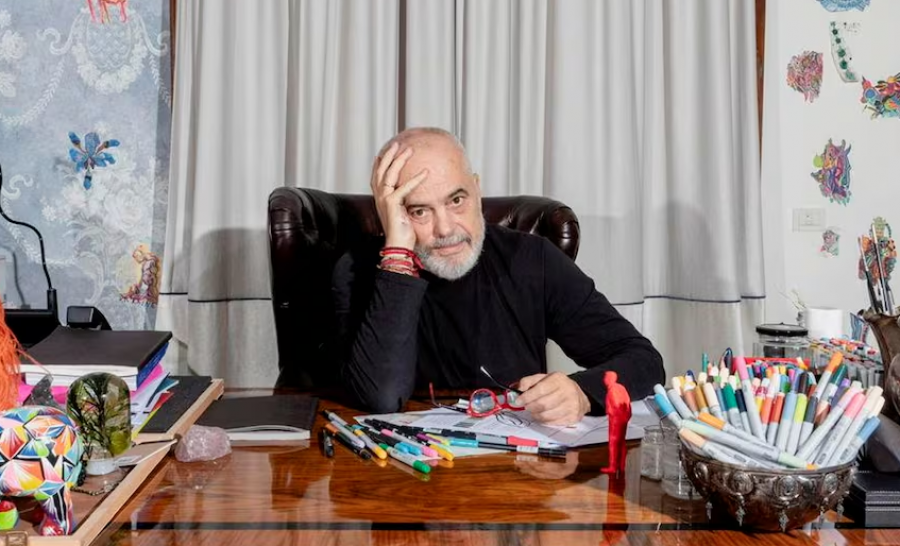
Anne Nivat, one of France’s most formidable journalists, has interviewed Prime Minister Rama for the renowned magazine Le Point.
I had never seen the prime minister so flustered in his answers — the man who seized the sceptre of regional leadership during Europe’s golden age of Balkan courtship. Yet in this interview he was forced to explain, with visible strain, the transition from the positions he once fired at CNN against Trump as a “global catastrophe” to his current role as architect of the Peace Council.
The embrace of Zelensky has been superseded; the russo-Ukrainian conflict has acquired a different framing in the eyes of our foreign policy; Chinese investments in the country are denied, when in fact their presence in the oil sector is universally known.
But what blinds you with an illusory glare is the attempt to dodge direct questions with answers that would baffle even Xha Sulon and the Kapedani, pivoting in the manner of “from artificial intelligence to the Vietnam War.”
To avoid this style, the journalist intervened more than once with pointed interjections: “I am asking you about the United States, and you are talking to me about Russia.”
This interview deserves long and above all comprehensive analysis, but I will pause on one detail that exhausted the French journalist and has been exhausting journalism and the public here for some time.
Nivat stated with conviction that European Union officials are concerned that the country is not doing enough to combat corruption and money laundering in Albania. She raised the concrete case of the Port of Durrës, considered a major money laundering hub, but Prime Minister Rama denied the claim, dismissing it as “unfounded” and pointing to major European port cities such as Marseille, Rotterdam, and others as doing the same.
A relativisation of the kind we know well: the one about Germany having more corruption and money laundering than we do.
Fine. Agreed. Marseille, Rotterdam, and Antwerp have problems too. Germany wallows in corruption.
But this remains an old and worn-out rhetorical technique.
The logic is simple, and precisely for that reason, irrefutable.
If others have problems, that does not dissolve your problem. If Europe’s major ports are under criminal pressure, they are also under monitoring, investigation, and strong institutional transparency.
Marseille, Rotterdam, and Antwerp are not cited as models for self-justification, but as systems that, despite their many problems, have built mechanisms to fight them.
The debate here is not whether the phenomenon exists, but how seriously it is treated. Comparing Durrës to Rotterdam is like comparing a bank to a safe, as though it were a question of scale. We are talking about security standards.
A European port operates on the logic that every container is suspect until proven clean. In our model, every container is clean until it becomes a public problem.
In Marseille, crime is fought before it enters the port, not after it reaches the market. We have zero seizures of narcotic shipments over several years. So the prime minister compares us to European ports on the question of problems, but how does he justify the results in the fight against trafficking and money laundering?
The issue lies in the capacity to build institutions that do not tolerate the problem as a normality.
It suffices to look at the European standard, where the port is a security algorithm in which customs, police, intelligence, and Financial Action Task Force rules all interact.
Whereas here, propaganda strains to teach us a different philosophy: that the port is development, investment, image, marketing. A façade that neither asks, nor controls, nor suspects. And the problem is not what is being built — it is by now understood that the port has been replaced by a real estate agency — but what is not being controlled, putting Durrës at risk of graduating from a port of oversight to a guaranteed corridor for organised crime. In fact, at the Port of Durrës, our economy meets its own shadow.
And when propaganda strains to label every denunciation of this philosophy as damaging the country’s image, it suffices to read this Le Point interview to understand that a country’s image is not damaged by questions, but by the ridiculous answers that evade them.
The problem, o lum miku, is not that we have challenges, troubles, and corruption like today’s Europe, but that we justify ourselves like the tired leaders of yesterday’s Balkans.
Translator’s note: “Xha Sulon” and “the Kapedani” are characters from Albanian literary and popular culture associated with elaborate circumlocution and rhetorical evasion. “O lum miku” is an Albanian colloquial expression carrying a tone of weary, ironic affection, roughly equivalent to “oh, my friend” or “oh, dear.”