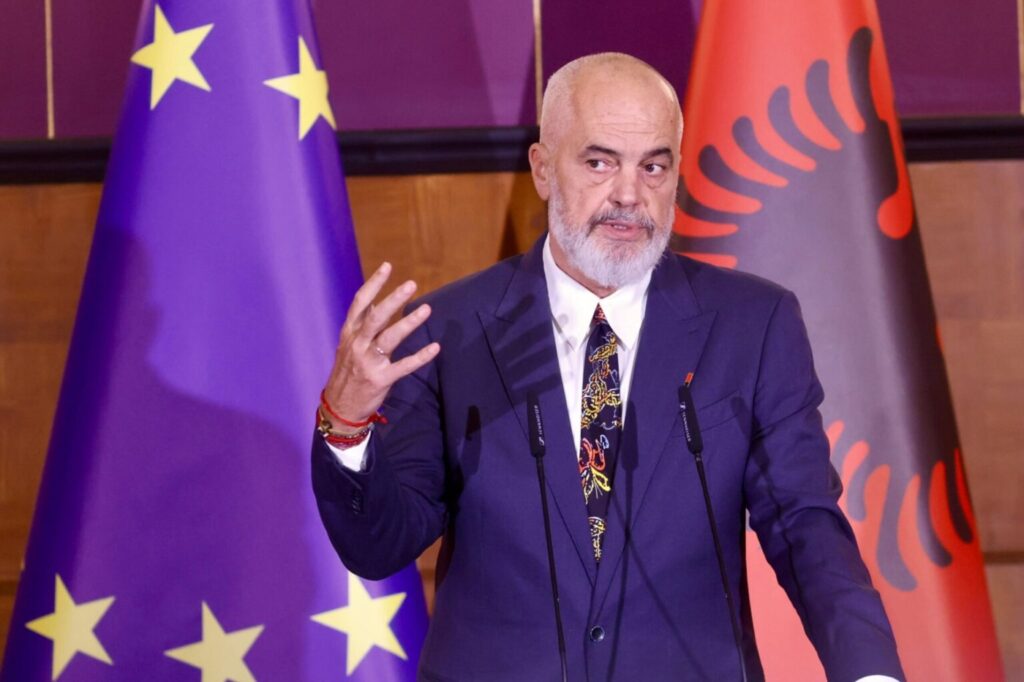
When Le Point, one of France’s most widely read political weeklies, publishes a long interview with an Albanian prime minister conducted in French and illustrated with his Paris years, the register tells you something before the first question is asked. Edi Rama is being received not as a regional interlocutor but as a European statesman, and he performs accordingly.
The interview covers considerable ground. Albanian readers will find the most consequential material in three places. First, Rama’s position on Iran: he frames Albania’s rupture with Tehran not as a reactive response to the 2022 cyberattack but as a principled stance rooted in Albania’s experience of dictatorship, and he defends the MEK hosting arrangement in terms that go beyond the standard security justification. Second, the Sazan question: Rama denies privatisation while confirming partnership, a distinction that will require further scrutiny given the absence of any published framework governing the state’s role in the Kushner project. Third, his comments on Viktor Orbán, which are the most politically exposed remarks in the piece and the ones least likely to travel well in Brussels.
What Rama does not address is as revealing as what he does. The domestic protests are dispatched in a clause. SPAK is absent. The rule of law benchmarks that have defined Albania’s EU negotiating record for the past two years go unmentioned. The interview is a foreign policy performance, and a technically accomplished one. Whether it reflects the full picture of where Albania stands is a different question.
The Tirana Examiner presents this interview in full English translation as a primary document. The French original was published by Le Point. Editorial commentary will follow separately.
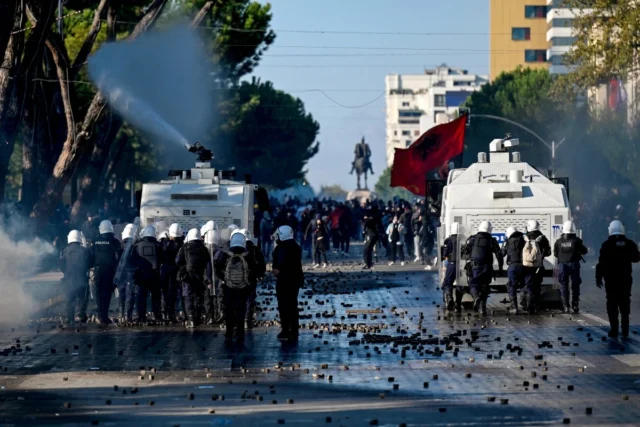
“Rama, go!” chant several hundred protesters on this spring Monday, armed with drums and smoke flares not far from the offices of Prime Minister Edi Rama, the Socialist leader of Albania who was re-elected for a fourth term with more than 53 percent of the vote last May. “No to a corrupt government, yes to a European Albania!” they repeat. The protest movement has been running for several weeks, though it struggles to gain wider momentum.
For Edi Rama, it is above all striking proof of democratic vitality. In the 1990s, the charismatic prime minister of this Balkan country of nearly 2.7 million people was living at the Cité internationale des arts in Paris as a painter. First a minister of culture, then mayor of the Albanian capital Tirana, he has been presiding over the fate of this former communist dictatorship since 2013, with determination and pragmatism, carrying his tall and unmistakable frame through diplomatic summits, the silhouette of a former basketball player standing well over two metres.
“When it comes to Albania, two names come up: Ismail Kadare, our most celebrated writer, and Edi Rama,” a local diplomat remarked recently, adding that “sometimes, being a small country with a great leader in every sense of the word works in our favour.” Was he referring to the inaugural summit of the new Peace Council, conceived by Donald Trump in February, where Edi Rama was seated directly behind the American president?
Highly skilled, this European leader of a NATO member state since 2009 is fundamentally pro-American but also fiercely pro-European. Rama has long known how to make himself useful to Washington, accepting, for instance, to host on Albanian soil the world’s only base for the People’s Mujahedin of Iran (MEK), a group of Iranian opposition figures opposed to the mullah regime, while never ceasing to advocate for a united Europe that Tirana is absolutely determined to join, and as quickly as possible, even if the demanding accession process has been under way for twenty-three years.
In his office in the centre of Tirana, the walls decorated with his own paintings, Edi Rama received us for a candid interview conducted in French.
Le Point: In the war between the American-Israeli coalition and Iran, while most European capitals are calling for immediate de-escalation, why do you support Washington’s hard line?
Edi Rama: I have not chosen to take a position radically different from other European countries, but Albania has a very particular recent history with the regime of assassins currently in power in Tehran. Today Albania is one of the few countries with no diplomatic relations with Iran.
Your country was the target of an Iranian cyberattack in 2022.
Yes. The attackers belong to a group ranked among the top ten in global cyberterrorism. Following that cyberattack, we decided to cut all relations with Iran. The aggression occurred because we host a group of Iranian opposition figures.
“You should never ask an Albanian whether he fears something.”
You host a training and logistics base for the Iranian People’s Mujahedin, housing around 3,000 people. It is the only sanctuary in the world for this opposition group, which in 2002 revealed the existence of Iran’s secret nuclear programme. Tehran has now declared this base a legitimate target for its missiles. Do you fear attacks on your soil?
You should never ask an Albanian whether he fears something. We fear nothing. During the Second World War, no one wanted Jews. This country, even very poor and with a Muslim majority, became their sanctuary. Albania entered history as the only European country to emerge from the conflict with more Jews than it had at the start of the war. They were fleeing everywhere except Albania, where, on the contrary, they were arriving. During that period, the Jewish population of Albania was multiplied by twenty. Because Albanians fear nothing.
You welcomed this Iranian opposition organisation because the United States asked you to do so, and no one else wanted them.
We welcomed them for purely humanitarian reasons. Before, they were in Camp Liberty in Iraq, where they were being targeted by Iranian intelligence.
Did the United States ask you to take them in?
The United States asked us, and we said yes. But no one wanted the Afghans either, after the catastrophe of the abandonment of Afghanistan in 2021. Here, we hosted more than 4,000 of them when everyone had turned their backs. These were people who had served our missions; women, academics, YouTubers who believed in the miracle of democracy, freedom, equality and fraternity. When the Americans said “we are going to Afghanistan,” we went, like many others. Then we left because the Americans left. Afterwards, we said we would not turn our backs on them. So the Afghans came here. Albania lives with the Code of the Albanais from the Middle Ages engraved in its spirit, our first written law. One article of that law says that for an Albanian, the most important thing is “your God and your guest.” That means if you are our guest, we protect you.
“Attacking a NATO country is not a simple matter.”
You have no fear of anything that might come from the current regime in Iran, which continues to issue threats against this base?
We are a NATO member. Attacking one of its countries is not a simple matter. We are protected. I mentioned Turkey, which has its own anti-missile air defence capabilities but which was nonetheless defended by NATO.
Let us return to Albania’s situation relative to Europe. Do you not feel that by supporting Washington’s hard line you are locking your country into a dynamic that could become uncontrollable?
I do not think so. First, because there is no unified position among all European countries. Second, because our position applies to a country whose enmity was declared by them and not by us. Third, because Albania has recent experience of dictatorship, which was not a theocracy but an “athéocratie.”
An “athéocratie”?
Albania was the only country in Europe, and perhaps in the world, to incorporate into its Constitution the atheist nature of its Republic. Not secular but atheist, which meant that any expression of religion, even through a Bible, could lead to prison. The Bible was considered a weapon. In certain cases, extremes find each other, and I found it shocking that while tens of thousands of Iranian citizens were being killed like dogs in the streets of Tehran, almost no one in Europe said anything.
Emmanuel Macron said there can be no regime change under bombs. The son of Ayatollah Khamenei, Mojtaba Khamenei, has just been appointed. The Iranian regime has not fallen. By aligning yourself with the American position, are you not on a different line from that of the European Union?
First, there is not one single line of the European Union. Second, the President of the French Republic is president of a very great Republic. I am the prime minister of a very small country. I am not talking about regime change. I am talking about the absolute necessity of making this regime incapable of aggressing its neighbours.
Do you feel the Israeli-American coalition is acting effectively?
Absolutely.
If the European Parliament voted a resolution condemning the offensive, could Albania appear as the black sheep among EU candidate countries?
Albania is not a member of the European Parliament. It is a candidate country, currently negotiating with the European Union. And I repeat: the European Union does not have a formalised line on this conflict. Moreover, it is not contradictory.
In June 2025, at the Paris Air Show at Le Bourget, you purchased a French radar system manufactured by Thales, the GM400 Alpha, which has not yet been delivered. For Albania’s strategic security, are you refusing American exclusivity, given that you previously sourced from Lockheed Martin?
We are obliged to follow the major powers. When you are prime minister of Albania, you have the privilege of mixing with the great figures of this world, but not the weight of deciding the destiny of the world. They decide, and you follow. If they are right and success comes, you can say “I am part of it.” But if they are wrong and they do something “fucked up,” then you can say that is their fault!
Will you buy European for the rest of your defence procurement?
We will buy European, Israeli, American, of course. We will buy whatever is necessary.
The island of Sazan has always been a prime site for the defence and surveillance of your coastline. Yet you are in the process of privatising it in favour of the real estate projects of Jared Kushner, Donald Trump’s son-in-law, which has generated considerable comment.
In today’s world, you can tell the truth, but the lie will always be more attractive. We have never spoken of privatising the island of Sazan. We are not going to privatise it. As the Albanian state, we will be a partner in this magnificent initiative.
Will the military exclusion zone on the island be maintained?
There has been no military exclusion zone on the island for a very long time. Today Albania is a democracy; we do not need this island as a strategic military post. There will remain a minimal radar activity, almost invisible, and the rest will be excellent. It is a two-part project: the island and the peninsula. It is a gift that Albania will give to Europe.
What are Albania’s ties with Jared Kushner?
When Jared Kushner came to Albania with his wife, his father-in-law had a 50 percent chance of going to prison and/or returning to the White House. And few people could have bet on his return to the White House! I first welcomed this couple because they are Americans. If you are American and you arrive in Albania, you are always warmly received. The same goes if you are French. Second, I found him remarkable.
In what sense?
On a human level, he is remarkable. I always say that if people knew Jared and Ivanka personally, they would fall under the spell of their humility, their upbringing, their simplicity.
We are speaking of the son-in-law of the President of the United States.
I grew up under communism: the son-in-law of so-and-so, the father of so-and-so, the son of so-and-so. For me, it is the person who counts. He could be the son-in-law of Maduro; if he is someone who is a good human being and has nothing to do with his father-in-law, then he is a good person. But Jared and Ivanka, they are remarkable! Their project is a project for the new generation of tourism, entirely oriented towards nature.
A major environmental organisation is opposed.
Environmental organisations are born to oppose every project! They help us to be attentive, to refine our analyses, and that is important, but everyone must stay in their lane. A group of outstanding architects, including Jean Nouvel, is participating in this project.
“Trump may not have created his Peace Council to reinvent the UN, but the effect is the same!”
On 19 February you were in Washington for Donald Trump’s Peace Council, of which you were even an honoured guest. Why did you decide to become one of the pillars of this project?
Albania has no relationship with Russia. It is the only European country that has never had a high-level visit from Moscow since 1960. We do not miss political Russia. As for cultural Russia, literary Russia, musical Russia, which is magnificent, it lives in our libraries. However, I find it troubling that Europe did not speak with Russia throughout the entire war in Ukraine. I find it troubling that Europe cannot accompany the weapons it sends to Ukraine with a diplomatic voice.
I ask you a question about the United States and you answer me about Russia. You do not want to talk about the United States? Why do you bring up Vladimir Putin the moment I mention Donald Trump?
Putin reinvented Europe, he reinvented the relationship between Europe and the idea of enlargement, he reinvented NATO as a necessary force by attacking Ukraine. Trump may not have created his Peace Council to reinvent the UN, but the effect is the same! I was invited to Washington by the President of the United States for an initiative that brings together people who represent their countries. Imagine I said no! That would be madness.
In your four-minute speech at the podium, you described the UN as “a giant in agony,” which greatly pleased Donald Trump.
That is true, but I did not say it to please Donald Trump. And I hope that what he is doing will help the UN to wake up. Everyone says the same thing as I do about the UN! I do not know a single international leader who does not let out a sigh when they go to the UN General Assembly (he grimaces).
That badly?
But of course! I am not saying the UN should be dismantled. But it must be reformed and reinvented.
Is Donald Trump reinventing it with his new Peace Council?
He is contributing to it.
In participating in this Council, do you not risk giving the impression that Albania is becoming the American Trojan horse in Europe, precisely when you wish to join the European Union?
I do not know whether Europeans like it or not. I have no information on that.
You know very well that it displeases Europeans.
No, I do not think so. In Europe, we still live in a world where our choices are free! I do not think invitations can be refused. For example, China is a reality far removed from ours. Albania is the only European country without Chinese investment. And yet I found it troubling that there was no senior European representative in Beijing at the 80th anniversary of China’s victory over Japan.
Why did the absence of senior European representatives shock you?
It was an anti-fascist celebration at which the Chinese showed on a large screen the arrival of American forces in Italy. They also played the anthem “Bella Ciao.” The Chinese even awarded medals to American and British pilots. So why not attend? What is that? Europe has always known how to talk with everyone; it must regain that ability.
Is it not doing so?
In Europe, Viktor Orbán is treated as a kind of leper. When Orbán said “there must be a ceasefire between Russia and Ukraine,” everyone responded “No, no.” Then when Donald Trump uttered the word “ceasefire,” Europeans discovered it and began repeating it. Why should we wait for Donald Trump to think of a ceasefire? Why is Europe not already at the table to negotiate? I am 100 percent with Ukraine. I feel honoured to be a friend of Volodymyr Zelensky. He is a person I respect deeply. I am not saying, as certain pacifists in Italy and France do, that weapons deliveries to him should stop. But more should have been given, and faster. And at the same time, there needed to be a conversation with Russia.
Emmanuel Macron was in favour of dialogue with Russia before changing his position. Do you feel closer to the French president, with whom you have displayed a total affinity since your visit to Paris in 2024, or to Viktor Orbán?
Why should we make these categorisations and separations? I am honoured and privileged, I say this sincerely, to have had the chance to live in Paris when I was an emigrant, privileged to be a Commander of the Legion of Honour and to have the friendship of your President of the Republic. That is very personal, it is magnificent, it is extraordinary. But I can also tell you that I am very honoured to be a friend of Viktor Orbán. He is one of the most interesting men I have met, and I have met many in the worlds of politics, art and academia. It is rare to find someone who knows Europe and the world from a historical perspective the way Viktor Orbán does.
But you are not always in agreement with Orbán, on the question of the war in Ukraine for instance.
No, I am not entirely in agreement with Orbán, because I am in agreement with all those who have supported and continue to support Ukraine to the end. But I think that from the beginning, he developed a very strong argument. And his argument won. On the necessity of a ceasefire and the necessity of opening the path to peace, he was right.
Your idea is that we must talk to everyone?
To everyone, except terrorists like the mullah regime in Iran.
Would you be prepared to welcome back Albanians living in France under an OQTF, that is, an obligation to leave French territory?
Always. It is their home. It is not for me to say whether they must return or not, but I think they should return because today it is better here than in France for them.
The accession of your country to the European Union is close to your heart. But what is the interest for Europe in welcoming Albania?
Europe must see through to completion the great project of its founding fathers. And there is always a point around which the debate stalls. Should there be more or less Europe? Less Europe would bring fewer solutions and more problems. There must be more Europe. But there must also be more flexibility. That means those who say that national sovereignty cannot be entirely delegated have a point. On the other hand, those who say we should return to the past are wrong. Of course Europe can live without Albania. But if there are borders on the outside of the EU, there are also internal borders. Albania is not at the heart of Europe, but it is in its stomach (he taps his stomach).
What do you mean by that?
We are in the middle. To get out of the Western Balkans, you have to enter the European Union. Why does a man two metres tall like me need this small point in the stomach? That small point is not important in itself, but it can become important if it turns into a source of pain. Europe needs to be united. The founding fathers wanted a united Europe. And if Europe today has problems, it comes in part from this great project that remains unfinished.
European officials consider that your country is not doing enough to combat money laundering and corruption. The port of Durrës, the country’s second city, is notably regarded as a major centre of money laundering in plain sight. How do you respond to that?
This kind of assertion, made without sources yet treated as truth, is the disease of our world. Durrës is the second city of the country, but its port is not a major money laundering centre in plain sight by anyone’s definition. The problems in Durrës are far more minor than elsewhere. Are there not also problems in Marseille, Rotterdam, Antwerp or Barcelona?
Translator’s note: All quotes have been translated from the original French. “Athéocratie” is a neologism coined by Rama in the original to describe Albania’s constitutionally mandated state atheism under communism, distinct from both secularism and theocracy. The English profanity in the defence procurement section appears verbatim in the French original; Rama used the English phrase himself.