Edi Rama answered the Financial Times. A strategist answered Rama. The coverage printed his badge and left out his stake.
by Klea Ukaj (Michigan, USA)
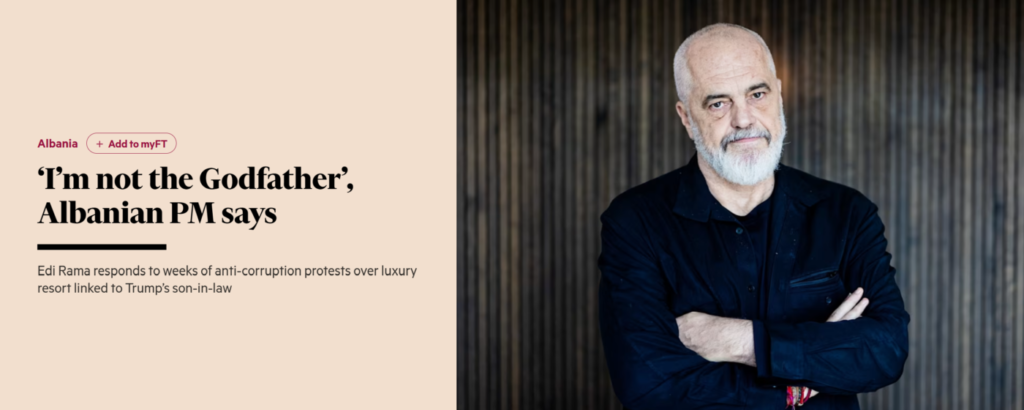
Edi Rama gave the interview on 23 June, three weeks into the protests. Asked whether he was the “Godfather” the demonstrators accuse him of being, he refused the premise and inverted the burden. The charge was not his to disprove. As he put it to the Financial Times, “it’s for them to prove I’m the Godfather.” He answered the crowd with an obscenity and laid part of the unrest at foreign doors, Iran among them.
Hours later, David Zaikin replied in public. The strategist’s post runs to four sentences. It opens by conceding Rama’s own ground: investment is good, and the mafia, he wrote, has a “different leader.” Then it turns. Drug money has flooded the country; a handful of oligarchs have captured tourism, retail and energy; Albania needs new leadership and a “caretaker government.”
Begin with what the post withholds about its author. Zaikin is not an outside analyst who happened to turn his attention to Tirana. The 2017 ProPublica and Politico investigation documented him as the facilitator who introduced the Socialist Movement for Integration, Ilir Meta’s party, now the Freedom Party, to American lobbyists, the same service he performed for Macedonia’s VMRO. He was not the lobbyist of record. He was the man who made the introductions. The party he served is the opposition lineage now ranged against Rama, and the 2016 and 2017 lobbying that followed, some 460,000 dollars of it now unexplained, sits inside the SPAK case that holds Meta in detention today. His call for the government’s fall and a caretaker administration in its place is therefore not a reading delivered from outside the contest. It is one side’s standing demand, returned in the voice of an expert. He is an interested party. The only open question is whether the reader is told.
The statement carries three claims of unequal weight. That drug money enters the economy is reported, on sourcing, and can be argued with. That a few owners hold three named sectors is an assertion of concentration, testable against ownership records it does not provide. The third claim is the one the opposition trades in daily: that development in Albania is laundered money wearing a suit, that the built economy as such is narco proceeds. That proposition cannot be falsified, and a proposition that cannot be falsified proves nothing. It is a slogan.
Zaikin writes the first. He gestures at the second. He does not write the third. His sentences stop at “flooded” and at three captured sectors. The totalisation is absent from the page.
It is supplied by the reader, and the composition is built to make him supply it. The concession at the top certifies the speaker as fair, so the indictment that follows reads as reluctant rather than partisan. Then comes the remedy. Not reform, not prosecution, but the dissolution of the government and a caretaker administration in its place. That is a cure proportionate only to the maximal disease. A state with laundered money in it does not need dissolving. A state that is laundered money does. To make the demand fit, the reader reaches for the premise the author declined to write, and the escalation happens off the page, where no fingerprints are left on the man who induced it.
Rama’s own answer to the charge is, in its structure, the same distinction. He rejected the claim that the national economy rests on laundering and called it grotesque. He did not pretend laundered money is absent; his point was proportion. He reached for London. A financial capital can host laundering on a large scale without anyone concluding that the British economy is, in its bulk, laundering. The presence of the crime is not the composition of the economy. On the narrow question the logic holds, whoever is making it.
The documentary record holds it up better than the Prime Minister does. On 19 June, asked about the SPAK files and the hundreds of millions suspected of passing through construction, most of it through the capital’s towers, Economy Minister Delina Ibrahimaj did not deny the exposure. She called construction a sector at risk of laundering, in Albania as everywhere in the world. But she placed its financing elsewhere: the analyses conducted with international institutions, she said, show the sector funded chiefly through the banking system and kept under continuous monitoring for exactly that reason. A sector financed through banks and watched as a known risk is not the same object as an economy built on trafficking.
The prosecutions confirm the point rather than defeating it. The SPAK files the opposition cites as proof of a captured state are the same files freezing the money inside it. The 128 million euros halted over the Shehu land sale to Albania Land Development, the company tied to the Kushner project, is enforcement operating in daylight. A system that protected laundering would not freeze it. The cases are evidence of a machine working, not of a machine owned.
The press that carried the intervention completed it. Outlets amplifying the protests badged him “the Israeli strategist.” The label is false on its face. He is a Canadian citizen, born in Ukraine, based in London, whose public alignment is with Israel, and the coverage converted an alignment into a nationality. The conversion is not idle. Rama had told the same Financial Times that foreign hands, Iran among them, were stoking the streets. A strategist badged as Israeli, endorsing the protesters’ central demand, is the readiest answer to that charge, since an Iranian operation is not imagined to recruit Israeli strategists. Whatever any editor intended, the label does that work. And the single disclosure that would have cautioned the reader, that the strategist once served the party now leading the fight, appears in none of it. The badge that lends him authority is printed. The interest that would withdraw it is left out.
Zaikin supplies the matching asymmetry from his own side. The reporting that documents his interest, the ProPublica record, he answers through lawyers and calls smear; the reporting that indicts Rama he treats as settled and builds on. The Flynn connection that record drew, three steps through the Turkey file, he denied, no prosecutor substantiated, and the Mueller report does not contain; a published rebuttal called the framing a category error. He is entitled to all of that. He is not entitled to it selectively. One standard for the record that points at him, another for the record that points at his targets. The man is fluent in the weight of a sourced claim. He proves it each time he spends it on Rama and each time he refuses it about himself.
The fluency convicts the composition. A writer who measures evidentiary weight this finely did not stop at the second tier by accident. A man who knows what a sourced report is worth knows what an unfalsifiable claim is worth, and declines to sign one while building a text that delivers it whole. The tiering is craft, not caution.
Two things are missing from the record by the time it reaches the reader, and neither was lost. The sentence Zaikin did not write, that all development is laundered money, which arrives in the reader’s mind with no author attached. And the disclosure the coverage did not print, that the author is a former servant of the side he speaks for. The slogan has no fingerprints. The strategist has no stake. In men this fluent, and outlets this practised, the accident is the one explanation that does not fit.
A clean absence is not innocence. It is design.