Albania’s state condemned the desecration of the Israeli flag within hours. The European Union’s mission in Tirana, and every member-state embassy beside it, has found nothing to say. The omission is not an oversight. It is a disclosure.
The Editorial Board
When masked protesters pulled the flag of the State of Israel from its pole outside the embassy in Tirana on Saturday night and tore it apart to the cheers of the crowd, the condemnation came quickly. It came from the Albanian state, which invoked the Vienna Convention and called the act incompatible with the values the country is straining to adopt. It came from the Albanian Jewish Community, which called it not an incident but an alarm signal. It came from the Israeli ambassador, Galit Peleg, who said the act shamed the Albanian people and their heritage. It did not come from the European Union Delegation in Tirana. It did not come from the embassy of a single EU member state. It has not come from any of them since.
We state it plainly, because the omission inverts the usual order of things. Albania is the candidate, the applicant, the country whose conduct is forever measured against a European standard it does not yet hold. Brussels and its member states are the assessors, and they are tireless in the role. Yet on Saturday it was the applicant who reached for the standard and the assessors who let it fall. The Ministry for Europe and Foreign Affairs reached, almost reflexively, for the language of European values and democratic norms. The European missions whose entire vocation is to hold Albania to that language could not be moved to use it.
This is not because the missions are reticent. The diplomatic corps in Tirana comments on Albanian affairs constantly and as a matter of declared principle. It speaks on judicial reform and on corruption. It speaks on the conduct of elections. It speaks on protest violence: when a Democratic Party demonstration turned to molotov cocktails and pyrotechnics earlier this year, the German embassy condemned it in sharp terms and instructed the party’s leadership to distance itself. Across the present cycle, the movement that began at Zvërnec, European voices have pronounced on rule of law, on property rights, on the fate of a lagoon. They are not short of words. They located none for a torn flag and an antisemitic libel. The pattern is not difficult to read. These missions speak when speaking is cheap or congenial, and they fall silent at the precise point where principle would cost them something. The silence over Saturday night is not the absence of the standard. It is the standard, shown in operation.
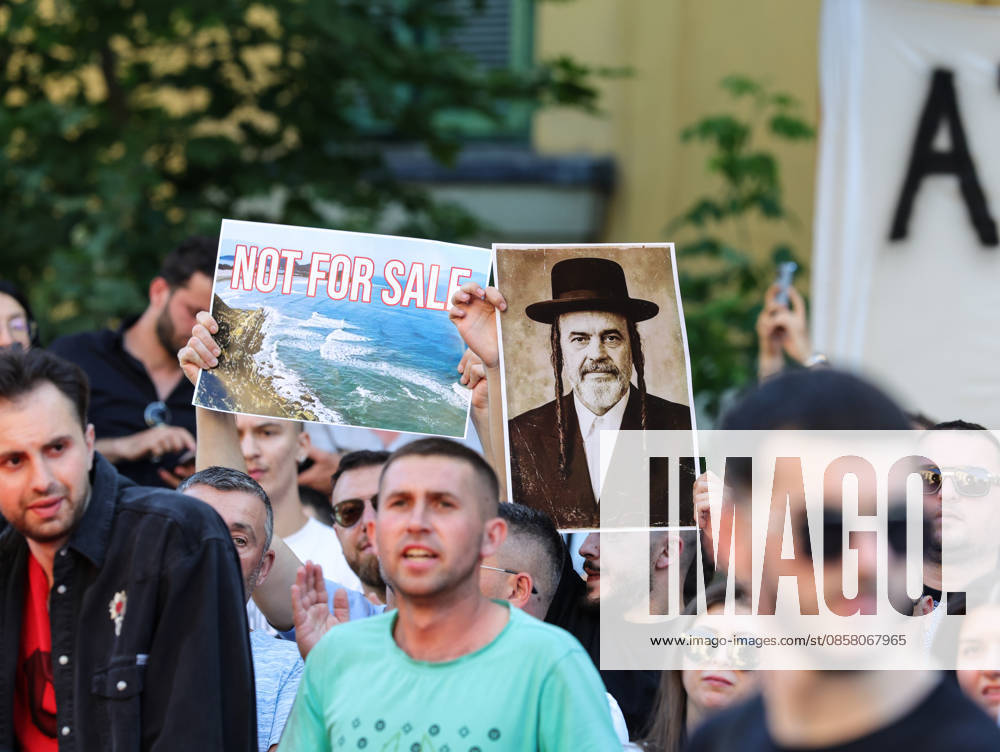
We are told, when this is pointed out, that no statement was issued and none was required, that a mission is free to keep its own silences. For a mission this voluble the defence convicts rather than clears. An embassy that pronounces on judicial vetting, on a contested permit, on the fate of a lagoon, on cocktails thrown at police, and then alone goes quiet when a people is libelled beneath its windows, has not declined to comment. It has commented. The selection is the statement, and the statement is legible. What stayed the hand is not hard to locate, because only one feature sets this case apart from all the others on which these missions spoke without prompting: to condemn the act would have meant crossing a constituency they are courting, a large, fashionable, broadly approved protest movement, at a moment when much of European opinion has turned hard against Israel. One need not read a single cable to read that much. And the choice was not even a hard one. To criticize the Israeli government’s war is legitimate political speech about the actions of a state. To pull down a flag to applause, and to circulate the claim that a hidden Jewish hand is buying up Albanian land, is not speech about a state at all. It is the marking of a people. The two are cleanly separable, and every professional diplomat knows they are separable. A mission could oppose the Zvërnec project, walk beside the protesters, denounce the bombardment of Gaza, and still say without the faintest contradiction that a desecrated flag and an anti-Jewish libel have no place in a European country. That sentence cost nothing but the approval of people these missions would rather not annoy. That was the entire price, and they declined to pay it.
It is worth naming what they would not, because this is no borderline case that a careful diplomat might prudently avoid. For weeks a current inside the protest has pushed the claim that the coastal development conceals an Israeli agenda, illustrated with images of settlers seizing Albanian territory. The images are fabrications. Fact-checking desks traced one widely shared photograph of a barbed-wire border flying Israeli and Albanian flags to digital manipulation, and a viral clip of settlers being chased off to an unrelated protest in the north months earlier. Stripped of the forgery, the claim is the oldest accusation in the European repertoire: a country’s troubles laid at the feet of a secret Jewish agent. Ambassador Peleg named the resemblance at the start of June, before the flag came down, when she said the banners recalled an element of 1930s Germany, a nation blaming its difficulties on its Jewish minority. She was not reaching for hyperbole. She was describing the structure of the thing itself.
The Albanian institutions grasped the weight of this, and that they grasped it while Europe’s missions did not is the indictment in miniature. Albania is one of the few states on the continent that left the Second World War with more Jews on its soil than it entered, having hidden them under occupation. Some seventy-five Albanians are honoured at Yad Vashem as Righteous Among the Nations. Peleg gave her first public address as ambassador at Tirana’s Holocaust memorial. The candidate state drew on that memory within hours. The missions of the union that styles itself the guardian of that memory drew on nothing. The pupil held the line the teacher let go.
Which brings the protest’s own slogan into the dock beside them. The movement marches under the banner of a New Albania, and Europe has taken the phrase to its heart, reading the protests as democratic renewal, as Europe arriving at last in a stubborn corner of the Balkans. A slogan, though, is a promise, and a promise is tested at the exact moment something foul attaches itself to the banner and asks to be disowned. The test came on Saturday. The movement’s European admirers failed it in silence. So we put the question to them and not to the crowd, because they are the ones forever instructing Albania on what Europe requires. Is this the New Albania you applaud, one in which a people is scapegoated, a flag torn to cheers, and a forgery passed off as reporting, while the embassies of Europe watch and say nothing? If the New Albania is to mean the European standard, then the European standard begins, before anything else, with refusing to let the continent’s oldest hatred march under a clean new flag. The missions that could not say so have told us precisely what their standard is worth.
Peleg, in her statement, spoke to the other ambassadors directly. She asked them to condemn the act whatever their governments make of Israel, and she added a line that was a warning and not a plea: today it is us, tomorrow it is them. The principle is not a position on Israel. It is the floor beneath every other principle these missions profess, the rule that a people is not to be blamed for a plot. The Albanian state stood on that floor within hours. The European Union’s mission in Tirana, and every member-state embassy beside it, has chosen to stand elsewhere. We do not expect them to take a side in a war. We expect them to recognise a libel when it is screamed in the street beneath their windows, and to say so, as the country they grade said so without hesitation. Their silence is now a matter of record. It is the answer they have given. It is not the one they claim to stand for, and from this day no lecture they deliver to Tirana on European values should be received without it.