POLITICO Europe rewrote Rama’s Delphi interview with a single verb. The verb revealed more about Brussels newsrooms than about Tirana.
By Ardit Rada (Tirana)
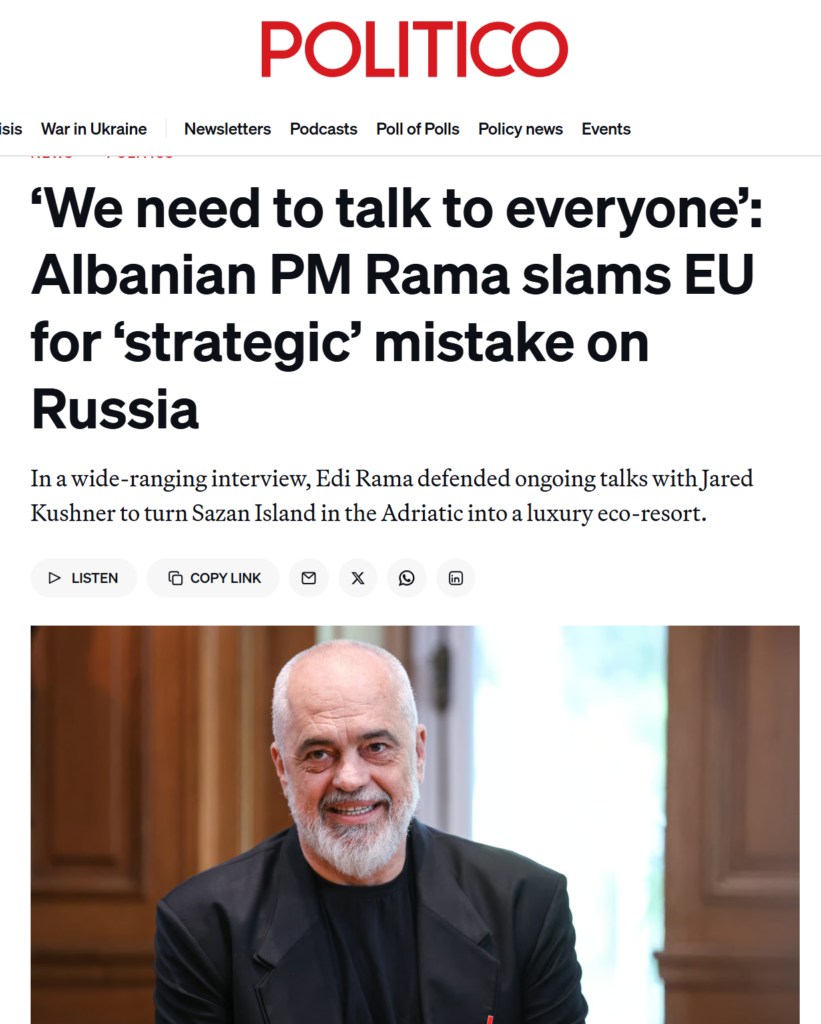
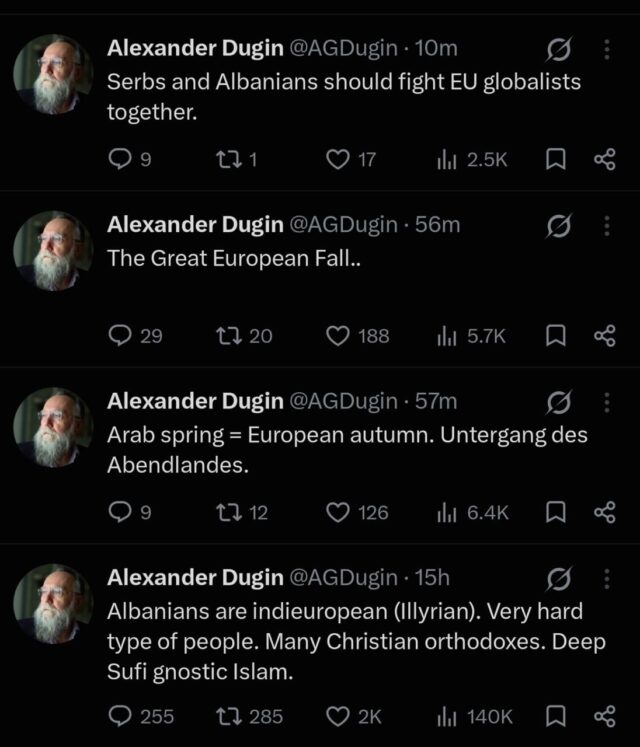
On Thursday evening, POLITICO Europe published Nicholas Vinocur’s interview with Prime Minister Edi Rama from the Delphi Economic Forum. The headline read: “‘We need to talk to everyone’: Albanian PM Rama slams EU for ‘strategic’ mistake on Russia.” Within hours the verb had done more work than the interview itself. Headlines of this shape travel a predictable path, screenshots into Serbian-language channels, lifts into Russian aggregator sites, repackaging by English-language accounts that specialize in the idea that the Balkans are Europe’s weak flank. The interview sat underneath all of it, quieter than its packaging.
Rama did not slam anything. The interview contains two propositions of equal weight. “Europe has done a big strategic mistake to cut every channel with Russia,” and Albania is “100 percent aligned with Europe” on strategic aims. The headline selects one and erases the other. That is not a summary. That is a selection.
What Rama actually gave was a careful, policy-register critique in a room he knew how to read. His position on Russia was closer to the Élysée habit of keeping Moscow on the phone than to the hard-isolation line now dominant in Brussels. He said Europe had cut too many channels. He said Europe should talk to everyone. He said Albania has no Russian gas, no Russian investment, no Russian leverage on its decisions. Then he named the leverage question directly, because the point was structural: the countries that actually depend on Moscow cannot say what Tirana can.
None of that is a slam. It is a candidate country’s prime minister arguing for the soft-engagement wing of European opinion against the hard-isolation wing currently represented by Ursula von der Leyen and Kaja Kallas. The position has European company. Emmanuel Macron has kept a Putin channel open at various points in the war. Robert Fico speaks to Moscow openly. Neither has been described as slamming anything for taking this line. When Macron argues for engagement, he is “pushing,” “urging,” “proposing.” When Rama argues for engagement, he slams.
The verb is the tell
The verb is worth examining on its own terms, because it carries most of the headline’s argument.
“Slams” belongs to a specific family of Anglophone political-journalism verbs: slams, blasts, rips into, lashes out. The family was invented by British tabloid subeditors to compress confrontations into single-column headlines. The verbs were short and morally loaded. They promised a fight. POLITICO Europe inherited the vocabulary when it built a Brussels operation staffed partly by UK and Irish veterans, and the verbs migrated into a publication whose subject matter, actual EU policymaking, is almost never a slam. Commissioners do not slam directives. Ministers do not slam each other over fisheries quotas. Accession candidates do not slam the Commission that holds their file. They issue statements, they raise concerns, they criticize approaches, they argue for alternatives. “Slams” is a costume, and the costume is heavier than the body it dresses.
There is a second-order problem. The verb flatters the wrong party. It makes Rama sound like the aggressor and Brussels the target, which inverts the actual power relationship. Albania is the accession candidate. The Commission decides the pace of the country’s future. Rama is in no position to slam the institution that holds the file. The headline gives him an aggression he did not display. Politicians rarely complain about this kind of headline, because being described as slamming things makes them sound bigger than they are. The verb is a gift wrapped in a grenade.
The asymmetry that matters for Tirana
The second-order frame is the one that matters for Albania specifically.
Brussels-tier outlets shape the Commission’s informal reading of candidate-state leaders. A headline like this one is unlikely to enter a COELA memo. But it enters the informational environment in which such memos are read and drafted, the morning Playbook, the digest circulated before a cluster meeting, the corridor conversation that sets the tone of a room. Officials will not recall the triple “always” of the actual quote, nor the hedge about being fully aligned on strategic aims, nor the offhand insistence that Albania has no Russian exposure of any kind. They will recall the word slam. Over enough mornings, the impression calcifies.
This is the asymmetry the Balkans live inside. A French president can spend three years talking to Vladimir Putin and be described, on balance, as a statesman exploring channels. An Albanian prime minister can argue, once, at a Greek forum, that Europe should preserve the option of dialogue, and the headline verb is slam. The substance is nearly identical. The framing is not. The framing reflects a newsroom assumption about where the dissent lines in Europe are drawn: the old member states occupy the space of legitimate disagreement, and the candidates occupy the space of rogue statements that need to be contained. This is not written down anywhere. It does not need to be. It is how the verbs get assigned.
POLITICO Europe is not doing this deliberately. It is doing it by reflex. That is worse, because reflexes are harder to correct than policies. The house style wrote itself during the years when the only Balkan story that sold in Brussels was a problem-country story, and the verbs settled into the grooves that sold. The grooves are still there. Rama’s interview this week fell into one of them.
In Brussels coverage, the argument is often not in the quote. It is in the verb.
This week it was.
Ardit Rada is a Tirana-based journalist covering Albanian politics, governance, and institutional developments. His work focuses on the intersection of domestic political dynamics and Albania’s European trajectory.