The Pandora Papers now name who paid for the DPA’s 2017 lobbying in Washington. Eight years on, the same operation runs through the same operator.
by Klea Ukaj (Michigan)
In May 2018, weeks after the United States Treasury imposed sanctions on Oleg Deripaska and EN+ for what it called the Kremlin’s global malign activities and its attempts to subvert Western democracy, an associate of the Moscow lawyer who managed Biniatta Trade LP wrote to him with a recommendation. Rename the company. Appoint new proxy directors. Leave no trail back to the operators. The associate did not specify which consequences a recovered trail might bring. She did not need to.
The trail led, the documents now show, to the Democratic Party of Albania.
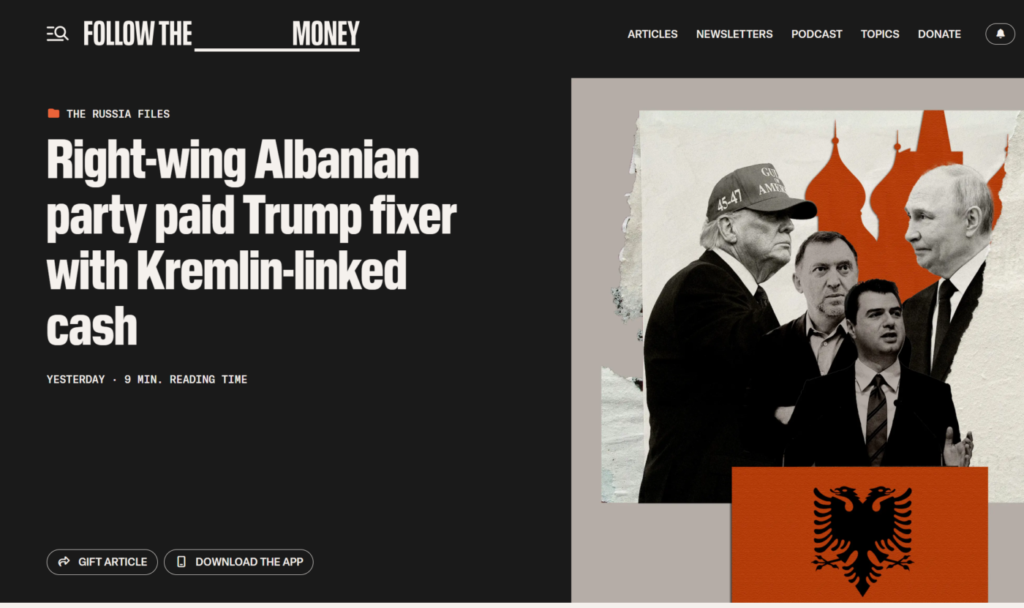
What Follow the Money has established, drawing on the Pandora Papers, on records secured by the non profit DDoSecrets, and on banking material from Liechtenstein’s Bendura, is the documentary chain that Albanian and American outlets could only suggest in 2017. Biniatta Trade LP, the Scottish limited partnership that paid Republican lobbyist Nick Muzin for his work on behalf of the DPA in the 2017 election cycle, was not an opaque vehicle of unknown origin. It was a managed entity inside a network operated by a Moscow lawyer named Eduard Blokhin, with banking concentrated at a private institution in Liechtenstein, and with documented financial connections to Oleg Deripaska, EN+, and personnel inside Deripaska’s immediate orbit. Between December 2017 and August 2018, in the months immediately following the Albanian election, the network moved approximately €55 million in loans and contracts. Two thirds of those flows trace, by FTM’s documentation, back to Deripaska or his associates.
This is not a question of inference. It is a question of what the Pandora Papers contain.
What that documentation does to the Albanian record is something the prior reporting could not do. In 2017, when Mother Jones and BIRN first surfaced the Biniatta payment, the most that could be established was that the funding for Muzin’s contract did not come from the party itself, and that the actual payor was an opaque Scottish vehicle with a Russian linked profile. The DPA insisted publicly that it had paid Muzin $25,000. Muzin’s own filing under the United States Foreign Agents Registration Act, amended in late 2017 under the pressure created by Paul Manafort’s indictment, recorded $675,000 in total. The $650,000 gap was attributed to Biniatta. No one in 2017 could say with documentary certainty whose money that was. We can now.
The Albanian prosecution office that opened a case into the funding of the 2017 DPA lobbying campaign closed it in 2019 without charges. Prime Minister Edi Rama had publicly called for an investigation. The DPA had publicly denied wrongdoing. The case ended in suspension. There are two things to note about that closure. The first is that it was issued under the prosecutorial architecture that preceded SPAK, the structure that the DPA, under Lulzim Basha, characterised in 2017 as bullshit. The second is that the documentary basis on which a reopening would now rest did not exist in 2019. It exists now. Whether SPAK chooses to look at the file is its own question. The file has changed.
If the story stopped here it would belong to recent Albanian history. It does not stop here.
In the run up to the 2025 general election, the DPA, by then under Sali Berisha following his retaking of the party, again retained Trump camp operatives. The retainers this time included Trump’s 2024 campaign co manager, one of his pollsters, and Paul Manafort himself. Manafort is not an incidental name in this narrative. He is the figure whose business relationship with Deripaska sat at the centre of Robert Mueller’s investigation into Russian interference in the 2016 American election, and whose 2017 indictment was the indictment that prompted Muzin’s amended FARA filing in the first place. The lobbying contract for Berisha’s 2025 effort, valued at approximately $6 million, was funded by a New Jersey foundation incorporated days before the contract was signed. No donor list was disclosed. Albanian law on political financing requires it.
What FTM presents as a recurrence we should read as continuity.
The DPA of 2017 and the DPA of 2025 are not two parties. The leadership has shifted, Basha out, Berisha returned, but the doctrinal posture has not. Trump alignment as foreign policy strategy, Make Albania Great Again as recycled slogan, opposition to EU anchored justice reform, foreign retention of operators with documented Kremlin adjacent histories: this is one operation with two electoral expressions. The personnel rotates inside a fixed architecture. Manafort’s reappearance is not coincidence. It is the architecture revealing itself.
There is a temptation, when material of this weight surfaces, to read it as governmental advantage. The temptation should be resisted. The story is not about Edi Rama. It is about what the political class of an EU candidate country can be documented to have absorbed, across two electoral cycles, while presenting itself in Brussels and Berlin as the country’s pro Western alternative. The opposition that dispatched a parliamentary delegation to the Bundestag in March 2026 to lobby against the adoption of Albania’s IBAR is the same opposition documentarily linked, across nine years and two cycles, to foreign financial vehicles whose ultimate beneficial owners include sanctioned Russian capital. The continuity here is not only financial. It is strategic. A party that has twice funded its foreign profile through opaque structures tied to figures named in Kremlin influence investigations is not credible as a guarantor of EU aligned governance, regardless of the destination of its lobbying flights.
What remains is institutional. The Albanian prosecution office of 2026 is not the Albanian prosecution office of 2019. SPAK exists. The vetting process exists. The justice reform that the DPA called bullshit in 2017 is the same reform that, nine years later, supplies the institutional basis on which a foreign financed lobbying operation tied to a sanctioned oligarch could be reopened on the documentary record now available. Whether it will be is a separate question. What the record shows is that the case was closed before the evidence was complete.
The associate who wrote to Blokhin in May 2018 understood what she was asking him to bury. She understood that a renamed company and rotated proxy directors would, in the ordinary course, leave no trail. She did not anticipate the Pandora Papers. The trail was not erased. It was archived.
The file remains open in international forensics, even if it has not been reopened in Tirana.