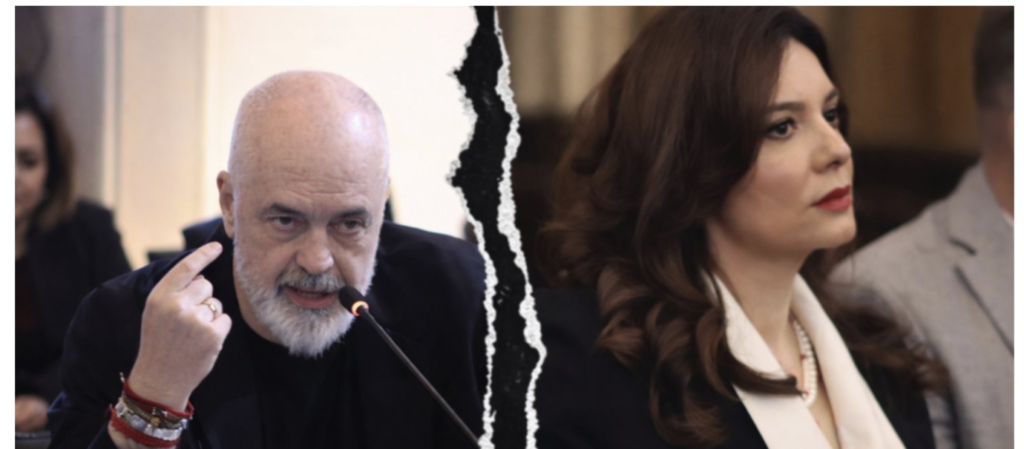
Three unrelated events are being fused into a single narrative of control. Remove the sequence, and the argument collapses.
By Ardit Rada (Tirana)
This needs to be said plainly: external audiences are being fed a narrative about what occurred inside Saturday’s Socialist Party parliamentary group meeting that does not correspond to what actually occurred.
The narrative is structured, deliberate, and targeted. It is circulating in diplomatic, European institutional, and diaspora channels unlikely to cross-check it against sourced Albanian reporting. The gap between what is being said abroad and what the evidence supports is now large enough to require correction.
The mechanism is straightforward. Three separate developments are being presented as a single system of coercive political control. The March 12 vote on Belinda Balluku’s parliamentary immunity is treated as the starting point. Elisa Spiropali’s political trajectory is inserted into that frame. The exchange between Spiropali and Prime Minister Edi Rama at the Brigadat meeting is presented as the enforcement mechanism.
Each of these elements exists. The system built from them does not.
Start with the factual correction the narrative cannot absorb. Spiropali’s dismissal from her ministerial role occurred on 26 February, fourteen days before the March 12 vote. It cannot be a consequence of that vote. This is not a sequencing detail. It removes the causal spine on which the entire argument depends. What remains is a set of unrelated developments forced into coherence by interpretation, not by evidence.
The March 12 vote itself is a serious matter. Tirana Examiner has treated it as such and will continue to do so. Questions around SPAK’s operational latitude and Albania’s Chapter 23 obligations are legitimate and require sustained scrutiny. But those questions are not clarified by retrofitting a party meeting exchange into a theory of systemic coercion. That move produces a closed loop: the conclusion is assumed, and each subsequent event is made to confirm it.
The Brigadat exchange warrants the same discipline. What occurred was a sharp internal confrontation between a prime minister and a senior party figure. The language was direct, at points abrasive. It is also not exceptional in the life cycle of centralized political parties, including in functioning parliamentary democracies.
Now to the claim being advanced: that internal party dynamics, and specifically Rama’s language toward Spiropali, constitute evidence of constitutional transformation. Accepted as a standard, this argument proves far too much. Public reprimands, internal humiliation, and the enforcement of discipline through informal authority are features of party systems across Europe. They are not, in themselves, markers of autocracy.
Applied consistently, this standard would recast routine intra-party conflict across multiple EU member states as evidence of democratic breakdown. It is not being applied consistently. It is being applied selectively, to one target, at one moment.
That selectivity matters.
The actors advancing this framing have not demonstrated sustained concern for internal democratic practice within the Socialist Party. They were not alarmed when Spiropali herself functioned as a senior enforcer of party discipline, when she was the instrument of alignment rather than its subject. The current framing is not the arrival of a principle. It is the deployment of a moment.
Spiropali has become useful. That usefulness, not the exchange itself, explains the intensity of the narrative built around her.
Internal party dynamics become a matter of legitimate public concern only when they translate into institutional outcomes: legislation passed under coercion, prosecutorial independence compromised by political pressure, judicial processes distorted by party enforcement mechanisms. Those are the thresholds that matter.
No such threshold has been crossed here.
No institutional consequence has followed the Pallati i Brigadave exchange. What exists is a moment of internal tension being asked to carry the weight of a constitutional indictment it cannot support.
That raises the more relevant question: why is this framing being circulated, and why now?
Albania is under active evaluation in its EU accession process. Rule of law benchmarks are under continuous scrutiny. In that context, a narrative delivered in the language of structured analysis travels differently. It is received as diagnosis rather than argument.
That is precisely its function.
Recognizing that function is not political alignment. It is analytical discipline.
Tirana Examiner has raised and will continue to raise substantive questions on judicial independence, parliamentary practice, and executive power. Those questions do not require amplification through weak evidence. They stand on their own.
What they do not require is the conversion of a party meeting confrontation into constitutional proof.
The Spiropali story being told abroad is not the one that happened. The one that happened is narrower, more specific, and far less useful to those trying to turn it into something else.
Ardit Rada is a Tirana-based journalist covering Albanian politics, governance, and institutional developments. His work focuses on the intersection of domestic political dynamics and Albania’s European trajectory.