Albania’s territorial reform process moved forward on Saturday. How far forward is a different question.
the Newsroom (Tirana)
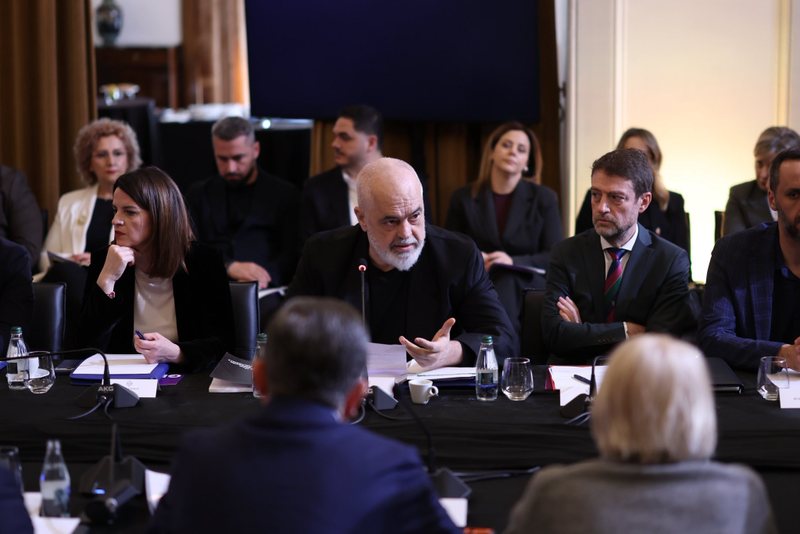
Saturday’s closed-door gathering of the Socialist Party parliamentary group at the Pallati i Brigadave was billed as an internal coordination session. What emerged from it was something more consequential: the clearest picture yet of how the governing majority intends to approach one of the most structurally significant decisions of this legislative term, the reorganization of Albania’s territorial administration.
Four scenarios for a new territorial map were presented to the socialist group by Arbjan Mazniku, co-chair of the Territorial Reform Commission. None was declared preferred. None was declared final. The commission will conduct public consultations across all qarks through April and May, assisted by 26 experts jointly nominated by PS and the opposition, eight of them senior.
The four variants cover substantial ground. The first proposes functional consolidation, merging smaller bashkis into larger neighboring ones while retaining qarks as coordinating bodies. The second goes further, proposing the creation of large municipalities roughly corresponding to the old rreth boundaries, a restructuring comparable in scale to the 2015 reform that reduced 373 communes and municipalities to 61 bashkis. The third moves in a different direction entirely, preserving existing bashkis but strengthening the qark into a directly elected executive tier. The fourth introduces a regional logic, consolidating only the smallest bashkis while creating four strategic development zones oriented around EU fund management and infrastructure planning.
The range is wide enough to mean that virtually any eventual outcome can be presented as the product of genuine deliberation. That may be the point. Territorial reform carries real political costs: smaller bashkis have constituencies, mayors have loyalties, and consolidation produces losers. Presenting four options simultaneously, with no hierarchy among them, is better designed to absorb political pressure across the spring than to resolve it. A majority that has already decided would not need four scenarios. A majority that has not yet decided which costs it is willing to bear finds four scenarios very useful indeed.
Also notable was the reporting by ASHK director Lorena Goxhobelli on the progress of the cadastre reform. The audience for that report was not the Assembly, nor a relevant parliamentary committee, but the socialist parliamentary group meeting in a party venue. ASHK is an agency subordinate to the prime minister. The choice of forum was not remarked upon by the session’s organizers. It should be remarked upon by everyone else. When the director of a state agency reports on institutional progress to a party gathering rather than to a parliamentary body, the line between state administration and party machinery has moved. That movement is worth recording even when it arrives without announcement.
The meeting also launched what the party is calling the “Punët e Shqipërisë” national tour, a series of public meetings beginning next week and running through June 12, the 35th anniversary of PS’s founding. Municipal leaders are expected to participate, accounting publicly for promises made and their delivery. The framing is civic. The timing and structure suggest something closer to pre-campaign mobilization.
A confrontation between Prime Minister Rama and former Foreign Minister Elisa Spiropali drew attention in reporting from inside the closed session. The exchange was sharp. It will occupy political commentary for the days ahead. It is worth noting, however, that internal party friction, however vivid, does not alter the substance of the decisions being prepared. The territorial reform scenarios on the table this weekend will reshape Albanian local governance regardless of who is or is not in the room when the final map is drawn.
The commission’s qark-by-qark consultations begin in April. That process, and what emerges from it, is the story worth watching.