The Commission cleared Albania’s IBAR. North Macedonia changed its name. Yet Johann Wadephul’s enlargement vision leaves untouched the architecture that allows member states to convert technical compliance into permanent political suspension.
by Albatros Rexhaj (Tirana)
Albania finished its homework. North Macedonia gave away its name. The Commission cleared Tirana’s IBAR. Berlin’s foreign minister offered them, this week, a more sophisticated waiting room.
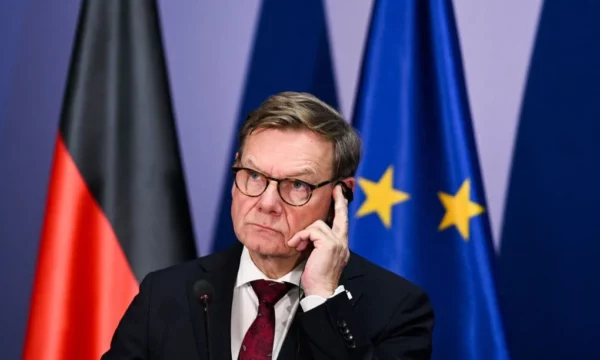
Johann Wadephul told the Adenauer Conference that Germany owes the Western Balkans results. The Western Balkans have heard this sentence, in various German translations, for fifteen years. Each time it has arrived attached to a new mechanism. Each mechanism has produced delay. Wadephul’s contribution to the genre is graduated accession with conditionality clauses written into accession treaties, designed, in his own words, to reduce the reservations of certain member states about early full memberships.
The acknowledgment of debt is welcome. The mechanism that follows it is the latest refinement of a logic that has held the region in place for two decades. The existing architecture has stopped functioning as a path to integration. It functions, instead, as a system of differentiated sovereignty, in which candidate countries serve as a laboratory for governance theories the existing members would never accept and which the Union’s enforcement instruments have already failed to apply against incumbent violators. In the same architecture, bilateral blackmail by member states pursuing narrow domestic interests, or older ideas of European supremacy, is tolerated because the system provides no incentive to suppress it. Wadephul’s speech does not break from this pattern. It refines it.
Consider the test cases. Albania has cleared the IBAR. The Interim Benchmark Assessment Report is a technical instrument. The Commission, which is the technical authority, has issued the clearance. The judicial vetting that dismantled and rebuilt the senior judiciary, the SPAK convictions against former ministers in real time, the cluster opening pace under the third Rama government: these are documented findings produced by the institution the Treaties assign to produce them. The Commission has done its work.
What follows is where the architecture breaks. The dossier moves to the Council, where the member states reopen the file. Not on technical grounds, because the technical authority has already pronounced. They reopen it on grounds that are theoretical, atmospheric, sometimes openly stereotypical. One capital cites concerns about organized crime in language indistinguishable from tabloid copy. Another raises the diaspora question with formulations that would be litigated as discriminatory in any domestic context. A third invokes absorption capacity, a phrase that has appeared in European debates for forty years and has never been operationalized into a measurable threshold. None of these are technical objections. The technical work was the Commission’s, and the Commission has cleared it.
This is the actual structure of the blockage, and it is the structure Wadephul’s speech does not address. If the IBAR is a technical process, and the technical authority has cleared it, what space remains for member states to theorize? In the current architecture, all the space that matters. The Council holds the unanimity rule. The unanimity rule converts theory into veto. The veto converts the candidate’s performance into the member state’s discretion. The criteria are objective; their application is political; the political application is unanimous; therefore the most subjective member of the Council determines the meaning of the most objective benchmark.
North Macedonia did Prespa. It changed its constitutional name to resolve a dispute no current member has ever been asked to resolve. It then accepted further conditions imposed by Bulgaria on language, on identity, on constitutional revision. By every metric of the Copenhagen criteria and every demand attached to them since, North Macedonia has performed. The performance was met by another bilateral veto, this one over language and history, neither of which appears in the acquis. The pattern is identical. The technical work is done. The member state veto reopens the file on non-technical grounds. The candidate country waits.
Wadephul’s graduated accession proposal does not solve this. It deepens it. Pre stages to full membership, conditionality clauses on EU funds inside the founding documents of new memberships, a reinforced principle of loyal cooperation: these are additional non-technical instruments handed to the same Council that already converts technical clearance into political suspension. The legal regime proposed for future members is stricter than the regime applied to existing rule of law violators. Berlin has supported conditionality mechanisms against Budapest, and the Union has activated portions of them. The problem is not the absence of enforcement. It is the inconsistency, the partiality, and the political negotiability of enforcement once activated. The proposed accession regime would impose, on candidates, a stricter version of a system that has already proven insufficient against incumbents. Future Albanians and Macedonians would join on terms current Hungarians do not respect, inside an architecture that has not found the political will to make them.
The geography of Wadephul’s speech is the second tell. He noted, in passing, that enlargement to Iceland and Norway would be evident and welcome. The Western Balkans, in the same passage, were assigned graduated stages, conditional clauses, layered integration. The semantic geometry described where the enthusiasm actually lives. Iceland: assumed in. Norway: assumed in. Albania, after IBAR: graduated. North Macedonia, after Prespa: conditional. The post 1989 east is treated, in this construction, as a region of permanent transitionality, governed by asymmetric standards of membership the founding members would have rejected as inadmissible if applied to themselves.
The chokepoint is the third. Wadephul proposes qualified majority voting for the Common Foreign and Security Policy. He does not propose it for enlargement decisions, where the unanimity rule has converted every accession step into a hostage of bilateral politics. Greece held North Macedonia for two decades over a name. Bulgaria held it for three more years over language and history. France held the entire region in 2019 over methodology. The Netherlands held Albania over rule of law metrics it does not always meet itself. None of these blockages reflected the Union’s collective interest. Each reflected the narrow calculation of a single capital, sometimes a single coalition partner inside a single capital. Wadephul’s reform leaves the chokepoint untouched. The veto stays. The theorizing continues.
The Adenauer reference, on which the speech is structurally hung, makes the gap unbearable. Konrad Adenauer was not offered a vestibule. He was offered a community whose founding act was to treat the Federal Republic as a full founding member. There were no pre stages on coal and steel. There were no conditionality clauses on the ECSC funds to manage the reservations of Paris or Rome. There were no member states reopening Bonn’s compliance file after the technical work had been done. The Westbindung Adenauer accepted was strategic embrace on equal terms. The proposition Wadephul named after him is its inversion: integration as suspended categorization, membership as conditional probation, the candidate country as governance experiment, the technical clearance as the prelude to a political reopening that has no end date and no defined criteria.
The Western Balkans should hear this clearly. The German position, even in its most rhetorically generous formulation, does not envision Albania or North Macedonia as full members of the European Union on terms equivalent to those Berlin would accept for itself. It envisions them as a managed periphery, useful as a testing ground for conditionality designs that have failed against Budapest and as a buffer against the strategic costs of leaving the region outside. The results Wadephul says Germany owes are not the results the region was promised. They are a more elaborate vocabulary for the same suspension.
The verdict is not that Wadephul is dishonest. He is, by the standards of his office, unusually direct about whose interests his proposal is designed to serve. The verdict is that German and broader European enlargement policy has constructed a system in which the Commission performs the technical assessment and the member states retain the right to disregard it. Albania has cleared the IBAR. The Commission has issued the finding. What remains, in the current architecture, is theory. The candidate country has no defense against theory. That outcome is the structural consequence of an enlargement regime in which technical clearance and political discretion have been deliberately decoupled, and in which no instrument exists to compel the political tier to honor the technical one.
The deeper proposition Wadephul advances, beneath the Adenauer scaffolding and the language of debt and responsibility, is that accession has ceased to mean incorporation into equality. It has become, instead, a permanent regime of differentiated sovereignty, in which candidate countries are admitted to the obligations of membership but not to its discretions. Berlin’s foreign minister offered, this week, a more sophisticated door. The candidate countries should name the proposition behind it for what it is, and decline to negotiate with it on its own terms.