The platform read on the boulevard on June 23 calls for Edi Rama’s resignation and a twelve-month technical cabinet. A fuller plan circulated by the man who read it proposes a 101-member assembly drawn by lottery. The Socialist Party and the Democratic Party have each rejected it.
The Newsroom
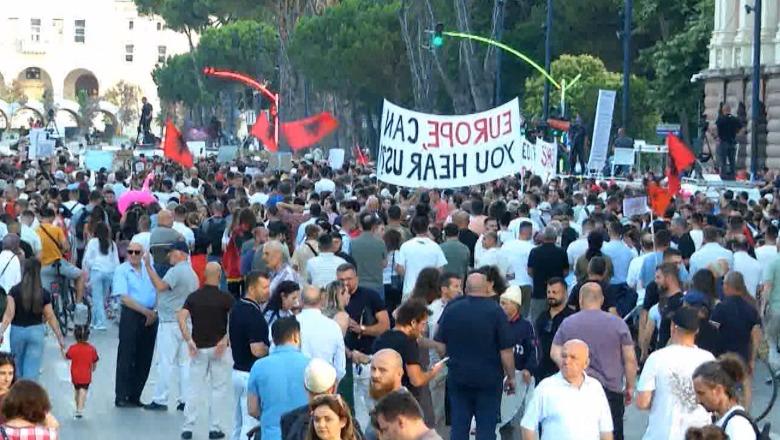
On the twenty-third day of the protest outside the Prime Ministry, organizers published five demands, read aloud on the evening of June 23 by Dritan Goxhaj, a former Kosovo Liberation Army fighter. The demands call for the immediate resignation of Prime Minister Edi Rama and his cabinet and the creation of a non-party technical government with a twelve-month mandate. By the following day both the governing Socialist Party and the opposition Democratic Party had rejected the platform.
The protest began on May 31 over a planned coastal resort development in the Zvërnec area and against government environmental decisions, and has gathered for more than three weeks.
The five demands
According to organizers, the platform read on June 23 contains five points: the immediate and non-negotiable resignation of Rama and his government; the creation of an apolitical, technical transitional government with a twelve-month mandate to administer the country until reforms are carried out; constitutional changes ratified by popular referendum; a limit of two terms on the office of prime minister; and the equality of all citizens before the law, expressed with the language of the “sovereign.”
A fuller plan, drawn by lot
A more detailed proposal predates the boulevard reading. On June 14, Goxhaj published a text on Facebook setting out a mechanism for replacing the current system, which he says the five demands confirm in part.
Under that plan, every citizen would propose names of people who have not been part of the political system of the last thirty-six years. The text sets disqualifying criteria: candidates may not have served as party chairs or heads of party branches, nor held senior posts in central or local government, including ministers, deputy ministers, secretaries general, directors, mayors, municipal or regional council members, or deputies. The proposal says candidates should be people who have contributed in their fields, naming teachers, doctors, workers, artists and farmers.
From that pool, one hundred and one people would be selected by lot rather than by election, the draw conducted in public, before cameras, with domestic and international observers. Goxhaj calls this body a National Transition Assembly. It would sit for twelve months and then dissolve, and no member would be permitted to stand in the elections it organizes.
In the text, Goxhaj argues that elections create campaigns, that campaigns create money, that money creates ties and that ties create corruption, and that the lot, by contrast, cannot be manipulated and creates no leaders. He invokes ancient Athens, which filled public offices by lot, as the model. He rejects the description of the plan as a utopia, calling it instead a bridge that, once crossed, is left behind.
The Assembly’s tasks, as set out in the plan, would be to appoint a transitional government, also chosen by lot from professionals in each field; to draft a new constitution; to put that constitution to a referendum; to organize the first free elections under it if it passes; and then to disband. The transitional government would be limited to managing the country for the twelve months, responsible for utilities, taxes, customs, the police, the army, schools and hospitals, without the power to award tenders or sign contracts, and its members would be barred from standing in the elections it organizes.
Goxhaj’s role, according to organizers
Luçiana Kokaj, a resident of Rrjoll and one of the protest’s public figures, told Report TV that Goxhaj is not a member of the protest’s coordinating group. She said that group numbers around forty people, with a membership that changes as new participants join, and that the five demands were collected and refined by it over more than three weeks of gatherings.
Kokaj said Goxhaj was asked to read the demands precisely so that no single organizer would be elevated. According to her account, the organizers first approached two or three people from outside the initiating group, and turned to Goxhaj after the others declined, citing his support for the protest and his role in the Kosovo war. She said he is not part of the coordinating mechanism.
Goxhaj’s background
Goxhaj worked for several years as an air security specialist at the Civil Aviation Authority. He was dismissed in 2017 for what the institution described as a breach of official ethics. He has challenged the dismissal in court without securing reinstatement.
In July 2023 he was arrested in Tirana on a warrant issued by the Kosovo Specialist Chambers in The Hague, which accused him of revealing the names of protected witnesses in cases opened by Kosovo’s Specialist Prosecutor’s Office and sought his extradition. The Court of Appeals ruled in his favor, and the Supreme Court rejected the extradition request.
His war record is disputed. The KLA War Veterans’ Organization in Pristina told Radio Free Europe that Goxhaj does not hold veteran status issued by it and does not appear in its database. Goxhaj told the same outlet that he holds KLA veteran status, and presented a 1999 document bearing the seal of the provisional Kosovo defense ministry and the signature of its then minister, Azem Syla. He has also said in television interviews that during the Kosovo war he was authorized by the KLA General Staff to maintain contact with the command of United States forces stationed in Albania as part of NATO operations in the region.
Goxhaj has also published posts taking positions against United States and Israeli policy in the Middle East, with language supportive of Iran and of Hezbollah, which one post described as armed resistance.
The government’s response
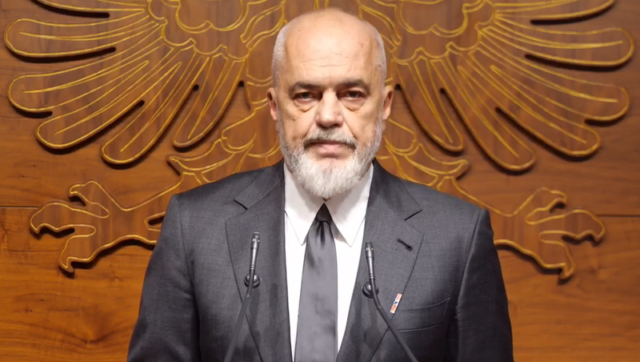
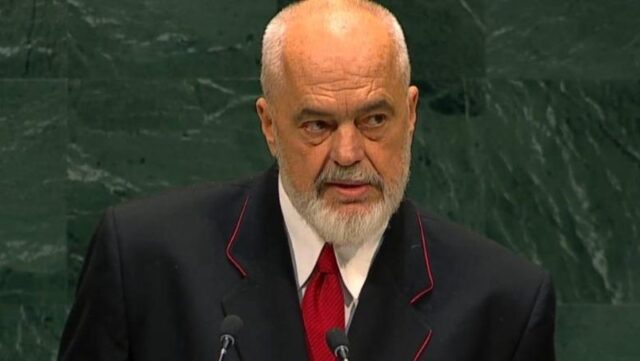
Rama has commented on the protest regularly without addressing the platform directly. He posted on social media a 1999 document of the provisional Kosovo government, unsealed and carrying only a signature, which according to him states that Goxhaj did not take part in the Kosovo liberation war. He described Goxhaj as a manipulator and, in his words, half-Taliban and half-mythomaniac. Interior Minister Taulant Balla referred to Goxhaj as the protest’s spokesman.
Rama has framed the protest as driven by external and internal factors and by disinformation rather than as spontaneous civic revolt, using the term hybrid war and citing influences he attributed first to Greece and Iran, then to propaganda spread by bloggers and social accounts, and to the participation of people from Kosovo and North Macedonia. The KLA War Veterans’ Organization issued a statement asking that the symbols of the war not be misused for political purposes.
Reaction from the Socialist Party
Erion Braçe, a Socialist Party deputy, rejected the platform, calling it chaos and describing the protest as containing primitive and dangerous agendas. He argued that a prime minister who resigned under pressure from the square would still be the one required to vote a technical government into office in parliament, since there is no other constitutional route for such a government to exist. That requirement, he said, would repeat and would push the country toward instability rather than resolve the crisis.
Reaction from the Democratic Party
Democratic Party leader Sali Berisha said he supports the protest in principle and backs several of its points, including the prime minister’s resignation, a two-term limit, and the creation of a technical transitional government. He said he could not act outside the constitution.
Berisha rejected the proposed method. A technical government, in his account, should result from an agreement among the political forces and receive a vote of confidence in parliament, rather than emerge from the lot of a 101-member assembly. He said the Democratic Party would be ready to vote in parliament for a two-term limit and to call on citizens to support such a measure in a referendum, but that constitutional changes should not bypass parliament. He also criticized Rama’s attacks on Goxhaj, calling the targeting of a war fighter shameful, and said there had been threats against protesters arriving from Kosovo, North Macedonia and the diaspora.