A leaderless movement built itself around an empty phrase. The Prime Minister has begun filling it.
by Alban Bici (publisher of Tirana Examiner)
The most important words in Tirana this June are also the emptiest. “Shqipëri e Re” has echoed down the boulevard every evening for nearly two weeks now, from Skanderbeg Square to the doors of the Prime Minister’s Office, and the chant works precisely because it specifies nothing. New Albania has no program, no manifesto, no list of demands beyond the resignation it pairs with. It is a vessel. Everyone in the square pours their own grievance into it: the lagoon at Zvërnec, the towers in the capital, the relatives in Germany, the pensions, the thirteen years. The phrase holds all of it because it commits to none of it.
This is the source of the movement’s strength. A slogan with content can be argued with; a slogan without content can only be joined. It is also the movement’s one structural weakness, and in the second week of the protests that weakness was found, not by the police and not by the opposition, but by a thirty second video.
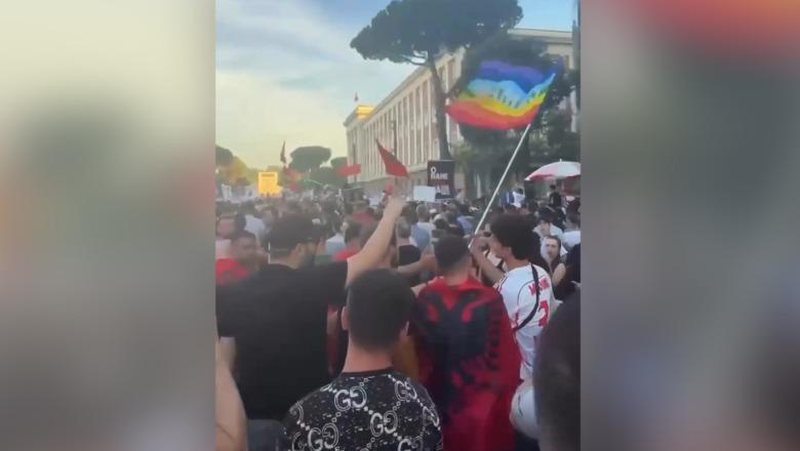
What the video shows is not in dispute. A young man stood in the crowd holding a rainbow flag. He was told to lower it. When he did not, it was taken from his hand. The footage exists, it circulated within hours, and no honest account of these protests can write around it. A citizen exercising the most basic right the square claims to defend was stripped of his banner by the people standing next to him. Whoever did it handed the government something no press office could have manufactured.
Edi Rama understood what he had been handed. His statement arrived the same evening, and it must be read first as what it is: conviction. No one should be humiliated or targeted for being different, the Prime Minister wrote, declaring full solidarity with the young man and shame on those who surrounded him. Nothing in his record suggests posture. Rama’s Europeanism and his social liberalism are among the few constants in a long and otherwise flexible political life, and his Health Ministry’s order opening public hormonal treatment to transgender patients, signed in April and public since late May, was issued in the teeth of objections from all five traditional religious communities. The man believes this. The young man with the flag deserved exactly the defense he received, and he received it from a Prime Minister who would have written the same words in a quiet month.
But conviction and aim are not opposites, and this statement was aimed with care. Indeed the aim works only because the conviction is real; an improvised tolerance would have rung false, and the crowd has picked its fight on the one terrain where Rama is fully authentic. Note what Rama actually contested. Not the protest’s legality, not its size, not its demands. He contested its adjective. This is not the Albania we believe in, he wrote, and not the Albania being built as a proud member of the European family. The construction mirrors the chant deliberately. The square says New Albania; Rama answers that the new Albania, the European one, is the one his government is building, and that what the video shows is the old one. In two sentences he reversed the polarity of the movement’s only word.
He could do this because the movement, by its own design, cannot answer him. Leaderlessness has been the protests’ organizing pride. There is no figure to be arrested, bought, or embarrassed, no party to inherit the crowds, and the organizers have gone so far as to restrict the open microphone. The cost of that architecture is now visible. A movement with no authorized voice has no one who can say, with standing, what New Albania means and what it does not mean. The phrase sits in the public domain, and in the public domain the loudest fluent speaker wins. The Prime Minister commands a state, a press operation, and an international audience. The square commands a chant.
The international audience is where the maneuver does its real work. Brussels and the member state capitals are watching Tirana through a regional lens shaped by a decade of civic movements that curdled into something narrower, and the raw material for that pattern is present in the square if one chooses to assemble it. The same evenings that produced “Albania is not for sale” also produced “Ethnic Albania” from some throats, and now the cameras hold a Pride flag pulled from a young man’s hand. Rama does not need to call the movement reactionary. He needs only to circulate the footage and let a European official’s pattern recognition do the rest. New slogan, old chant, stripped flag: the picture composes itself, and it composes itself unfairly, because the thousands who marched peacefully night after night are made answerable for the worst hands and the worst voices among them. That is the injustice of the maneuver. It is also how the maneuver works.
So the burden has shifted, and it is worth being precise about where it now sits. It does not sit on Rama, who said what he believes and was strengthened by saying it, a coincidence of conviction and advantage that is the rarest asset in politics and the hardest to answer. It sits on the movement. A leaderless protest can refuse many things, but it cannot refuse the question the video has put to it, because the question will be answered either way; the only choice is by whom. If the square wants to keep its phrase, someone in it must expel the meaning that has been attached to it, visibly and soon, before that meaning sets. The young man’s flag back in the air over the boulevard, raised by the crowd rather than against it, would say more than any communique. Silence will also say something, and Rama will be the one to translate it.
Governments rarely defeat movements in their second week. Margins do, once someone else has named them. “Shqipëri e Re” remains the most powerful phrase in Albanian politics this month, and the contest over who owns it has now openly begun. As of this week, only one side has a recognized speaker.