by Keler Marku (Washington D.C)
They accuse PM Edi Rama of selling 4 billion dollars of Albania’s flamingo infused land for a smile from someone whose office is not far away from where I am writing this article, here in DC. That accusation does not even pass a laugh test, so pointless to even bring any logic in discussing it.
But here is a smile that is worth 4 billion dollars. Or more.
One between PM Rama and his brother. Not Vucic. Kurti.
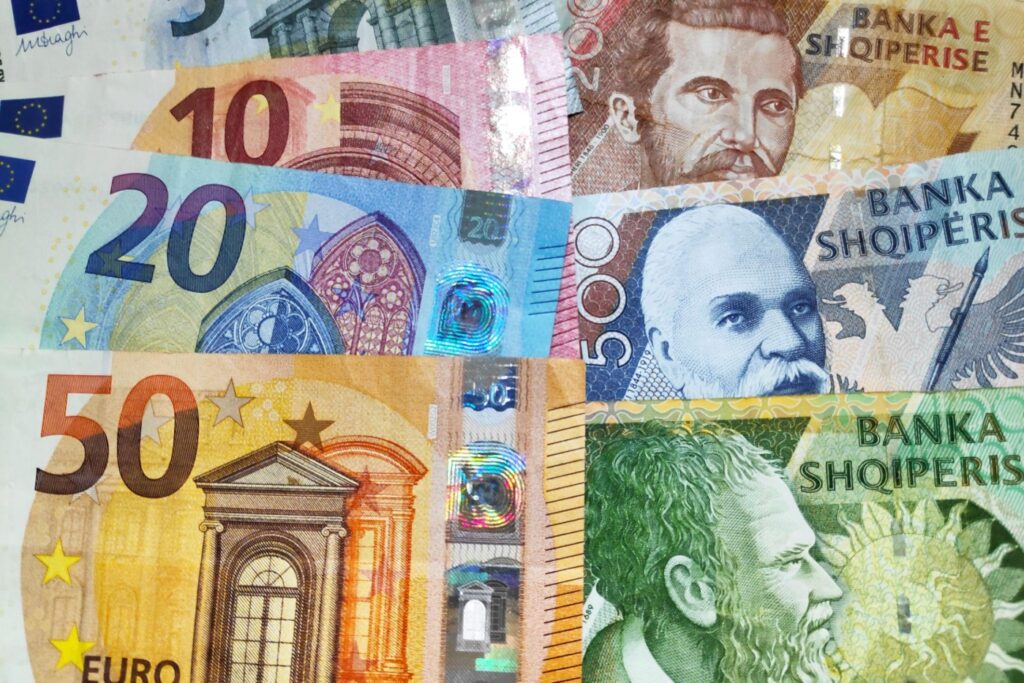
An old idea that has resurfaced many times but always faded away for one reason or another. Having Kosovo adopt the Albanian Lek instead of the Euro. It was brought up in 2010, 2014 and most recently publicly in 2021 when it was shot down as not plausible here.
I argue that now is the time to revisit it. It is the optimal moment and has to happen before Albania closes negotiations on Chapter 17 of the EU accession process, so the window is closing quickly. The price tag, from a simple back of the envelope, at least 4 billion dollars if not more. The source. Seigniorage. We’ll get to this a bit further down but first:
Why now? Two reasons.
Reason number one: The fiscal and monetary position of both countries, Albania and Kosovo, is quite stable. In fact, both central banks have enough foreign currency to cover the foreign denominated debt of each government, so the risk of speculative attacks is essentially zero. The Albanian Central Bank is in the process of purchasing more euros to slow down the appreciation of Albanian Lek. Inflation in Albania has been fairly stable and tracking similar paths to that of the Eurozone. Kosovo’s transition and adoption should be fairly costless and to the extent it has any adjustment period it will simply align more capital flows between the two countries. Most of Kosovo’s exports are to countries that don’t use the Euro. Albania, North Macedonia, Turkey, Switzerland and Serbia account for a clear majority of its export sector. It’s much riskier and probably not worth it for Kosovo to simply issue its own currency rather than adopt the Lek.
Reason number two: This is even more important. It’s an excellent bargaining chip in the EU accession process that Albania is speedily moving along on. Once negotiations are over, the legal framework makes this leverage unusable. One distinction needs care here. The seigniorage itself does not expire at accession — if the switch happens, its value survives joining the euro, and then some, as we will see below. What expires is the leverage. Once Chapter 17 closes, Albania locks itself out of making the move, and an option you are no longer permitted to exercise is worth exactly zero at the bargaining table. The asset is permanent; the window in which to be paid for it is not. The negotiations process so far seems to me to be a bit lop-sided. EU gives us some homework, and we do it. Great. We should do it well and quickly. But we also need to understand our own outside option better, and present it cleanly to the EU overlords, with all the math spelled out. For the EU bureaucrats, Kosovo adopting the Lek instead of the Euro, is a headache on two fronts. The first is an annoyance this might bring to Rama’s brother from another mother, Vucic. The second, in case it is successful, it could turn Kosovo into the example to follow for other Euro skeptics within the Eurozone. A likely stupid idea as elaborated here, and here, but the EU has its own disturbing share of populist currents that don’t do cold arithmetic so the risk is real.
Why only a smile might suffice?
Kosovo adopting the Lek doesn’t need to happen, for a payout to materialize. All we need is a smile between Rama and Kurti to make this idea, in the economics jargon, a credible threat. In the current environment, the EU bureaucrat sitting at the other side of the table will simply dismiss it as theatrics. But with a smile that breaks the ice between the two leaders, and a careful calculation by Dr. Delina Ibrahimaj, who seems to have been reluctantly dragged into pulling the numbers anyway for a related topic, it could become real leverage. And let there be no confusion: none of this is a conspiracy. It is the opposite of one. Doing it in the open is precisely what makes it credible. A back-room scheme can be dismissed because it can be denied; a joint press conference, a feasibility study published by the two central banks, and a draft law with a timetable cannot. Who knows, the EU bureaucrats might want to throw money at this to just make it go away and avoid the two aforementioned headaches. They do that a lot. Note that Brussels does not even need to match the number exactly. If the honest tally comes in at 3 billion, they are not paying for our seigniorage anyway; they are paying to keep Vucic calm and the euro-skeptics without a role model. Headaches are priced above arithmetic.
But we need to do the ROI calculation of such a strategy. The EU won’t do it for us. My bet is that the ROI on this smile, is even more obvious than the ROI of spending 4 million dollars for a Kanye West concert in Tirana, which from afar seems clearly worth the bang for the buck. The political risk, I don’t know. It’s not my area of expertise, but from a layman’s perspective it does not seem outside the range of political risk-taking appetite of the moment. I doubt it can be worse than having a mentally-unstable genius artist light up a conspiracy-laced cigarette next to a boulevard with dangerous levels of methane in it. I’m talking about Kanye not Rama.
Where does the windfall of 4 billion dollars come from?
Seigniorage. A windfall that would happen when the Central Banks of Kosovo and Albania purchase circulating Euros and convert the Euro deposits of Kosovo banks in the Central Bank of Kosovo into Lek. I would invite you to read Prof. Vjosa Hajdari’s doctorate dissertation and subsequent articles on an in-depth elaboration of this concept in the context of Kosovo. My back of the envelope says the tally — the euros circulating in Kosovo, plus the reserves Kosovo’s banks keep at their central bank — lands somewhere between 3 and 4 billion dollars, likely closer to the middle. But I am a patriot, so I cannot publish the low end of the range. Call it 4. I invite others to do the math properly. And I invite the government to make sure that “properly” also means “as large as defensibly possible.” Nobody ever opened a negotiation by rounding down.
And before an economist objects that the windfall evaporates the day we join the euro: it does not. Conversion is not redemption. When the deutschmark, the lira and the franc became euros, nobody handed back the assets of the Bundesbank, the Banca d’Italia or the Banque de France. The notes were exchanged; the balance sheets stayed. Better still, once inside, the ECB allocates euro banknotes — and the seigniorage that comes with them — according to its capital key, a formula weighted half by population. Run that formula for Albania and Kosovo and it hands us seigniorage on more cash than our citizens actually hold. Brussels’ own arithmetic is generous to countries like us. We should read their formulas more often.
What about the flamingos?
“Aha!” some will say, “This is just another smoke-screen, of that evil trickster of a prime minister, that has found a useful idiot in DC to flash dollar signs and distract us from overthrowing him. His end must be near! Albania is not for sale!!!”
Keler Marku, PhD, is an economist based in Washington, DC.