By Adriatik Doçi (Tirana)
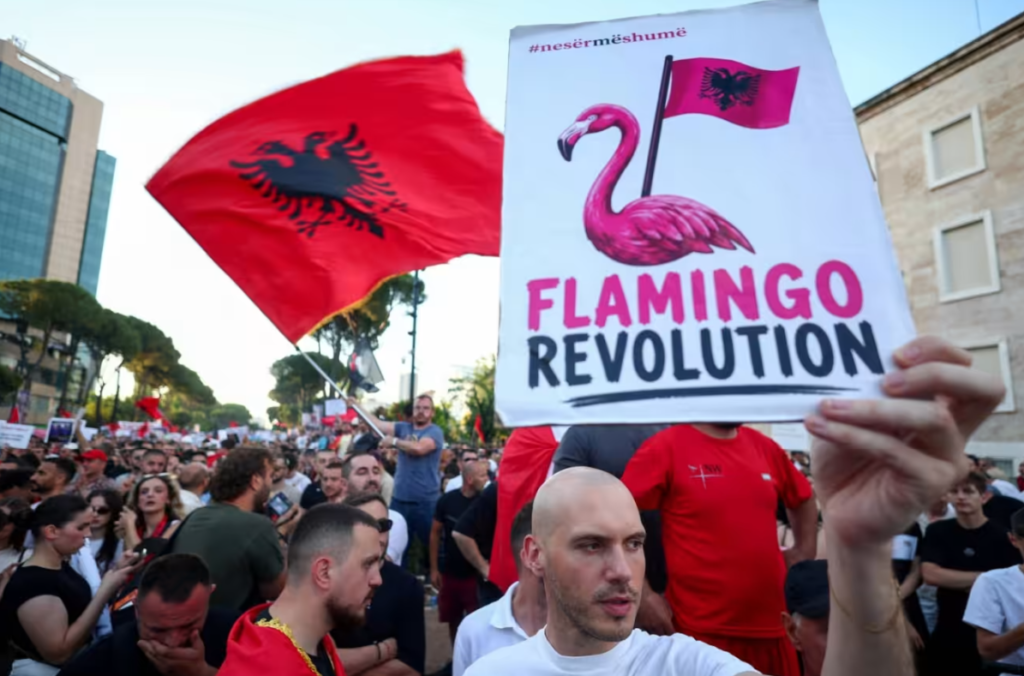
From a hurricane that shook the government and the political class as a whole, the “Flamingo” protest, in its fifth week, has ended up as an ordinary parade, settling into the contours of the Lapaj-Qori protests and the revolution Sali Berisha proclaimed 13 years ago.
So why did the so-called Flamingo Revolution burn out like a summer hit, a rainbow after the transition’s rain, dissolving into Berisha’s Revolution, the one that plundered and intimidated the justice system for as long as it could?
First, in the fourth and fifth weeks, the protest deviated into organized acts of violence, especially in front of Parliament, compromising its peaceful character. The attacks on MPs, journalists, and police have, I believe, led a segment of citizens to distance themselves from the protest.
Second, the prehistoric, utopian, and grotesque manifestos. Here I refer to Dritan Goxhaj’s manifesto based on the lot and the bullet, but also to Përparim Gjeka’s laughable platform for establishing parallel institutions via WhatsApp and on spiritual-literary criteria. These platforms gave the protest a character as comic as it was dangerous. The attempts to secretly establish a so-called National Citizens’ Assembly, based on Telegram and WhatsApp groups, added another dimension to the comic character.
Third, Sali Berisha’s infiltration into the protest, which in its first days he had labeled pathetic and a game of the government, compromised and shifted the vector of the “revolution” away from the political system it began against, redirecting it toward Edi Rama. Berisha’s capture and complete privatization of the protest has, I believe, smothered its nerve, driving away from the boulevard the gray stratum, the non-partisans, who were the heart of the protest.
Fourth, in the absence of intellectuals and figures who enjoy some measure of respect in public opinion, at the head of the protest emerged a handful of charlatans, characters distinguished for nothing useful in their lives, loudmouths, characters with pronounced criminal records, small fry, and the occasional journalist mired in conflicts of interest.
Fifth, instead of showcasing role models, middle-class families, pensioners, young people without prospects, farmers, and so on, the protest brought to the surface the social dregs: pedophiles, maniacs, arsonists, call-center boys, pickpockets, drug traffickers, prostitution managers, money launderers, fixers, fraudsters, escorts, stalkers, idlers, hooligans, dropouts, fortune tellers, women complaining their husbands left them, and so on.
Sixth, in a protest where the emphasis should have been on poverty, the opposition’s millionaires appeared strutting about, such as Gjin Gjoni or Agron Shehaj, former ministers notorious for corruption affairs, dismissed deputy ministers of this very government, bankers, corrupt former directors, and the NGO hustlers, who suck in and evaporate millions of euros in donations every year through fictitious reports.
Seventh, the Iranian backdrop emerged as an undeniable reality in the protest. One of the protest’s protagonists, Dritan Goxhaj, author of the manifesto for a system of governance based on the bullet and the lot, and the first to read out the demands in the protest’s name, is a declared supporter of Hamas. Ikballe Berisha-Haduti, declared non grata, who appeared at the protest, has consistently expressed harsh positions toward the United States. She is among the rare individuals photographed with Iran’s former president, Mahmoud Ahmadinejad. When American forces killed the Iranian general Qasem Soleimani, she called the United States a criminal state.
Eighth, the protest also displayed an antisemitic spirit. There was a campaign on social networks against Israel, largely disinformation, claiming Zvërnec had been sold to Israel, that Palestinians would be brought there, and so on, which culminated in the removal of the flag placed on the premises of the Israeli Embassy in Tirana. These fascist atavisms have, I believe, damaged the protest and contributed to its fading.
Ninth, the repulsive and primitive funereal symbolism displayed at the July 4 protest changed the image of the protest’s first weeks as artistic, with creative slogans and fine notes of humor. The funereal symbolism of July 4 may have brought to many minds the coup d’état of September 14, 1998.
Tenth, the bloggers and influencers cannot be considered a natural added value to the protest. Not only because some of them take Skanderbeg for a clothing brand, did not recognize the President, or hold books upside down. Rather, they saw the protest as a trend, a summer hit, and an opportunity to maximize followers on their social media accounts. Today, when Berisha’s own core takes to the square, they have returned to their usual advertising of creams.
Adriatik Doçi is an Albanian investigative journalist known for his reporting on justice-system corruption and his long-running investigative coverage of Sali Berisha and Ilir Meta. A columnist for Shqiptarja.com and contributor to Report Tv, he was assaulted near his home in 2022 in an attack he attributed to organized crime, drawing public support from the US Embassy in Tirana. He remains one of the most combative and contested voices in Albanian journalism.