What a former foreign minister’s photograph in Beijing says, and what it carefully does not
By Ardit Rada | Tirana Examiner
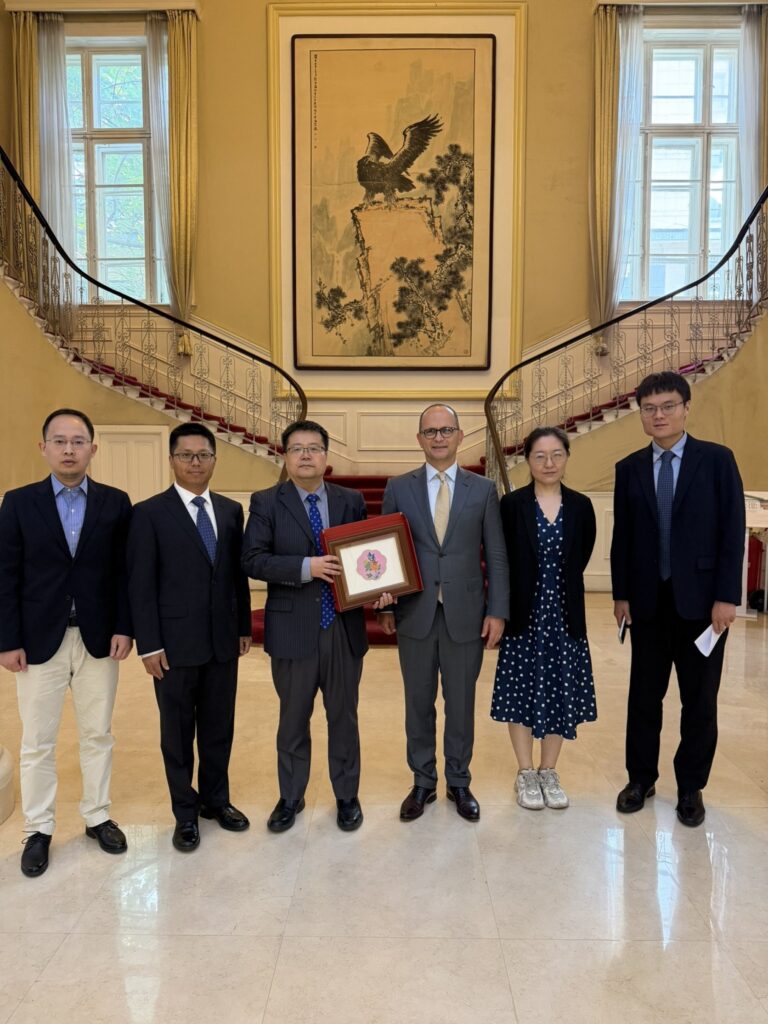
There is a photograph from Beijing, posted on July 3, in which Ditmir Bushati is smiling. Beside him stands Yan Xuetong, honorary dean of the Institute of International Relations at Tsinghua University and the most influential theorist of China’s rise now working. Between them is a book: Ancient Chinese Thought, Modern Chinese Power, Yan’s own volume. A former foreign minister of a NATO member state holding, for the camera, the foundational text of the leading Chinese realist theory of national rejuvenation.
Bushati’s caption was brief. In the margins of the World Peace Forum, he wrote, he had exchanged views on the main challenges facing the world order with “distinguished Prof. Yan Xuetong and leadership of Chinese Institute for International Studies.”
It is worth taking each element of that sentence seriously, because each one names something specific.
The forum, in its own words
The World Peace Forum is routinely described, including by its organizers, as China’s leading non-governmental platform for international security dialogue. The description deserves scrutiny on its own terms. The forum’s fourteenth edition, held in early July at Tsinghua University under the theme of global governance and international security cooperation, gathered more than four hundred participants from over eighty countries. Its opening ceremony on July 3, the day of Bushati’s post, featured a keynote address by Han Zheng, the Vice President of the People’s Republic of China. Non-governmental forums do not usually open with the second-ranking figure of a state’s executive.
The forum is jointly organized by Tsinghua University and the Chinese People’s Institute of Foreign Affairs. The latter body was founded in 1949 at the initiative of Premier Zhou Enlai as an instrument of what Beijing calls people’s diplomacy. It operates under the guidance of the Communist Party of China, and it describes its own vocation, without embarrassment, as making friends for the country. This is not a hidden affiliation uncovered by investigation. It is the institution’s mission statement.
None of this makes the World Peace Forum a trap or its attendees agents. It makes the forum what it is: an interface where the party-state engages foreign elites in a register soft enough to be deniable and structured enough to be useful. Whether the platform serves Beijing’s purposes is not the question. The question is what the attendee’s presence is worth, and to whom.
The institution he named
Which brings us to the second half of Bushati’s sentence.
The Chinese Institute for International Studies is not a university department and not a civil society organization. The China Institute of International Studies, CIIS, is a research institution directly administered by the Ministry of Foreign Affairs of the People’s Republic of China. Its presidency is conventionally held by retired senior ambassadors. Since 2020 it has housed the Xi Jinping Thought on Diplomacy Studies Center. It is, functionally, the analytical arm of the Chinese foreign ministry, and diplomats in Beijing treat it as such: a channel for signaling ministry positions in a semi-official register when formal channels are constrained. The Tirana Examiner has confirmed that this is the institution whose leadership Bushati met.
One further detail matters for readers in this region. CIIS hosts the China-Central and Eastern European Countries Global Partnership Center and administers the China-CEEC Think Tanks Network, the successor scaffolding of the cooperation format once known as 14+1, of which Albania was a member. The MFA organ whose leadership received Albania’s former foreign minister is the same organ tasked, institutionally and by name, with cultivating Central and Eastern Europe.
So the sentence in the tweet, read precisely, says this: on the margins of a forum opened by China’s Vice President and co-organized by a party-guided friendship body, a former Albanian foreign minister exchanged views on the world order with the foreign ministry’s own think tank, the one that houses Beijing’s dedicated engagement center for his region.
The itinerary
The Beijing appearance did not interrupt anything. It sits inside an itinerary Bushati himself has documented.
Through June he built a visible identity as the movement’s interpreter for Western audiences: in the Guardian on June 22, describing a leaderless civic revolt; in Euractiv four days later, arguing that the streets were demanding European standards from the bottom up; on his own feed, day after day, declaring a new Albania inevitable.
On July 3 he was in Beijing, in the photograph.
By July 4 he was back on familiar ground: Albanians deserve accountability, justice, prosperity. Albania deserves better.
Set out in sequence, the itinerary reads as a single performance across four stages: Harvard, the Guardian, Euractiv, Tsinghua.
The Beijing stop is not a deviation from the reformist persona; it is one of its venues. Bushati fits the profile Beijing has long sought to engage: credentialed former ministers with Western institutional standing, continued public relevance, and freedom from the constraints of current office. The forum acquires a European reformist face for its family photograph. The visitor acquires a world-stage backdrop for his. Nothing improper needs to be said by anyone for the exchange to clear.
What the record does and does not show
Fairness requires stating plainly what this record does not establish. Attending the World Peace Forum is not improper. Former Western officials, scholars, and diplomats pass through it every year, and engaging Chinese counterparts in structured dialogue is a legitimate, arguably necessary, part of international life. Bushati traveled as a private scholar, a fellow at Harvard, not as a representative of the Albanian state, and his stated subject, the challenges facing the world order, is exactly what such forums exist to discuss. No rule was broken, and this newspaper does not suggest otherwise.
Nor is this a story about Albania’s protest movement. The movement Bushati praises is genuine, plural, and larger than any of its interpreters, and nothing about one supportive former minister’s travel schedule attaches to it.
What the record does establish is narrower and harder. A man who spent June asserting moral authority over Albania’s democratic future, in the vocabulary of European standards and accountability, spent July 3 appearing at a forum designed as an instrument of Chinese state engagement, and meeting the leadership of the regional cultivation apparatus of a foreign ministry whose government maintains one of Serbia’s closest strategic partnerships. He then resumed the June vocabulary within twenty-four hours, as though Beijing were a neutral layover between Cambridge and the protest square.
There is also the matter of the mirror. Bushati’s July 6 observation, that Albania and Serbia are alone in the region in being led by transition-era figures, is a striking sentence from a man who served as foreign minister of one of those countries for six years. He is not an outsider describing the transition. He is one of its senior products, critiquing it from a fellowship abroad while conducting a parallel diplomacy of his own, one whose stops he announces but whose purposes he does not explain.
The question in the margins
Bushati chose his preposition carefully. Everything happened, he wrote, in the margins of the forum. It is an honest word. The margins are where such forums do their real work: not in the plenary speeches, which are for the cameras, but in the exchanges beside them, where standing is traded quietly and photographs are the receipts.
The question his itinerary leaves open is not whether he did anything wrong. It is simpler and more uncomfortable. When a former foreign minister between posts speaks of the world order in Beijing, whose order is under discussion, and whose voice does he believe he is lending? The photograph shows him holding the answer one theorist gave. His own, so far, remains in the margins.
Ardit Rada is a staff analytical reporter for the Tirana Examiner.