by Aurel Cara (Tirana)
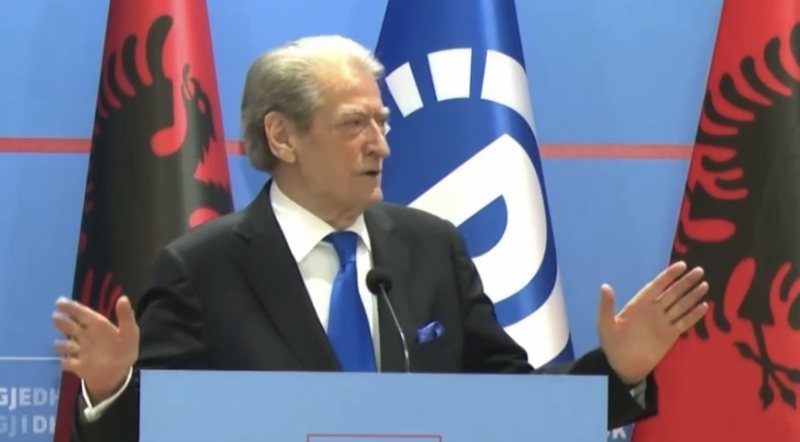
The body that ruled on who could challenge Sali Berisha for the chairmanship of the Democratic Party is a body whose composition is determined by Sali Berisha. This is not a procedural detail of secondary order. It is the determinative fact about what the 23 May ballot certified.
Five potential candidates filed for the chairmanship. Five were disqualified by the party’s Election Commission before the ballots were printed. The justification offered by the party’s communications director, Alfred Lela, was that the disqualified candidates did not meet the criterion of “high political profile” required for the chairmanship. This phrase appears nowhere in the public text of the Democratic Party Statute. The Statute and its Internal Regulation specify candidacy criteria for parliamentary and municipal candidates in considerable detail (education, integrity, lawfulness of assets, conduct under the communist regime, absence of criminal record); they do not contain a free-standing test of political profile enforceable against candidates for chairman. A member of the National Council, Myslim Murrizi, stated this plainly: exclusion is not a category the Statute provides for at all.
A commission whose membership is determined by the leadership being challenged ruled five challengers ineligible on a criterion that is not in the Statute. The chairman was then placed on a ballot with no other name. The result, on Saturday evening, was 37,341 votes in favor, 1,055 against, and 506 abstentions, on a total of 39,441 ballots cast. The chair of the electoral commission, Albana Vokshi, described the process as transparent, orderly, and marked by massive participation. The chairman, in his statement afterward, called it a massive vote of confidence and projected from it to the next general election.
This is the architecture in its simplest form. To see why it matters, the ballot of 23 May has to be set against two prior Statute operations that produced the conditions for it.
The first operation predates the 23 May reconfirmation by a full year. The Democratic Party Statute requires the chairman of the party to resign following a defeat in general elections. The party lost the parliamentary elections of May 2025. The chairman did not resign. Asked to account for this, he replied that the elections had not been lost but stolen. That answer is a political position; it is not a statutory mechanism. The Statute provides for the verdict of the Central Election Commission and the courts, not for the chairman’s own characterization of the result. The 23 May ballot, by the plain reading of the document the party invokes when it suits it, was a ballot for the reconfirmation of a chairman whose position was no longer his to hold.
The second operation is the candidacy-criteria question itself. The Statute did not specify “high political profile” as a candidacy test. The Election Commission enforced it as one. The Statute was, in that act, amended by interpretation rather than by the procedures the Statute itself provides for amendment.
The third operation is the one with which this piece opened, and which the first two make legible: the commission that performed the second operation, and that adjudicates appeals from it, is a body whose composition is determined by the figure the second operation was designed to protect. The DP Statute does provide a route for contesting Election Commission rulings, through the party court, which exhausts the administrative remedy before judicial review becomes available. This is the route Berisha himself invoked when defending the disqualifications. What the route does not address is that the party court’s composition is determined by the same structures that determine the Election Commission’s. The Statute provides a remedy; it does not provide an independent remedy. A challenger asked to exhaust the party’s internal procedures before seeking judicial relief is a challenger asked to exhaust procedures whose outcome is structurally predetermined.
Read in sequence, the three operations produce a closed system. The chairman who should have resigned under the Statute does not resign. The Statute is then amended by interpretation to exclude the challengers who would have run against him. The commission that performs the amendment, and the court that hears the appeals from it, are bodies whose composition the chairman determines. None of this is hidden. It is all observable on the public record of the past two weeks. The Institute of Political Studies, examining the history of DP leadership selections from 1991, has characterized the current Democratic Party as a “leader-party” in which the individual leader has acquired more weight than the principles of competitive democracy on which the party was founded. The verdict is not contested by the party’s own conduct on 23 May; it is confirmed by it.
The numerical contest that occupied the Albanian press on Saturday evening, with Ervin Salianji asserting 3,885 voters by 18:00 against Vokshi’s claim of more than 28,000, is a real factual dispute that neither figure has been independently audited to resolve. The transparency obligation under which the discrepancy could have been resolved sits with the same KOKOE that issued the disqualifications. The dispute is therefore not external to the procedural question; it is a further instance of it.
On 30 May, an extraordinary Congress will convene under the banner of modernization, renewal, and digitization. The chairman it will modernize the party around has led the Democratic Party, with interruptions, since 1990.
What the 23 May ballot certified was a result. What it did not certify was a contest. The reader of the result is left with the question of which of those two things the Democratic Party’s chairmanship is now meant to be.