Editorial Board | Tirana Examiner
The Secretary General ended the speculation in Ankara. The real uncertainty was never Albania’s ability to host, but whether NATO will continue holding annual summits at all.
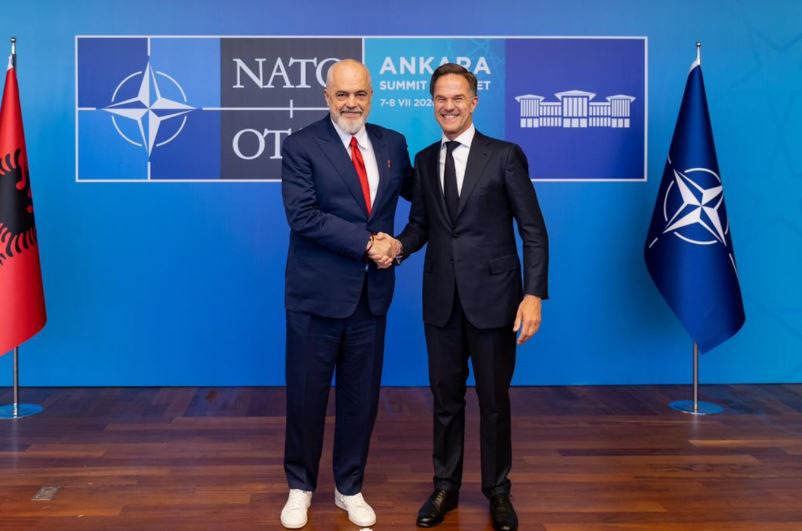
The question was answered in Ankara, in the plainest language the Alliance’s Secretary General could manage. “The next Summit will indeed be in Albania. That was the decision in The Hague,” Mark Rutte told reporters at the close of the 2026 NATO Summit. The timing remains to be fixed. The destination does not. After forty-eight hours of avoidable suspense, the record now reads as it read thirteen months ago, when the leaders of thirty-two nations put it in writing at The Hague: Türkiye, then Albania.
It is worth pausing on how that suspense was built, because the construction tells us more about the coverage than about the country.
The uncertainty had two legitimate sources, and neither of them was Albanian. The first was reported by Reuters in late April: six sources — a senior European official and five member-state diplomats — described an internal debate over whether NATO should abandon annual summits altogether, in significant part to ration the Alliance’s exposure to a US president who has spent a decade turning its gatherings into spectacle. One diplomat suggested the Albania summit would slide to autumn 2027, with no summit at all in 2028, the American election year. The second source was reported by Bloomberg on the morning of July 8: the cadence discussion had picked up steam in Ankara, driven by the wish to reduce tensions with Washington and to avoid drawing a spotlight to any host’s spending figures.
Read those dispatches carefully. They describe an alliance redesigning its institutional rhythm around the temperament of one man. They describe a scheduling debate conducted in Brussels and Washington, about Brussels and Washington. What they do not describe — in any sourced sentence, from any of the diplomats and officials who actually spoke to reporters — is Albania’s domestic politics.
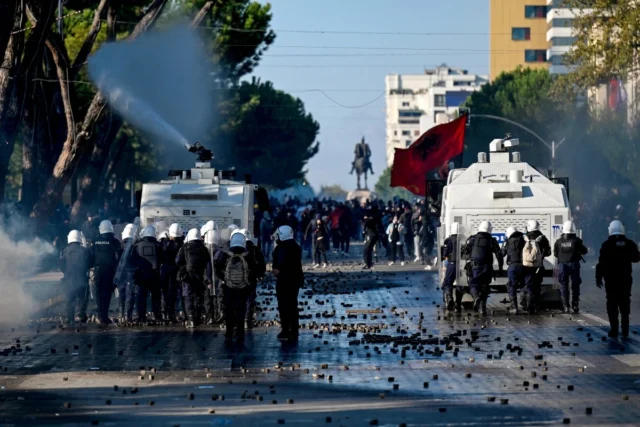
And yet, by the time the story reached certain analytical columns and secondary coverage, a third ingredient had been stirred in: the protests in Tirana. The suggestion, sometimes insinuated and sometimes stated outright, was that Albania’s protest cycle cast doubt on the country’s fitness to host, that the streets of the capital had become a security variable in NATO’s calendar. No Reuters source said this. No Bloomberg source said this. The Ankara Declaration said nothing of the kind. The protest linkage entered the story not through reporting but through editorial grafting — an unsourced inference dressed in the borrowed authority of two wire investigations that never made it.
This is the move that deserves to be named. Spain spent the summit being denounced from the podium by the American president as a “terrible partner.” Czechia and Slovenia sat alongside Albania below the two-percent line in 2025. No one proposed that Madrid’s political turbulence or Prague’s coalition disputes disqualified those capitals from Alliance life. Only in Albania’s case was a domestic protest movement — a constitutional exercise of assembly, whatever one thinks of its politics — converted into an argument about national reliability. That conversion served a narrative, not a fact pattern. It recast an alliance-internal problem of summit fatigue and presidential management as an Albanian problem of stability, and it did so at precisely the moment Albania’s confirmation hung in public view.
The facts, meanwhile, moved in the opposite direction. Albania crossed the two-percent threshold, with 2026 defence spending projected at roughly 2.12 percent of GDP and, under the government’s current fiscal plan, measures in preparation to reach 2.6 percent. Foreign Minister Ferit Hoxha was in Ankara when the reaffirmation came. The Secretary General removed the ambiguity himself, on camera, unprompted by any Albanian pleading.
What remains open is a date, and the date is not Albania’s to give. If the Alliance meets in Tirana in the autumn of 2027, it will be because thirty-two governments decided the format still serves them. If the summit calendar stretches, it will be for reasons that have nothing to do with any banner carried through Skanderbeg Square.
The question was never whether Tirana could host the Alliance. The question — still unanswered in Ankara — is whether the Alliance still knows how to meet. That is a story worth reporting. It is not a story about Albania.