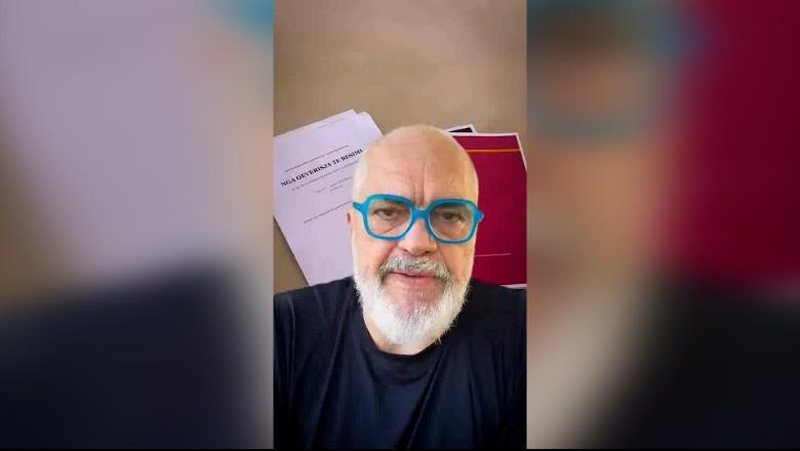
Prime Minister Edi Rama used his weekly podcast to address several policy and governance matters: the June normative budget act and its package of citizen support measures, the ongoing boulevard protests and the government’s engagement with genuine grievances, the Zvërnec and Sazan investment projects and the role of the European Commission as guarantor, a visit to Bochum for the Ruhr Summit on technology, a bilateral meeting with the Minister-President of North Rhine-Westphalia, a Deutsche Welle interview on the Zvërnec controversy, and a new phase in the development of Albania’s Armed Forces including the Fincantieri partnership expansion and the opening of the National Flight School. Below is an edited transcript of the weekly address, reconstructed and condensed for clarity from the original recording.
The headline of the week was, without question, the June normative act, where once again the economy, which is growing beyond projections and bringing in revenues beyond projections, gave us the possibility of coming forward with a series of measures in direct service of people and in respect of all those who, entirely rightly, ask for even more from the government and from society through the government.
We approved a bonus for pensioners. A reminder here, because some things need to be recalled from time to time, even as memory grows ever shorter and ever more people do not want to know where things are coming from. Churchill put it well when he said that those who forget where they are coming from have no idea where they are going. The reminder is this: last year it was said that the spring bonus for pensioners, which followed the same logic, namely the growth of the economy and the principle that when the economy grows and we manage to fulfil what we have projected and something remains, that remainder must be shared with those who need it most, and pensioners are first among them, was being done for electoral purposes. It was not. We have no election campaign. The next election campaign is in 2029. And so pensioners received another bonus, into which went every single cent gained from the unnatural rise in the price of fuel as a result of the war crisis between the United States, Israel, and Iran, and what happened in the Strait of Hormuz.
We did not put a single cent that came in additionally from taxes on fuel into the budget. We gave it all to pensioners. We also made available 15 million euros more for the medications of cancer patients, and we approved the raise in the salaries of emergency physicians, true heroes. We approved the increase of the sovereign guarantee for the national programme of doubling enterprises, which begins shortly. We approved the doubling of support for persons with disabilities. We approved the doubling of support for children with special needs. I recall that last year, following a mistake I made for which I apologised, the issue of autistic children became a matter of public debate. I committed during that period to doubling the support for them, and we did it. Just as we also gave carers of persons with disabilities and of children with special needs a level of support they had been asking for for some time, not counting the other portions that went toward rural and urban development.
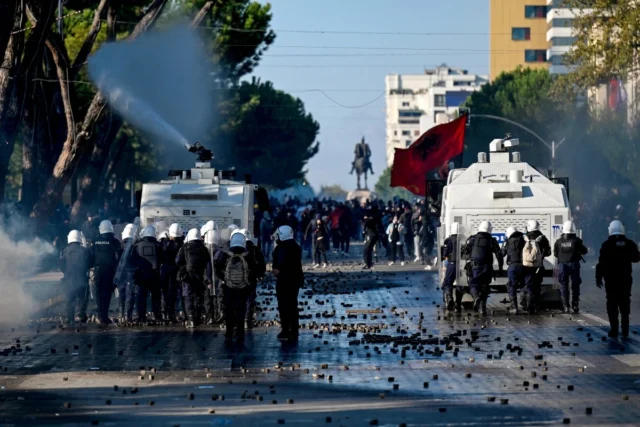
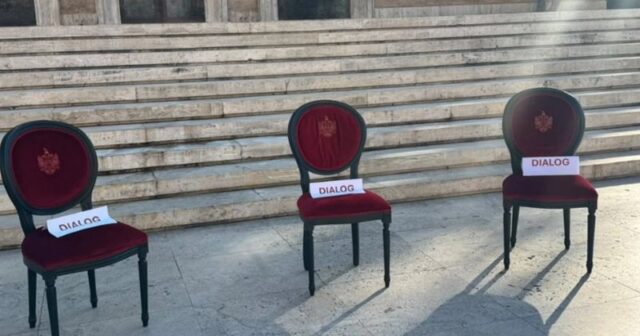
I am paying close attention, and an entire team is listening with great care to everything that needs to be heard from the boulevard protest, which has two layers: the flowing water of all those who came out sincerely and who are sincerely concerned or who have real grievances, and the black crust of all the failed and resentful figures who have arrived from every walk of life, who have created a convulsive situation in which the unavoidable elements of violence have also appeared, as always happens in these cases, because when you follow Berisha you end up in front of a wall.
Zvërnec is private land. Sazan is public land, where we have not yet concluded an agreement, because we are negotiating the partnership and the state, which will always remain the owner of the land, will need, for the agreement to be realised, to be a partner in the enterprise. There has been no sale of public land. And as for everything connected to protected areas, to Chapter 27, to how committed we are, or whether we would sacrifice even EU membership itself to do the project: this is simply not a logical question. Anyone who has a clear understanding of the fact that I am here to lead Albania toward EU membership, that we have a very strong popular mandate to realise this historic mission, and that this historic mission is not comparable or equivalent to anything, understands very clearly that there is no chance Albania will take steps or pursue developments that fall outside the standards and criteria of the European Union. In the specific case, the guarantee for all those who are concerned is precisely the European Commission, which has been continuously briefed on the facts to date and has no sense of alarm whatsoever, because it is very clear that the entire process will take place in harmony with the monitoring process of the European Commission.
Another moment worth noting from the week was the visit to Bochum in Germany, at the invitation of the organisers of the Ruhr Summit, the international technology summit, where I was invited to present the transformations we have made in Albania through digitalisation and the way we have modernised and are continuing to modernise governance through digitalisation and, most recently, through the introduction of artificial intelligence. Another moment during that visit was the meeting with the Minister-President of the Land, Hendrik Wüst, one of the most distinguished figures of German political life, and a friend interested in developments in Albania and in the pace of the Western Balkans accession process, with whom we spoke both about Germany’s support for the closing of negotiation chapters and about expanding the bilateral relationship with Germany through relationships at the regional level.
But without doubt the most memorable moment of that visit was the unexpected one: the interview with the journalist from the international section of Deutsche Welle, where to be honest I was surprised by the degree to which journalism had swallowed entirely the broth of untruths surrounding Zvërnec and the relationship between the government and the company represented by Jared Kushner, without realising she belonged to the broad camp of all those who have turned Albania into an arena for fighting their own battle against Trump, whether in America, whether in Australia, whether in Europe.
I was confronted with assertions of the type: how can you justify the sale of public land, which has not happened and has no reason to happen. Zvërnec is private land. Sazan is public land where we have not yet concluded an agreement, because we are negotiating the partnership. And as for the rest, the part connected to protected areas and Chapter 27 and our commitments, or whether we are willing to sacrifice even EU membership for the project: this is simply illogical. Anyone who understands clearly the fact that I am here to lead Albania toward EU membership understands that there is no chance Albania will take steps that conflict with the standards and criteria of the European Union.
We have entered a new phase in the history of the Armed Forces. The new chapter is not only the strengthening of the entire defence system but the rebirth of our defence industry. A series of steps have been taken toward this, and this week another step was taken. The partnership with Fincantieri was extended to include a partnership with the Industrial School Pavarësia in Vlora, because the new production base at the new Pashaliman shipyard will need around 500 young engineers, technicians, and IT specialists, and for this reason this agreement was reached. Work on training the young men and women who will be selected by Fincantieri Albania will begin in parallel with the construction of the shipyard. They will be trained both at Pashaliman and at the parent shipyard of this global Italian company of excellence on the shores of Italy.
Another significant moment was the opening of the doors of the National Flight School. Albania is entering a new phase with its air forces, becoming a platform for the training and certification of pilots for the armed forces. This partnership involves Elbit Systems from Israel, and our own state company KAIO, which has now become a hub of transformative developments in our defence industry, the rebirth of which continues.