By Ardit Rada (Tirana)
“It is no accident that the Zvërnec issue has drawn attention even at the highest levels of the European Union. This shows that the problem is not simply an isolated project, but a model of governance that has raised serious questions about the rule of law, the protection of property, and transparency.”
— Jorida Tabaku, in the name of the Democratic Party
Some investments are too small to carry geopolitics. The development planned for Sazan and Zvërnec is not one of them. A former military island and a stretch of protected coastline, a valuation in the billions, the firm of Jared Kushner alongside Qatari capital, the name of a sitting American president’s daughter attached to the brochure. Whatever else this project is, it is a place where the interests of Washington and the anxieties of Brussels meet on Albanian ground. A European who forms a view on it is not commenting on a resort. He is taking a position in a contest between allies. That is exactly why the view, if it is held, should be stated openly, by someone willing to sign it.
It has not been. What the Albanian public received instead was the statement above, issued this week in the name of the Democratic Party by Jorida Tabaku. In the original Albanian, the phrase she reaches for is nivelet më të larta të Bashkimit Europian, the highest levels of the European Union.
Read the two sentences again, because the whole maneuver is in the seam between them. The first reports a fact about Europe. The second converts that fact into a verdict about Albania. The first claims that Brussels, at its summit, is paying attention. The second concludes that the attention proves a governing model failing on the rule of law, on property, on transparency. And between the two there is nothing: no institution named, no official quoted, no document cited. The construction is by now familiar. Europe is invoked and never quoted. The concern is reported and never sourced. The only person on the record is Tabaku herself.
There is no reason to doubt that someone speaks to Tabaku. She says so herself, and often. She has described being in constant contact with international representatives, and has cast her own role as the one who makes citizens aware of what those representatives think. She travels to Berlin and Brussels with a regularity that few in Albanian politics can match, and she is the Democratic Party’s recognized interlocutor with the German Bundestag and the European People’s Party. People in those rooms talk to her. That much is not in question.
Two things are. The first is whether the people who talk to her are the highest levels of the European Union, the phrase she reaches for. The second, and the more important, is whether any of them ever decided that Jorida Tabaku should be their voice in Albania. These are different claims, and she conflates them. Being spoken to is not the same as being deputized. A member of parliament who hears a concern in a meeting in Berlin has heard a concern. She has not been handed a mandate to announce it to her country as the settled judgment of Europe.
Because here is what the highest levels actually do when they have something to say about Albania. They say it, in their own name, on the record. The European Parliament debated this country and adopted a resolution, by 502 votes to 120, that welcomed Albania’s progress and located its European commitment in a cross-party consensus, the government and the opposition together. The Commission publishes its report each autumn under its own seal. The Union keeps a delegation in Tirana with an ambassador who speaks on camera. This past week the President of the Commission sat at the summit in Tivat and said, for attribution, that Albania remains on course to close its chapters by 2027. None of these institutions is mute. None of them needs an Albanian opposition deputy to carry its meaning home. When they wish to warn, they warn, and they put a name and a letterhead to it.
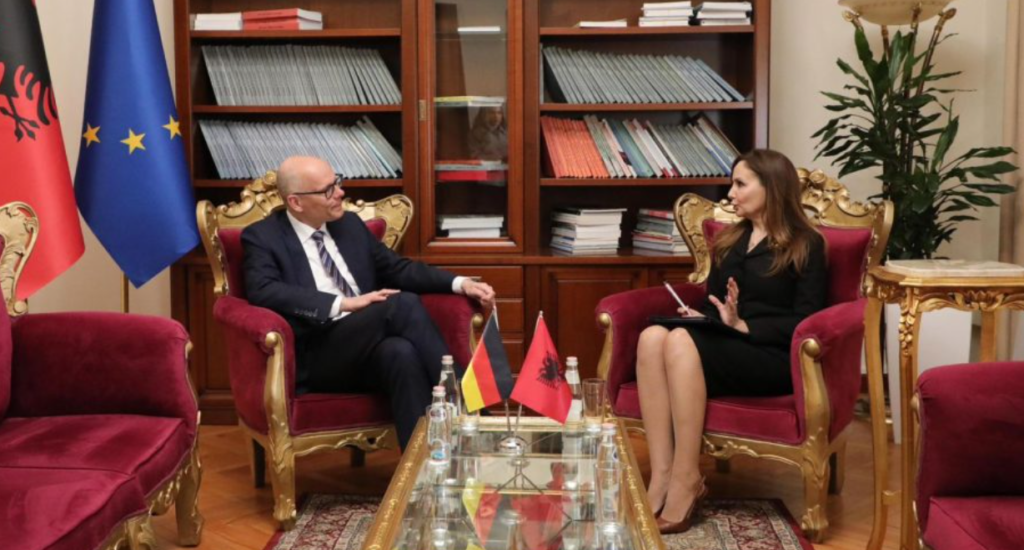
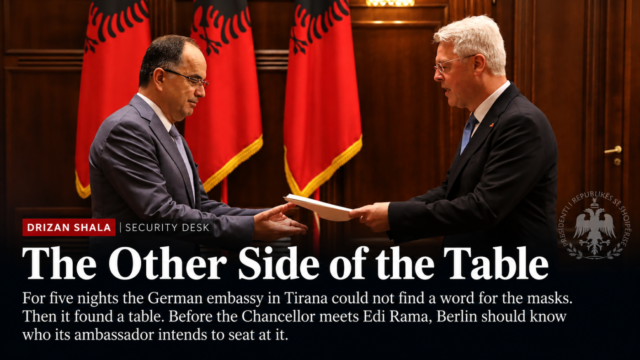
So if there is a European concern about the Kushner investment serious enough to justify the language Tabaku uses, the concern has an author, and the author is hiding. This is the part worth saying plainly. If it is the German embassy in Tirana that holds this view, let the embassy state it. If it is Peter Beyer in Berlin, the Bundestag’s rapporteur on the Western Balkans for more than a decade, chief rapporteur for Albania in his parliamentary group, and a former coordinator of his government’s transatlantic relations, a man whose every title places him precisely on the fault line this project runs along, then let Beyer say it under his own name, in the Bundestag or in a German newspaper, where his words can be weighed and where he can be held to them. If it is someone else of standing, let that person come forward. What none of them should do is form the view in private and let an Albanian member of parliament present it to the Albanian public as the voice of Europe, deniable at both ends.
The objection that this is how diplomacy works, quietly, through trusted intermediaries, does not survive the nature of what is at stake. A quiet word about a technical reform is one thing. A campaign against a billion-euro investment tied to the family of the American president is another. That is a transatlantic act with consequences for the relationship between Europe and the United States, and an act of that weight cannot be both real enough to shape Albanian politics and deniable enough that no European official has to own it. If a European government or parliamentarian believes this investment endangers the rule of law in a candidate state, that is a legitimate position, and the way to hold it is openly, accountable to one’s own electorate and to the ally one is, in effect, opposing. The way not to hold it is through a cutout in Tirana.
There is an irony in this that the protagonists should feel. The standard Europe demands of Albania, in report after report, is transparency. Decisions in the open. Authors who sign their work. Influence that can be traced and answered. A European concern delivered through an unnamed channel, inflated by a domestic proxy into the judgment of the highest levels, and sourced to no one, is a violation of exactly the principle the Union came to Albania to teach. It asks the country to meet a standard its own messengers decline to keep.
Jorida Tabaku may believe she is doing Europe’s work. She is not authorized to. The highest levels of the European Union have voices, delegations, reports, and a parliament that votes by the hundred, and when they want Albania to hear something they have never once needed her to say it for them. If someone lower than those levels is using her, the remedy is simple and it belongs to that person, not to her. Step into the light. Sign the concern. A European position worth holding is worth a European name. Until one appears, what Tabaku carries through Tirana is not the voice of Europe. It is an unsigned message, and an unsigned message in matters this grave is not diplomacy. It is evasion.