Albatros Rexhaj
Germany knows who Alexander Dugin is. It knows better than anyone in Europe. Last December the Foreign Office called in the Russian ambassador and said, on the record, that Russia had run an operation against the Bundestag election. It named the people who did it: the Center for Geopolitical Expertise, founded by Dugin, and Malofeyev’s Double-Headed Eagle, with the GRU behind both. The BND and the Verfassungsschutz signed that finding. The government wrote it to parliament twice this year. The Americans had sanctioned Dugin’s Center a year before, the EU in July 2025, the British in December. Two weeks ago the head of the BND told the Bundestag that Russia is waging a shadow war on Germany. A week ago the Interior Minister said the aim of that war is to break Germany from within.
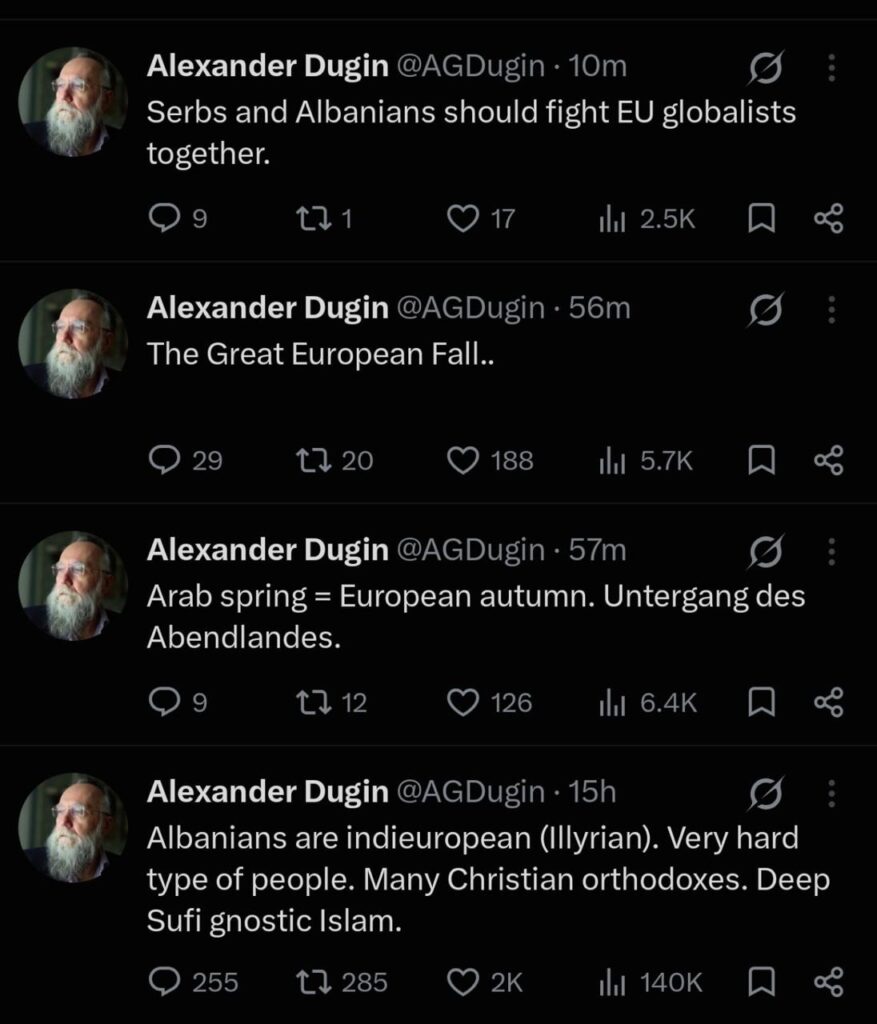
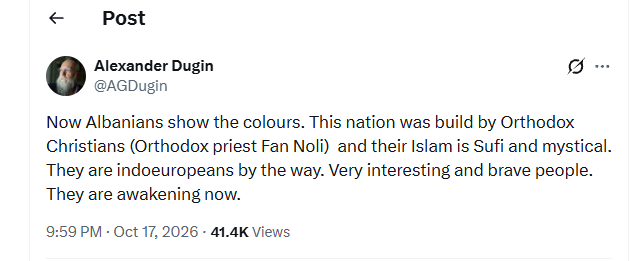
So when Dugin wrote on Saturday night, while Albania’s High Court was on fire, that the Albanians are awakening, Germany did not need anyone to explain who was speaking.
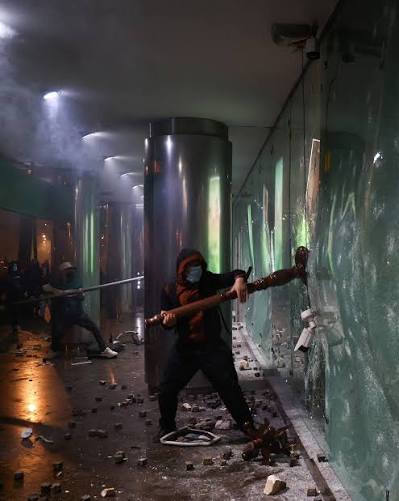
Tuesday, the Ministry of Education attacked. Wednesday, the Ministry of Justice burning. Saturday, the High Court firebombed, the Bank of Albania hit with iron bars and petrol, a private bank set alight, shops on the boulevard looted. A drone with explosives stopped on its way to the Prime Minister’s office. Thirty-seven policemen in hospital. Then Dugin’s post. Then, on Sunday, Maria Zakharova telling Edi Rama to solve his own problems and stop blaming others (“Sami rešavajte svoje unutrašnje probleme”). Then Dugin on Monday, on what kind of people the Albanians are. Then Dugin on Tuesday morning: Serbs and Albanians should fight the EU together.
Anyone who has watched Moscow work knows what happened in those three days. Dugin spoke first. On Saturday night, with the court burning, he claimed the street: the Albanians are awakening. On Sunday Zakharova spoke, and she did not answer Dugin; she answered Rama. No foreign hand, your own citizens, solve it yourselves. She did not retract a word of what the man in Germany’s file had written the night before, and she was not meant to. Then Dugin spoke again, on Monday about what kind of people Albanians are, on Tuesday about whose side they should take. The denial sits between two claims and covers neither. Zakharova is the state, and the state says there is no Russian hand. Dugin is the idea, and the idea says this street is ours. They do not contradict each other. One clears the ground, the other builds on it, and the gap between them is where Moscow lives. Germany knows this. It is the exact pattern its own services described in December: the Russian state denying what its instruments do, while the instruments do it.
And what did Germany do, when the pattern it had described turned up in a NATO ally, signature included?
On Thursday, with three ministries burned, the Foreign Office spokesman in Berlin was asked about Albania. The same man who had named Dugin’s organisation in December. He said rule of law and the fight against corruption are tasks the Albanian government must fulfil, and the population demands the same. Not a word about the fires. Sali Berisha thanked him the next day.
The embassy in Tirana reposted one EU statement about police proportionality. That is all. In March, when an opposition protest burned a villa, this embassy posted within a day that protest can never justify violence. Three weeks later, when six policemen were hurt, it demanded that the parties responsible distance themselves. Thirty-seven policemen in October, a court on fire, a drone, and nothing. Not one sentence about the men in masks.
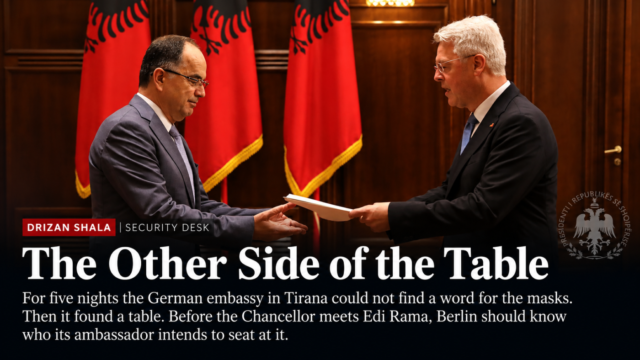
Everyone in Tirana knows this and nobody in Berlin has been told it. For a year the German embassy has been known in this city as the embassy that wants Edi Rama gone. I did not invent this and neither did Rama. Former ministers say it over dinner, after buying their way into rooms in Berlin and coming home to speak in Germany’s name. The portals print it. Other embassies repeat it. The masked men on the boulevard believe it, and it is why they believe a great power stands behind them. The ambassador was told, through official channels, that this belief exists, that it is hardening, and that it is dangerous. He was asked to deny it. He did not. He has had every day since to say one sentence, that Germany does not seek to remove an elected government of a NATO ally by any road but an election. He has not said it. I spent nearly thirty years beside international missions in this region, and I know what a rumour becomes when the man it concerns refuses to deny it. It becomes his position. Berlin can check this in an afternoon. Pull the cables from Tirana and see whether the ambassador ever reported that he stands accused of this, and whether anyone in the Auswärtiges Amt told him to answer. If the cables are silent, Berlin has an ambassador problem. If they are not, it has a bigger one.
Germany would never allow this at home. It prosecutes left-wing extremist violence, bans the groups that practise it and publishes a report on them every year. When a drone with explosives failed over a German airport in August, the government blamed Russia within days. When fake videos targeted its ministers, it summoned an ambassador and told parliament. If a German court burned tonight, no official would stand up tomorrow and tell the Chancellor he has homework. And no foreign embassy in Berlin would last a year letting it be said, unanswered, that it wants the Chancellor out. What Germany would not tolerate for a day at home, it did to Albania for a week, with Dugin’s name in its own file.
The tool was the European Union, and this is the part I cannot forgive. Edi Rama wants Albania in the Union more than he wants anything in politics. Whatever his enemies say about him, nobody who knows him doubts it. He opened the negotiating clusters. He staked his mandate on closing the talks. He accepted every condition Brussels put on courts and on corruption, and he paid for them. Those conditions exist to change how a country is governed. In October they were read out over a burning court, as if the arsonists had a point, to decide who governs it. The rest of Europe took its cue from Berlin. The Commission spoke on day six and left out the word violence. The EU Delegation found excessive police force on day two and nothing else all week. That was not caution. It was a wish, held in several capitals for a year and never put to a single voter, to see this government fall by some road other than the ballot. A capital that wants that cannot condemn the men delivering it. So it waits. And when it finally speaks, it speaks of proportionality and reform.
To take the one thing a man sincerely wants and make it the price of his removal is morally sick. And the sickness is German first, because the German embassy is where the rumour lives, the German podium is where the homework was handed out, and Germany alone held the file that should have made the wish impossible.
On the only question that counted this week, whether Albania’s elected government should be brought down by the street, Alexander Dugin said yes, in writing, three times. Germany, which has his name in its intelligence file, answered with a year of silence from its embassy and a reading list from its podium. Berlin will say it never wanted what Dugin wants. Perhaps. But on outcome, the founder of a GRU front and the German state finished the week wanting the same thing, and the one that could have ended it with a single sentence chose not to.
The Chancellor meets Edi Rama soon. He should know, before he sits down, that the pattern his own services attributed to the GRU in December was applied to a NATO ally in October, and that his embassy’s answer was silence. One sentence from Berlin would still do. If Berlin cannot say it, it owes Albania an explanation of why Alexander Dugin found the words first.