For five nights the German embassy in Tirana could not find a word for the masks. Then it found a table. Before the Chancellor meets Edi Rama, Berlin should know who its ambassador intends to seat at it.
Drizan Shala | Security Desk
On 1 March this year, the day after a Democratic Party protest in which the former villa of Enver Hoxha was set alight, the German embassy in Tirana posted a statement. Political protest and the right to demonstrate can never justify violence against people or property, it said, and political leaders must meet their responsibility for peaceful coexistence in a democracy. On 23 March, after a second Democratic Party protest in which molotovs were thrown and six police officers were injured, it posted again. It condemned the violence as unacceptable and demanded that the representatives of the responsible political parties distance themselves from it unequivocally. In July, Ambassador Karl Bergner told reporters in Kolonja that violent protests are not compatible with the EU.
That is the standard the embassy set for itself. It was the right one, and the government in Tirana said so at the time.
Then came this week.
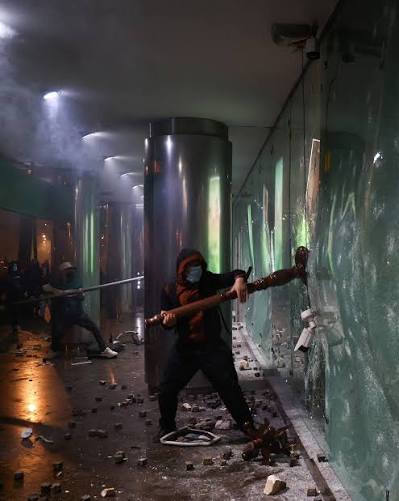
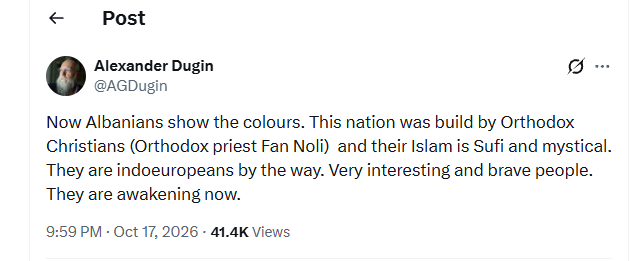
On Tuesday 13 October the Ministry of Education was attacked. On Wednesday the Ministry of Justice burned and protesters entered the Ministry of Finance. On Saturday 17 October masked men attacked the High Court with molotovs and set offices on fire, attacked the entrance of the Bank of Albania with iron bars and petrol, burned a private bank, looted shops along the boulevard and burned cars. By the Health Ministry’s count on Sunday, thirty-seven police officers and twenty-four protesters had been treated in hospital over the week. The Prime Minister says a drone carrying explosives was stopped on its way to the courtyard of his office. For two nights RENEA, the counter-terrorism unit, has been deployed on the boulevard against what the state assesses as credible threats from armed elements inside the crowd. On Saturday evening Alexander Dugin wrote that the Albanians are awakening.
The German embassy’s record for the week is one repost. On 14 October it shared the EU Delegation’s statement, which took note of allegations of excessive police force against protesters and journalists and asked that police action be proportionate. Not one sentence from the embassy about the men in masks, the court, the central bank or the shops. The embassy that found words for six injured officers in March found none for thirty-seven in October. The embassy that told party leaders in March to distance themselves from violence had nobody to address this time, because the violence has no leader, and it did not ask why.
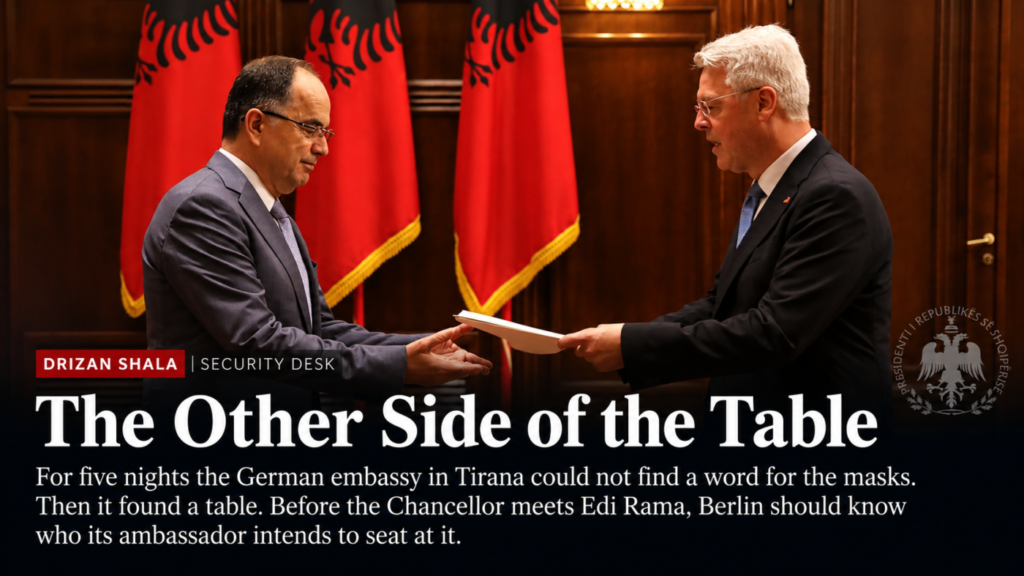
The President’s offer of a space for dialogue, made in a video message on 15 October, did not begin with the President. The German ambassador asked Bajram Begaj to host a dialogue platform. I have it confirmed that when the government learned of the approach and began asking questions, the ambassador reached out to the Prime Minister and asked whether he would sit at such a table if the President hosted it. I have also confirmed the Prime Minister’s answer, which was in two parts. He will not sit at any crisis table with the Democratic Party or the other parliamentary opposition, because they lost the election seventeen months ago and a riot does not give back what the ballot took away. And he will sit at any table, anywhere, with or without cameras, with the movement in the street, the moment it names the person who speaks for it. He said the second half in public, in a live stream from his office on Sunday morning. Nobody has answered it.
In official interactions earlier in the week, the ambassador’s attention was drawn to two things. First, that the language coming out of the EU Delegation on the violence was weaker than the week warranted. Second, that a rumour has run through Tirana for a year, that the German embassy wants the Prime Minister gone, and that his embassy has never dismissed it. He did not dismiss it then either. He has had every day since to do so and has not.
The ambassador’s initiative followed Elisa Spiropali’s contacts with him, and those contacts have a history. She was dismissed as Foreign Minister on 26 February. By March the Tirana press was reporting that she had been admitted to the China Club in Berlin, and quoting Socialists who said the access she had acquired there was part of the reason. On 12 June, the week the Flamingo movement was at its strongest and tens of thousands stood in front of the Prime Minister’s office, she posted from the Bundestag that she was in Berlin for something Shakespearean and durable. Within days of coming home she became the first Socialist to declare that everyone has the right to protest, and on 21 June she called for a New Deal for Albania. Her open letter to the Prime Minister appeared on 16 October. On 18 October Baton Haxhiu published a column in which someone from international circles who knows Albania well proposes that Edi Rama withdraw as head of government, remain as head of the Socialist Party and hand the executive to another figure. Haxhiu rejects the idea. He also confirms, without meaning to, that it is circulating, and who is circulating it. A membership, a Bundestag visit, a letter, a column and an embassy approach to the head of state, all pointing to the same arrangement.
In Tirana the ambassador’s initiative is being read as an attempt to prepare the succession of Edi Rama by Elisa Spiropali. I believe that reading is correct, and I put my name to it. Spiropali’s contacts with the ambassador, her open letter, the ambassador’s approach to the President and Haxhiu’s account of a proposal from international circles for Rama to surrender the premiership while keeping his party form a sequence that deserves more than a diplomatic explanation about dialogue. The proposal has a political beneficiary, a mechanism and an intermediary. Berlin may dispute the interpretation. It cannot reasonably expect Albania to ignore the sequence. The question is no longer why the German ambassador sought a dialogue platform. It is whether that platform was meant to carry through a political succession that Albania’s voters had not authorised.
To offer mediation you must have someone in mind to mediate with. The embassy has watched the same five nights as everyone else. The only voice that has spoken for this movement is a covered face. The Prime Minister has asked for a name and received none. Yet the embassy went to the President with a platform. So it has a counterparty. Either the German embassy knows who is behind the masks, in which case it holds information that the Albanian state needed on Saturday night while its counter-terrorism unit stood between a crowd and a burning court, and it has not shared it. Or it does not know, and it has proposed to seat the elected government of a NATO ally opposite people it cannot identify, in the middle of a security operation, with a drone already intercepted. It will be said that an ambassador may float an exploratory table without knowing in advance who will come. In a quiet week, yes. In this one, that is the second branch, not a third. One of these is complicity. The other is recklessness. The embassy may choose which word it prefers.
The President has since met two groups of protesters, on two different days. They asked him to dissolve parliament, decree a caretaker government for a year and call elections. These are the demands the Democratic Party has made since November. If a name finally appears at the President’s table, the country will be entitled to ask where it was found, and by whom, while the rest of Albania was looking at a mask.
From the boulevard, the sequence reads differently than it does from an embassy. The masked men believe a great power stands behind them. They say so. Here is an embassy that would not condemn them, would not deny the rumour when it was put to him through official channels, and now proposes to speak to them. On the street that is not mediation. It is confirmation.
For a year, former officials of the Albanian government have been buying their way into dinners on Behrenstrasse, at the China Club, and coming home to speak in Tirana in the name of the German government. They have told Tirana that Berlin has decided Edi Rama is finished. They have named his successor. She has been a member of the same club since before any of them started talking. They have attributed to Germany a part in changing power in a NATO member state outside an election. A dinner on Behrenstrasse is not a mandate from the Chancellery. But the embassy sits in Tirana, hears what these people say, knows what they claim and has not once said in public that they do not speak for Germany. Berlin should want to know who has been speaking in its name in Tirana, on whose ticket they got into the room, what they were promised there, and whether its own embassy let their version stand because it was convenient.
On 16 October, at the Federal Press Conference, the Foreign Office spokesman Martin Giese was asked about Albania. Three ministries had burned by then. He referred to the European Commission’s assessments, said that rule of law and the fight against corruption are tasks the Albanian government must fulfil, and added that the population in Albania raises similar demands. Sali Berisha thanked him the next day. In June, asked about an earlier phase of the same protests, the same spokesman had called them an internal political matter for Albania. Between June and October the protests acquired molotovs, a burning court and a drone, and Berlin’s register moved from internal matter to the government has homework. That is a choice, and the Foreign Office should be asked whether it made it or whether it was made for it.
Germany does not treat its own political violence this way. The Federal Republic prosecutes left-wing extremist violence, bans the organisations that practise it and publishes an annual report on it. No German government would accept a foreign ambassador proposing, after a night in which a federal court was set on fire by masked men, that the Bundespräsident host a platform between the chancellor and persons unknown. No German ambassador in Rome or Paris would propose such a table. Italy and France have parliaments, courts and elections, and so does Albania, the last of them seventeen months ago. The question for Berlin is what this embassy believes Albania is that Italy is not.
Nor does Germany treat drones this way. In August an explosives-laden drone failed in an attack on a German airport, and the Federal Government attributed it to Russia. On 5 October the president of the BND, Martin Jäger, told the Bundestag’s oversight committee that Russia is waging a shadow war against Germany. On 12 October, at the Federal Office for the Protection of the Constitution, Interior Minister Alexander Dobrindt said the same, and said that the aim of that war is to destabilise Germany fundamentally. Ten months earlier the Foreign Office had summoned the Russian ambassador over GRU cyberattacks and the Storm-1516 influence operation against the Bundestag election, and the spokesman who announced it was Martin Giese. In May the Federal Government told the Bundestag, in writing, who carried out Storm-1516: members of the Center for Geopolitical Expertise, founded by Alexander Dugin, and of Konstantin Malofeyev’s Double-Headed Eagle movement, with the support of the GRU. The European Union sanctioned Dugin’s Center two months later. So when Dugin wrote on Saturday night that the Albanians are awakening, the German embassy in Tirana was reading the founder of an organisation its own government has identified as an arm of a GRU operation against Germany, claiming the authorship of a week of masked violence in a NATO ally. Berlin knows the pattern: a grievance that is real, a crowd that is not the grievance, a device with explosives, a foreign hand that claims the result. It knows the pattern because it has been on the receiving end of it all year, and it knows the hand by name. This week the pattern appeared in Tirana, drone included, signature included, and the German embassy’s answer was a table.
There are four ways to read what has happened, and Berlin, not Tirana, has to say which one is true.
The first is that this is German policy: that the Federal Government has decided the elected government of a candidate country should be eased out through a presidential platform while its capital is under attack, and has instructed its embassy accordingly. If so, Berlin should say it, to Tirana and to its allies, because it is a position with consequences inside NATO.
The second is that this is one embassy, acting beyond its brief, and that the brief it has given itself has a name. Nobody has voted for Elisa Spiropali as head of government. No party organ has chosen her. No constitutional procedure leads from a burning court to her office. An embassy that works to seat a named successor to an elected head of government, outside any democratic norm and any democratic sense, is conducting a succession, in a country that has not asked for one. If this is what the embassy is doing, Berlin has an ambassador problem and should treat it as one before Tirana treats it as something else.
The third is that the embassy has lost control of who it is talking to. The people who carried the succession proposal to Berlin and back have been vetted by no security service of the state they claim to speak for. The people behind the masks are not identified by anyone. The movement has no name, so Moscow gave it one. A German embassy that cannot condemn the violence, cannot name the counterparty, has let intermediaries speak in its name for a year and proposes a table anyway is doing, in effect, what Dugin’s text asks for: it is treating the mask as a legitimate political actor. Whether that is by design, by incompetence or because someone has been talking into the embassy’s ear is a question German counter-intelligence exists to answer, and it is the same question the BfV was asking about Germany itself on 12 October, and about Dugin’s own organisation in May. It would not be the first time a German mission in this region was found to be carrying water it had not drawn itself.
The fourth is that all three are true at once, which is how these things usually turn out.
Until Berlin answers, the ambassador is not a mediator in this crisis. He is a party to it, and a party cannot host the settlement.
The Chancellor and the Prime Minister are due to meet soon. When they sit down, Edi Rama will know what the German embassy in Tirana has been doing since the ministries burned. The question is whether Friedrich Merz will. There are two versions of this week that can reach the Chancellor’s folder. One has a President offering dialogue and an embassy supporting it. The other has five nights of silence about masked men, a question put through official channels and left unanswered, intermediaries trading on Berlin’s name, a proposal that originated with a faction of the ruling party and a table with no one yet seated on the other side. A Chancellor who meets the head of government of a NATO ally knowing only the first version is being handled by his own service. This piece gives him the second, in time.
And one prediction, so that it is on the record before the table is set. If a name appears at it, we will know where it came from.