A speech full of stereotypes and hypocrisy: what Friedrich Merz told the Western Balkans in Budva
By the Editorial Board
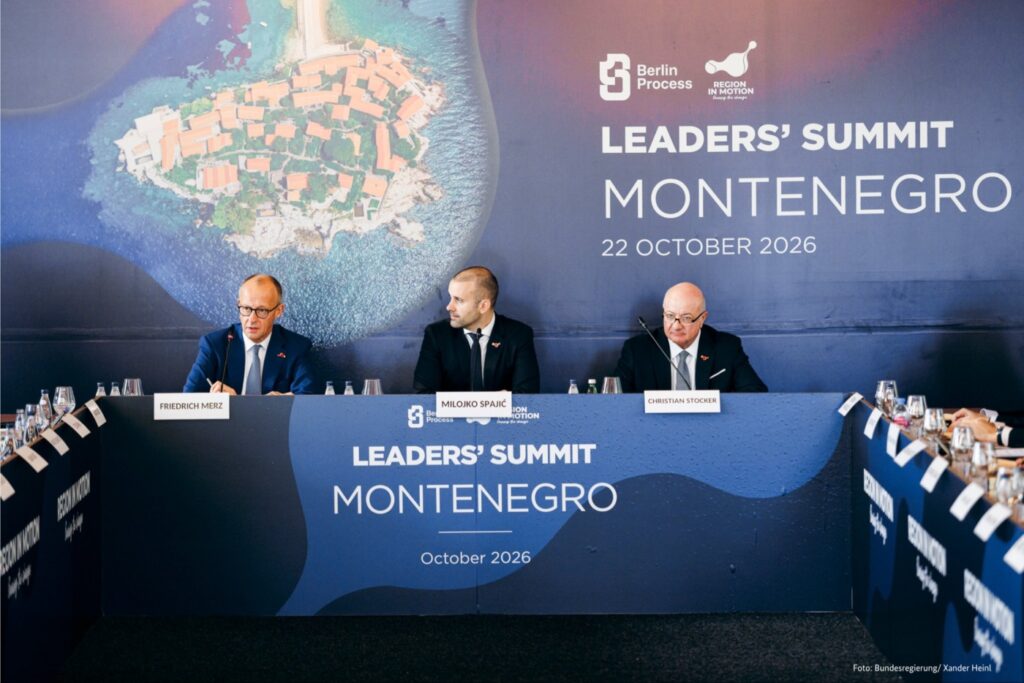
Friedrich Merz came to the Montenegrin coast on Thursday to open the Berlin Process summit, and he brought the speech Germany has been giving the Balkans since 2003. He read it to Serbia’s prime minister, to Kosovo’s, to Albania’s, to the host whose parliament speaker sent condolences to “General Ratko Mladić’s” son from his official account. He read it, by his own admission, after decades of the same words. “That was long a phrase for nice speeches,” he said of the sentence that the Western Balkans belong to Europe. He was right. The speeches were his country’s, and so is the habit of mind behind them: when something goes wrong in Germany it is a man or an office; when something goes wrong in the Balkans it is a people. It is the rule this publication reads in everything Merz said on Thursday, and in most of what Germany has decided here for twenty years.
“At a Berlin Process summit in London we all agreed to condemn hate speech and the glorification of war criminals. If we want to provide a better future for our children, we must not add fuel to the fire.” Six weeks ago Serbia buried Mladić with an army honour guard, five ministers and the president’s son in the front row. Montenegro’s speaker glorified him by rank, in writing, and kept his job by secret ballot. Both states had signed the London declaration Merz was quoting. Serbia’s prime minister was sitting in front of him. The sentence did not stop there. “This also applies to the normalisation talks between Pristina and Belgrade. We therefore strongly urge both sides to show responsibility.”
Both sides. Kosovo glorified nobody. Kosovo buried nobody with a salute. The first words a German chancellor has spoken about the glorification of war criminals since 7 September were spent putting the country that did it and the country it was done against on the same bench, and calling the arrangement responsibility. Serbia votes on Sunday. Merz was asked for nothing more than a name and gave “those who sow division will be judged harshly by history.” History is slow. The election is in three days. A state funeral for a genocide convict is not, in this vocabulary, Serbia’s act. It is a Balkan condition, and a Balkan condition has two sides.
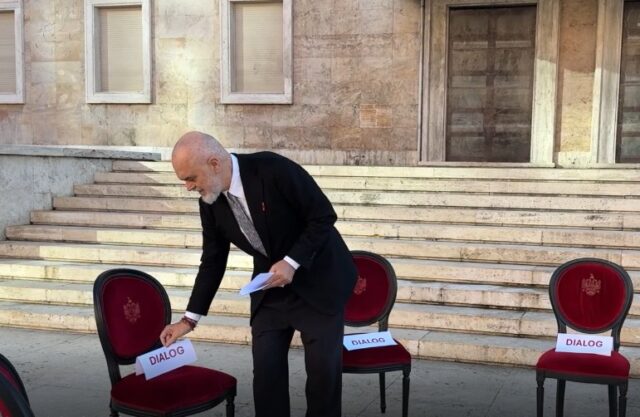
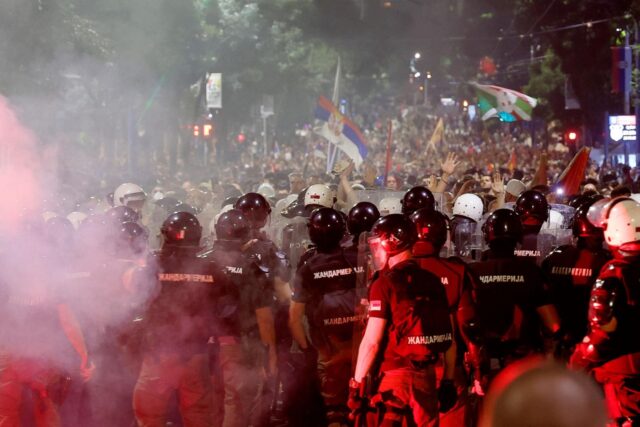
Albania got the same arithmetic. “When we face protests in the European Union or here in the region, violence must never be an option for either side.” Edi Rama was in the room. A week earlier people in masks had set fire to ministries in Tirana, and the state had put them out. In the chancellor’s sentence the arsonist and the fire brigade are two parties to a dispute, each with a responsibility. No German chancellor has said that to Paris after a riot. It is said to Tirana because in the file the Balkan state is always half the problem.
The rest of the speech was the file read aloud: corruption, independent judiciary, organised crime, rule of law, “bold reforms” as “a mandatory precondition for any progress,” to six countries at once. One patient, one disease, one doctor. Spajić had just given the least Balkan speech of the day, about SEPA and cross-border goods and clean energy, and Merz answered him with “you were determined and your efforts paid off,” the sentence one uses for a pupil.
In 2014 and 2015 the Bundestag declared all six countries “safe countries of origin,” the category that lets a Balkan asylum claim be refused on sight, Kosovo and Serbia alike, the country of the war and the country that made it. In 2016 it opened the Westbalkanregelung, up to fifty thousand of the region’s nurses, drivers and builders a year, a real door for the workers and a closed one for their countries, which wait as candidates while their people staff German hospitals. In 2019 it voted that Germany would consent to Albania’s accession talks only once the federal government had certified nine conditions the Bundestag had written itself, on judges, prosecutors and elections; the Commission had recommended opening without conditions. Kosovo met every benchmark the Commission set for visa-free travel in July 2018; the member states, Germany among them, kept the door shut until January 2024. Serbs have travelled without visas since December 2009, through Mladić’s arrest, through his trial, through his funeral. The decisions do not track the conduct of the six. They track what Germany needs from each: the labour, taken; the borders, kept; the membership, deferred; and the one state whose trade with Germany runs to ten billion euros a year, more than the other five together, admitted to Schengen fifteen years before the one that was bombed on its behalf. The standard moves with the interest, and the interest is never written down.
Germany’s own chart is not clean. Transparency International’s 2025 index puts Germany tenth, up from fifteenth, when the chair of Transparency Germany said the country was making no progress; the German chapter expects it to fall again, because the Merz government is stripping anti-corruption controls out of procurement law in the name of cutting bureaucracy. GRECO, the Council of Europe body whose reports Brussels uses to grade Tirana and Pristina, found in August that Germany had implemented four of the fourteen recommendations it issued in 2020 and declared it “not in sufficient compliance”; its file on the Bundestag ended in a non-compliance procedure. Germany ratified the UN Convention against Corruption in 2014, among the last in the West, because its deputies refused to criminalise their own bribery. Cum-Ex, the largest tax theft in German history, happened in Frankfurt. Wirecard invented 1.9 billion euros in Munich while the regulator investigated the journalists.
Nobody writes that Germany is corrupt. It would be a stupid sentence. Germans read Cum-Ex as bankers and Wirecard as a company and the mask commissions as a few deputies, and they are right to; the failure has a name and an address and a court. The same failures in Albania have no names in the German account. They have a region. That is the whole difference between the two files, and it is the only thing Merz brought to Budva: a vocabulary in which a German crime is an exception and a Balkan crime is a climate.
Asked at the pool about the newest Russian espionage case in Germany, Merz said it did not surprise him, that he expected more, that “the Federal Republic of Germany has become a target of Russian espionage.” A German spy is a man with an initial for a surname. A Serbian minister in Moscow is a country. If the rule ran the other way the German file would hold a former chancellor fifteen years on Gazprom’s and Rosneft’s payroll, two pipelines built against every warning from Warsaw and Washington, and a chancellor who expects the arrests to continue. No Balkan government has ever put a former head of government on Gazprom’s board.
Montenegro is the price. The chancellor said on Thursday that Montenegro as the twenty-eighth member in 2028 is “realistic,” and the host named the year. In the file that will be signed: the speaker’s telegram to the Mladić family; Milan Knežević telling the chamber this month that Mladić is a hero and that he does not recognise the Hague verdicts; Knežević’s party in the governing majority that will sign the treaty. If the glorification of war criminals is the red line Merz quoted in his first paragraph, Berlin owes the region one sentence: why is it not a line in Podgorica? Berlin has not given it. What the record gives is this: Montenegro has six hundred thousand people, the size of an average German city, it costs little to admit, and admitting it lets a chancellor say the policy works. For the five that cannot be admitted cheaply: “others must, others will follow.” No name, no year. Kosovo applied in December 2022 and has waited four years for candidate status; the chancellor did not say the word. The five get “gradual integration,” the plan Merz and Macron wrote in June: market access, observers in Brussels, roaming, payments. Membership on instalments, so that membership itself can stay where Thessaloniki left it twenty-three years ago.
A standard that moves with the interest cannot command, and in Miločer nobody waited for it. Belgrade took Putin’s call and sent Dačić to Moscow. Podgorica kept its speaker. Tirana told Merz and Söder this month that there will be no German return centres in Albania, and took its security to Washington and Ankara; when the city burned it was Turkey that sent help. Pristina signed with the Americans in September and used Budva to ask Brussels, not Berlin, for candidate status. None of this is distrust of Europe. In this spring’s Eurobarometer 80 percent of Albanians and 75 percent of Kosovars trust the Union, against 51 percent of the Union’s own citizens. It is the discovery that Berlin is not Europe, and not the only road to it.
Belgrade, Banja Luka and Skopje have drawn the further conclusion, that Berlin is not even all of Germany, and have started talking to the Bundestag’s second-largest party. The AfD’s Balkan file should be read without illusions. Tobias Teich told a Belgrade weekly last month that his party wants “a privileged partnership modelled on Switzerland and Norway instead of hasty EU enlargement,” which is the chancellor’s instalment plan without the manners; that it would not “formally withdraw Germany’s recognition” of Kosovo, because it could not; and that Kosovo is “a fragile state” in a region of “Islamist radicalisation,” which is the file again, with Belgrade holding the pen this time. The AfD does not offer the Albanians a friend. It offers them a lesson: the German list survives every German government, and the government that writes the next Kosovo paragraph will write it with whoever is in the room. Maximilian Krah went to northern Cyprus in August after the Bundestag twice refused him the trip, and told the Turkish Cypriot speaker that the isolation was “unacceptable”; the speaker saluted his “courage.” Cyprus entered the Union in 2004 with its division intact, and nobody in Berlin wrote a list for Nicosia. Whatever one thinks of the man, a party that will walk into rooms its own parliament closes is a party that can be walked into. Tirana and Pristina should start thinking about it, with the costs priced, for one reason that needs no sympathy from anyone: the Serbs are already in that room, and Pristina cannot afford to let Belgrade be the only Balkan voice the next Bundestag hears.
Merz said the sentence about the Balkans belonging to Europe had long been a phrase for nice speeches. He meant it as a confession. It is the evidence. The Western Balkans have not failed to understand Germany’s promise; they have understood it exactly, as a sentence written for ceremonies by people who dine at the China Club and have never once applied the list to the city it is served in. The region heard the speech on Thursday for the twenty-third year and went home to make other arrangements.