Editorial Board
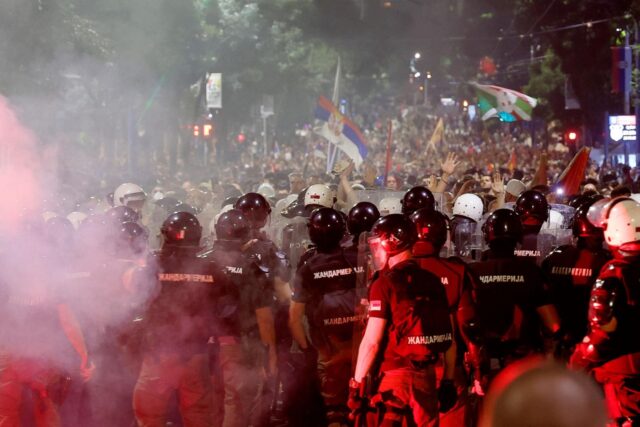
On 22 October, while shop windows on the boulevard were still being boarded up, a statement went out in Tirana telling “all actors” to act constructively, reject violence and create the conditions for “a meaningful dialogue through which legitimate concerns can be addressed in accordance with democratic mechanisms.” Anyone who follows this city’s diplomatic traffic will have recognised the sentence. It is the one the EU Delegation issued, the one the Commission issued on 18 October, the one every mission keeps in a drawer for weeks like this. This time it did not come from a mission. It came from the American Chamber of Commerce in Albania.
AmCham Albania is a private association registered in Tirana in 2000. Its members are companies operating in Albania, and the overwhelming majority of them are Albanian: the conglomerates, the banks, the telecoms, the fuel and construction groups. They pay dues. They elect a board. The board hires a director. The word “American” is used under licence from the US Chamber of Commerce in Washington, a franchise any local association can hold if it files the paperwork. The US government has no seat on the board, no vote in the assembly and no responsibility for anything the chamber says. There is nothing American about the organisation except the sign on the door. And for four years that sign has been used to exercise an authority the chamber does not possess, over a state it does not represent, in the name of a government that never gave it one.
A trade association writes to a minister about a clause that hurts its members. This one writes to the Government about the country. In July 2022 it warned that the fiscal amnesty “would endanger Albania’s official position in the international arena, putting the EU accession process at risk,” which is a foreign ministry’s sentence; even the Prime Minister asked at the time what business a chamber of commerce had speaking with the flags of partner countries. In 2024, fighting the national chamber law, it copied its letter to the EU Delegation and four embassies and put the American chargé on a podcast beside its president to say that chambers must be independent. In February this year it issued a memorandum on e-Albania declaring “serious risks to economic stability, business continuity and national security,” benchmarked Albania against “the United States and other advanced economies,” noted that some of its members “are fully vetted and authorised to provide services to the Government of the United States,” and demanded a legal framework for cyber-security audits. A business lobby had written a démarche. In the 22 October text the same voice assigns responsibilities to the state, certifies which grievances are legitimate and which mechanisms democratic, and invites “all actors involved,” which on that boulevard includes the people who broke the windows, to cooperate in resolving the situation.
This is how a fake authority is built. You do not claim it. You borrow its grammar, and the reader supplies the rest. A document that opens by addressing the Government, closes by addressing all actors, and in between pronounces on the rule of law and the legitimacy of concerns is read as a document from a state. Nobody checks the letterhead. The Albanian press did not: on 23 October the headlines were “the government left us without protection” and “we warned of the causes of this crisis,” the same headlines the opposition wrote in June when the chamber’s business index came out and a Democratic Party deputy called it “one of the heaviest indictments ever made of the country’s governance.” The chamber’s statements are useful to the opposition for one reason, that they are read as American. They are not.
The chamber’s president, Grant Van Cleve, is a Californian angel investor who, by his own published biography, has done business in Albania since 1991 and holds real estate and infrastructure interests in the region, which makes him an Albanian businessman with a US passport. A man with property and projects in a country who pronounces on that country’s fiscal laws, its coastal regulation, its national security and its police has a conflict built into the office, whether or not he has ever used it. A real embassy bars its officers from exactly this. The other embassy’s president lives on it, and nobody, least of all the mission that certifies him, has asked which of the chamber’s filed positions touched his own ventures.
The institution that should have asked is on Rruga e Elbasanit. The United States Embassy has indulged this for years, and indulged is the generous word. It certifies the chamber’s weight: in February the chargé’s office posted that AmCham “represents 270 companies that generate about 25% of GDP” and called it “an important bridge between American investors and Albania,” a number and a title the chamber now quotes as its own. It lends its voice on request. It attends every assembly and lets itself be photographed under the seal beside the board. What it has never done is say in public that national security in Albania is a matter between two governments, or that the embassy speaks for the United States and the chamber speaks for its members. During the riot week the embassy issued three sentences and the chamber issued seven paragraphs, and the seven paragraphs did the work the three could not: they criticised the state’s protection of property, lectured all sides, and got quoted the next morning as the American view. Whether anyone at the embassy intends it or not, the chamber now says in public what the mission cannot, and the mission has never once said that the two voices are different.
There is an old phrase for the man who has stayed so long at the station that he represents the station to headquarters rather than the other way round. Van Cleve has gone native. The embassy’s problem with AmCham is the problem every headquarters has with such a man: he speaks in its name, it cannot disown him without admitting it never controlled him, so it posts a photograph and a number and lets him carry on.
The chamber is entitled to say that its members’ windows were broken and the police did not come. That sentence has an owner and an addressee, and it is in the statement, in paragraph five, after the sermon. It is not entitled to tell Albania who its legitimate actors are. The embassy owes this country one sentence, that it alone speaks for the United States in Albania. Until it is said, this publication will read every statement from the American Chamber of Commerce as what it is: the Albanian business elite speaking under a borrowed flag, with the embassy’s silent consent.
Addendum, 25 October.
After publication, a member of the AmCham Albania board contacted this publication to say that the embassy is, in fact, on the board. His words: the embassy officers “are all present on the board, they just do not have a vote,” and “every communication like this gets the embassy’s amen beforehand.” He added that the chamber tried for three or four days not to react to the events in Tirana at all, and that the statement went out in the end because members demanded one.
We stand by what we wrote. The United States government has no seat on this board, because a private association in Tirana cannot give it one. What the chamber has done, in Article 14.14 of its own bylaws, is designate the Deputy Chief of Mission and the Commercial Officer of the US Embassy as “ex officio observing Board members, without voting rights,” by its own decision, without any act of appointment or acceptance by the United States. That is one more item on the list: a seat for the embassy conferred by the chamber on itself, in the same way the chamber confers on itself the right to address “all actors.” Article 24 of the same bylaws requires every public statement to be approved in advance by the board. If embassy officers sit in that room when the approval is given, as the board member says they do, then the embassy’s three sentences and the chamber’s seven paragraphs were cleared at the same table, and the question we put to the embassy stands with more weight than when we put it: does it speak for the United States in Albania, or does it watch while others do?