Every morning for a week the Prime Minister has set a table on his own steps. The guests have knocked it over, burned it and written “resignation” on it. The capitals that preach dialogue to Albania have yet to notice which side of the table is European.
By Maringlen Cara (Tirana)
A man gives a banquet and sends word that everything is ready. The invited guests send excuses. The host does not cancel the dinner. He sends his servant out again, to the streets and the lanes, and fills the house with whoever will come. Luke puts the refusal on the guests’ account and the persistence on the host’s, and the whole of the Gospel reads that way: the father goes out of the house to the elder son sulking in the yard, the shepherd goes after the one sheep, the prophet says to a people with blood on their hands, come now, let us reason together. The invitation comes first and keeps coming. Whether it is accepted is the other party’s sin or the other party’s virtue, never the host’s.
Since 20 October the parable has been running on the boulevard in Tirana, with props.
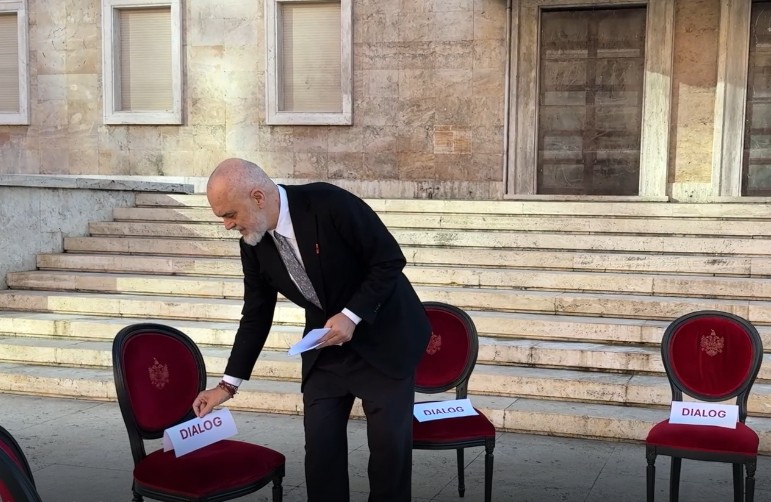
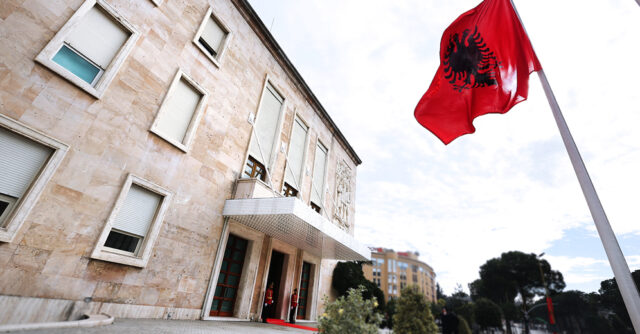
That Tuesday, day eight of the protest, red chairs stood on the steps of the Kryeministria with a sheet of paper on each seat: “Dialog”. The message was an offer without conditions, “jam në dispozicion së bashku me qeverinë” (I am at your disposal, together with the government). By evening the sheets read “Dorëheqje” (resignation) and the chairs lay on their backs.
On Wednesday the chairs were back and Edi Rama was filmed bending to lay the sheet on the seat himself. That night, after three quiet hours, a chair burned in the middle of the boulevard with a banner across it, the young men around it calling “Hajde të ngrohemi se është ftohtë” (come warm up, it’s cold). Then the molotovs.
On Thursday, stone benches, because stone does not burn. On Saturday a stone table with the invitations on top. On Sunday the whole week’s furniture went out at once; by four in the afternoon the chairs had been piled, broken and lit, and by nightfall there were molotovs at the Kryeministria and the Kryesia e Kuvendit, shop windows gone at Kullat Binjake, three people in Trauma, one of them a police officer. This morning there is only the stone table. The invitations are on it.
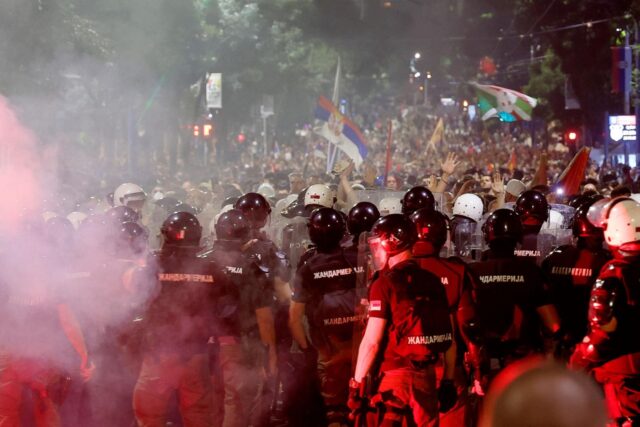
The men with the lighters call the host a dictator. The opposition behind them has said it every day for four months, and part of the foreign press for ten years. A dictator does not let a crowd stand under his window from June to October with a coffin and a rope. He does not then set a table for it, set the table again after it is kicked over, again after it burns, and in stone when the wood runs out. From Belgrade to Minsk the method is a cordon, a camera, a list of names and a quiet morning. Tirana has had the cordon and the water cannon. It has also had, every morning this week, a man on his own steps asking the crowd in, and every day the crowd’s one-word answer written over his.
On Saturday, beside his interior minister, he gave his own account of the four months: “unë kam dëgjuar më shumë se kushdo tjetër, më shumë sesa ata kanë dëgjuar njëri-tjetrin, ku kanë sharë, kërcënuar pa thënë asgjë konkrete dhe duke refuzuar në vazhdimësi që të ulen dhe të bisedojnë” (I have listened more than anyone, more than they have listened to each other, as they cursed and threatened without saying anything concrete and refused, continuously, to sit down and talk). What passed under that window from June was a coffin carried to the door of his office, a rope in every third chant and the stated wish to see him hanged. Cursed and threatened was the polite version. He answered with furniture.
That is the rule Europe was built on, before it was a market. It puts the willingness to speak before the worthiness of the listener, which is why it was possible, five years after the camps, for men to sit at a table with the people who had been shooting at them and call the result a Community. The Union that descends from that table lectures Tirana weekly on dialogue. By its own founding rule there is one European standing in front of the Kryeministria this morning, and he is the one being called a tyrant for it.
He gets no credit for it. The embassies found the word “condemn” after the city had burned for a day and have not found a word for the chairs. The commentators write that the table is theatre, as though a man attacked with petrol in the evening were not entitled to props in the morning. The opposition has spent fourteen days insisting that the only legitimate politics is the kind that ends with its enemy out of the building, and nobody who writes statements about European standards has told it otherwise.
On Sunday he also brought a law, and the people who have ignored the chairs will quote the law; its first sentence protects peaceful protest, and its date is the thirteenth day, after the thirteenth refusal, with the table already set beside it.
Edi Rama is the only man on that boulevard still setting a table for people who arrive with petrol. The people across the road from him have been given fourteen days and a great deal of foreign patience to show what they would do with the building. They have shown it with the chairs. The father in the parable went out to the elder son anyway.
Maringlen Cara writes on religion, law and public life in Albania and the region. A Catholic and a constitutional conservative, he holds that a church which serves the state stops being a church.