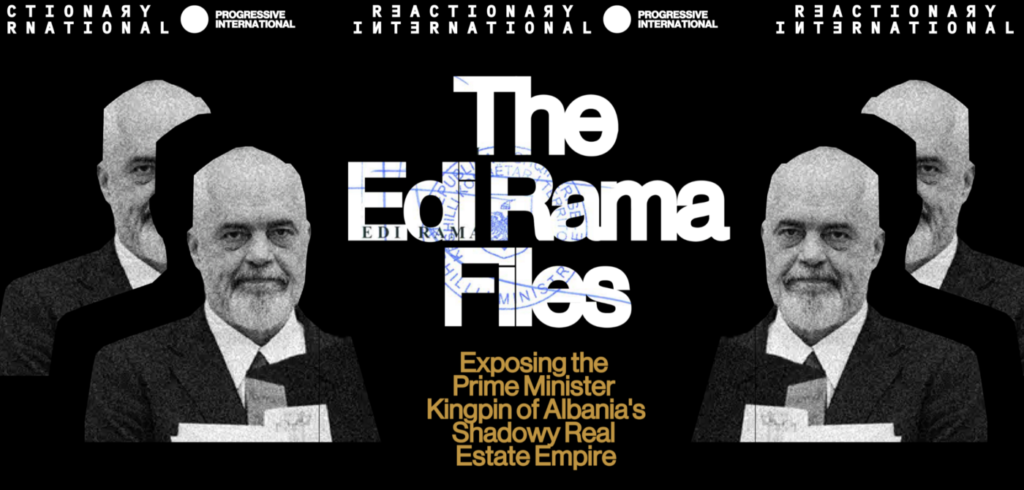
The Progressive International flew into Tirana, marched for a week, flew home, and published a verdict. What it did not publish is evidence. A close reading of the dossier that convicted Edi Rama by layout.
By Renada Bici and Ardit Rada
Last week David Adler was in Tirana, marching with the flamingos. This week his organisation published the sentence. The Edi Rama Files, released on 7 July by the Progressive International, place the Albanian Prime Minister, in the words of its Secretary General, at the helm of an illicit real estate empire. Yanis Varoufakis pronounced the report forensic and devastating within hours. The dossier itself closes by filing Rama into the Reactionary International, the global enemies list that the organisation’s research consortium exists to populate, and then, in the very next breath, asks the reader for a first name, a last name, and an email address.
Hold that sequence in mind, because it is the whole story. A political international arrives in a small country, borrows its uprising for a week, departs, and issues a criminal verdict against its head of government, closing with a subscription form.
We read the dossier against the record. The finding is brief. Zero evidence against Edi Rama. Not thin evidence, not contested evidence. None. There is not even an allegation. Nowhere in the document do the words appear that any actual accusation requires: that Rama knew, that Rama took, that Rama directed, that Rama protected. The authors never write the sentence, because the sentence cannot be sourced, and a stated claim can be tested. So the claim is never stated. It is staged. Authentic material about other men, traffickers, forgers, an oligarch, is bound under one man’s name, a verdict is printed on the cover, and the reader is left to manufacture the connections that the file does not contain.
Here the law of evidence speaks with a clarity the dossier’s prose is built to escape. Aggregation is not evidence. A fact incriminates a person through one route only, a connective link: an act, a communication, a payment, a decision traceable to him, with knowledge and with intent. Absent the link, the probative value of the fact against him is zero, and zero multiplied across two hundred pages is still zero. Volume does not cure irrelevance. Proximity is not participation. A signature on a lawful act is not mens rea, and a verdict on a cover is not a charge. A dossier, however thick, is not a case. Every exhibit in this file has a proper address, a proceeding to which it belongs, and when each is returned to its address, the forgery to the civil title litigation, the laundering to the prosecution of the seller’s network, the intercepts to whatever case is or is not built against an oligarch, the permits to administrative and political accountability, the pile remaining under the name Edi Rama is empty. This is not journalism that failed. It is design. And it deserves to be dismantled in public, exhibit by exhibit, because the method will be used again, on this country and on others small enough to be used.
First, know the workshop. The Progressive International was founded by open call in 2018 from Yanis Varoufakis’s DiEM25 and the Sanders Institute, and launched in May 2020 as a political international of the global left, some seventy member parties, unions and movements under a secretariat coordinated by David Adler, an American who staffed Bernie Sanders’s foreign policy team and directed policy for Varoufakis before taking the helm. It is a political combat organisation with a fixed enemies list and a fundraising apparatus attached. Its Athens Declaration of 2022 demanded an immediate ceasefire in Ukraine and denounced military blocs in the year Russian armour stood on European soil. Its council published a collective statement against what it called the Cold War on China. This spring it organised a convoy of six hundred and fifty delegates to Havana. And this April its co-founder took the program to its destination. Varoufakis appeared on stage at a Moscow investment forum, three years into the full scale invasion, to declare that Europe stood guilty of a crime against logic in relation to Russia, then defended the trip in an essay canvassing Ukrainian neutrality which he traced, in his own words, to the Athens Declaration he had issued on behalf of the Progressive International. Note the standard being applied here, because it is the one this dossier could not meet. That is not adjacency. That is his own stated chain, from the organisation’s founding document to the podium in Moscow. The record is not a perspective. It is a program, its holder is a combatant, and three months after Moscow the same apparatus published its verdict on the Prime Minister of a NATO member state on the European Union path, a country whose entire strategic existence is built on the alignments the combatant campaigns to dissolve. A combatant does not audit. It targets.
And the dossier did not invent its verdict format. In April 2024 the Progressive International launched, with the Latin American social science council CLACSO and transform europe, the research foundation network of the Party of the European Left, a standing database called the Reactionary International, a registry of the parties, politicians, judges, journalists, foundations and financiers said to comprise an illicit global network undermining democracy. Trump is in it. Orbán, Meloni, Modi, Bolsonaro. The Edi Rama Files are simply the intake file for the newest inductee, and the induction produces an absurdity that measures the instrument’s precision. Edi Rama chairs the Socialist Party of Albania, a member party of the Party of European Socialists, a man of the European centre left by every taxonomy in use. He has been processed into a far right enemies registry because a Trump son in law invested on his coastline. An analytical lens that cannot distinguish a European socialist prime minister from the movement it exists to fight is not a lens. It is a sorting machine with one output, and Albania happened to be standing in front of it.
Start with the crimes, which are real, and note carefully whose they are.
The Special Prosecution’s proceeding 287/1 of 2021, the Aruba file, concerns by its own official notice four offences: money laundering through a structured criminal group, narcotics trafficking through a structured criminal group, the structured group itself, and the commission of offences by a criminal organisation. In June the Special Court issued its instruments. Decision 31 of 10 June, custodial arrest for fifteen men within twenty security measures. Decisions 432 and 435 of the same date, preventive seizure over villas at Gjileke and Green Coast in Palasa and properties in Tirana. Decision 427 of 12 June, seizure of the proceeds of the Zvërnec sale contracts, more than 128 million euros. The men in those instruments are private men. Artur Shehu, born in Vlora, resident in Florida, surveilled by European investigators as far back as 2019 discussing cocaine logistics in Aruba. His associates. His notaries and his money. Not one act in any of those decisions is attributed to any member of the Albanian government. And one word is absent from the charge list altogether. Forgery.
That absence matters, because the forged Ottoman register is the stone on which the entire dossier stands. The land, the Progressive International writes, was obtained through a forged document, as SPAK has established. SPAK has established nothing of the kind, and the authors would know this if they had read the file they claim to be publishing. The falsification of the Daimi Register enters the prosecution’s papers as a suspicion, in the statutory language, reasonable suspicion based on evidence, inside a request for preventive seizure. The suspicion leans on the reasoning, not the holding, of a Supreme Court decision in the civil title litigation. No one has ever been charged with forging the register. No criminal court has examined it. The civil courts, for their part, have produced a carousel: annulment in Vlora in 2013, recognition in Tirana on appeal, quashing and remand from the Supreme Court, and, in May of last year, a fresh first instance judgment recognising the seller’s title once again, itself now under appeal. Nothing is final. And the prosecution says so. In its earlier Zvërnec filing, material 410 of 2026, an in rem measure over sums parked in notarial accounts, in a proceeding with no persons under investigation at all, SPAK recorded that the court decisions on this land have altered the titles repeatedly and that the legal conflicts over the claims remain open. Read that again. The institution the dossier cites as having established its founding fact states in its own filing that the fact is not established. The base of the pyramid is a suspicion. The apex is the word kingpin. Everything in between is typography.
Then the history, which the dossier does not merely blur but reverses. The land, it writes, was made available through a sequence of decisions by the Edi Rama government. It was not. The title at Zvërnec was manufactured between 2006 and 2009, when the property restitution agency returned hundreds of hectares to the Shehu line on the strength of decisions resting on a court ruling from 1997. Every act in that chain was consummated years before Rama took office in the autumn of 2013, under governments of the party now leading the domestic crusade against him. The foundational property crime in this story, if the courts one day pronounce it a crime, belongs to another administration and another era. A forensic report that cannot correctly date the creation of the title at the centre of its own case has forfeited the adjective, and the forfeiture is not a detail. It is the tell that the conclusion preceded the research.
The tell repeats. The dossier describes a single court order of 10 June, one hundred and eighty pages, twenty warrants, more than one hundred million euros. No such order exists. The warrants sit in one decision, the villas in two others, and the money in a fourth, issued two days later. It informs its readers that nine EU member states have blocked Albania’s accession report, a formulation the deliberative record does not support, which this publication traced and rebutted months ago, and which the authors have lifted, unexamined, from the disinformation stream it entered through. It promotes Barack Obama to the presidency of the United States. Any Albanian desk editor would have caught all three in an afternoon. The Progressive International did not have an Albanian desk editor, because Albania was never the subject. Albania was the set.
And what remains against the Prime Minister, once the borrowed crimes are returned to their owners? Furniture. He chairs the National Territorial Council, because the law of this country puts the Prime Minister in that chair. He chairs the Strategic Investment Committee, whose Zvërnec designation of December 2024 carries his signature beside those of the Deputy Prime Minister, five ministers and the State Advocate. His government amended the protected areas framework through parliament and redrew boundaries through the Council of Ministers. Attack those acts as policy. Fight them in the administrative courts, at the ballot box, in the streets of Tirana with a plastic flamingo under your arm, as is every Albanian’s right. But none of it is a crime, the dossier does not claim it is a crime, and as this desk established when the deed changed hands, the seller was the registered owner, no court had suspended his right of disposal, and the freshest judgment in the file ran in his favour. The deed carried no suspension. A prime minister’s signature on a lawful act, laid on a page beside a trafficker’s intercept, incriminates the prime minister exactly as much as the page incriminates the paper. In evidentiary terms its weight against him is zero, and the dossier’s entire case is an exercise in stacking zeros and calling the pile a verdict.
Here the dossier turns on its authors, and it is worth watching it happen. The strongest material in the file, the intercepts, the warrants, the frozen millions, exists because an Albanian prosecution service pursued a politically connected network into its notary accounts and its beach villas. That service was created by the justice reform this government legislated. The dossier takes the state’s enforcement record and files it as the state’s indictment. A working prosecution becomes the crime scene of the man whose reform produced it. Rama’s public quarrels with SPAK are an Albanian argument, conducted inside Albanian institutions. They lend the Progressive International nothing. There is a name for the operation it has performed instead, taking a country’s functioning institution and repackaging its work as proof that the country is a criminal enterprise, and the name is not solidarity.
Because that is the real casualty, and it is time to say so without diplomatic padding. Albania is a candidate country in the most delicate phase of its accession, a small state whose reputation is a strategic asset it cannot buy back once spent. Its protest movement is genuine, grown from its own soil, owed better than annexation as content. Its prosecutors are mid case, owed the space to finish. Its dispossessed are litigants with names, owed a judgment. Into this the Progressive International has discharged a fabricated verdict, wrapped in the vocabulary of forensics, timed to a global campaign in which Albania features not as a country but as a stage flat with Jared Kushner painted on it. For two decades, while restitution commissions minted coastal titles from forged registers and villagers carried their documents from court to court, the consortium showed no flicker of interest in Albanian property law. It discovered Albania the day a Trump adjacent name appeared on its coast, and it will forget Albania the day the name moves on. What stays behind is the smear, quoted, translated, embedded in the country’s file, doing its quiet work in Brussels and Berlin long after the campaign has found its next stage.
The symmetry should embarrass everyone it implicates. The domestic opposition collapsed this record into the cry that Rama gave away the land, though the state owned nothing to give and the title was minted under its own governments. The international left now collapses the same record into the cry that Rama’s empire took the land by forgery, though the forgery is an unadjudicated suspicion and the taking predates his rule. Opposite flags, identical method, one shared need: that Zvërnec be about a single man. The record keeps refusing. Zvërnec is about a machine, older than Rama, built by many hands across many governments, and it is being dismantled right now, warrant by warrant, in the only forum with the power to do it.
Albania has courts for its crimes and elections for its prime ministers. It did not order a verdict from abroad, and it does not need one drafted before the evidence, in a proceeding where the defendant was cast first and the file dressed around him. The name on the cover will fade when the campaign moves on. The file that matters stays open, here, in this country, in its own courts. It runs to many hundreds of pages. Edi Rama is not in it.