Albania closes the opening phase. The 8th Intergovernmental Conference confirms fulfilment of the Cluster 1 interim benchmarks and sets the closing benchmarks for Chapters 23 and 24. Berlin and The Hague condition what comes next.
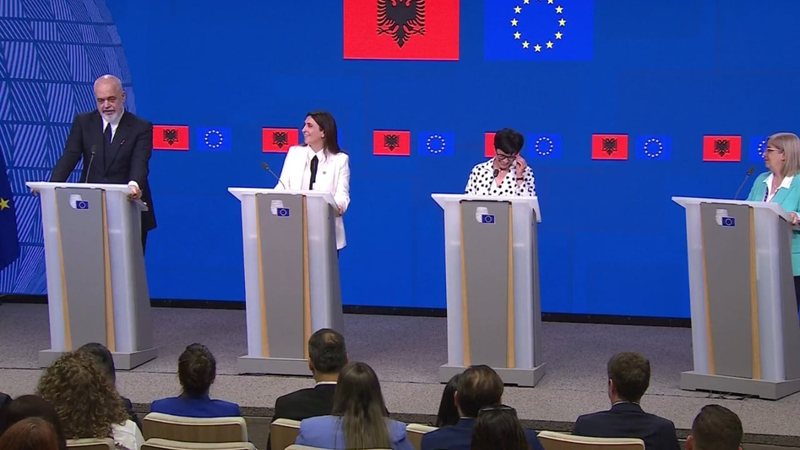
The Eighth Intergovernmental Conference between Albania and the European Union concluded in Brussels on Tuesday with three operative outcomes. The Council confirmed Albania’s fulfilment of the interim benchmarks for Cluster 1, the Fundamentals. The closing benchmarks for Chapter 23 on the judiciary and fundamental rights and Chapter 24 on justice, freedom and security were set. The procedural gate that under the revised methodology must be cleared before any chapter can be provisionally closed has been crossed.
The substantive decision was taken on 22 May by the Committee of Permanent Representatives, which approved the Common Position on Chapters 23 and 24 and authorised the Conference. The IGC ratified it. Albania becomes the second candidate, after Montenegro, to reach this stage of the accession process under the revised methodology accepted in February 2020. The Cluster 5 opening in December 2025 means all 33 chapters are now open. The Cluster 1 finding is what makes any of them closable.
Two things were placed on the record that the official communiqué does not foreground but that the briefing will. The first is a joint conditionality statement from Germany and the Netherlands, the two member states whose internal procedures have historically been the binding constraint on Western Balkans enlargement, issued in the margins of the Conference. The second is Prime Minister Rama’s open embrace of Chancellor Merz’s proposed restructuring of the accession architecture, a position whose consequences for Albania have not yet been read in Tirana.
THE OFFICIAL OUTCOME
The Cypriot Deputy Minister for European Affairs, Marilena Raouna, chaired on behalf of the rotating presidency. Her procedural confirmation:
“During the Cypriot presidency the Council has assessed Albania’s progress. The Conference concluded that Albania has successfully fulfilled the Fundamentals cluster grouping. This is an important achievement. This milestone allows Albania to move forward in the accession process and to provisionally close chapters.”
Raouna then placed the floor under expectations:
“Today’s Conference marks the beginning of a new and even more challenging phase. Progress is not measured solely by the adoption of reforms, but by their effective implementation, a consolidated track record, and stable and irreversible results.”
Cyprus has placed Western Balkans enlargement at the center of its presidency. Raouna: “Enlargement is strategic for the Cypriot presidency. We believe deeply in enlargement and we are pleased that Albania’s accession process is moving forward in a decisive manner, with rigorous and fair evaluation and conditionality.” This is the first Mediterranean presidency to lead a Western Balkans IGC of this consequence in six years.
The Commissioner for Enlargement, Marta Kos, endorsed the finding and committed the Commission to the closing horizon:
“Your work of ten years has been successful. Steps have been taken in the protection of human rights. The establishment of the new justice institutions has curbed the interference of politics in the judicial system. SPAK has proven that it can deliver results and become the most trusted institution in Albania. This is a solid foundation to build on.”
Kos repeated the closing horizon twice. The formal version:
“We continue to support Albania’s work for the closing of negotiations in 2027. Further progress is expected. We rely on Albania to consolidate the reforms, and this must include all political forces and civil society in the country.”
The informal version, with the conference-room joke that travelled the wires:
“When we speak about the date I told you that we support Albania’s vision of closing negotiations by 2027 and then I will climb Mount Korab together with the Prime Minister. That is the only closing benchmark I have had today.”
Closing of negotiations is not accession. It requires the negotiation of the Accession Treaty, ratification in all 27 member state parliaments, and a transitional period that has historically lasted between eighteen months and three years. The 2027 horizon Kos endorsed is consistent with the government’s working target of 2030 for full membership but does not guarantee it. The bilateral veto points remain intact at every stage.
RAMA
Rama acknowledged the partial character of the achievement:
“Half of the work, if I may put it that way, of the opened chapters will be closed and the other half of the closing will be opened. We feel encouraged, but with more responsibility because we know it is not the end, it is only the beginning of the end. We know we have to do much more work, but let us tell all Albanians that the word IBAR became even more trending than the World Cup. It passed. We will be members of this family within this decade. I know it, I feel it, I will fight together with the team.”
The IBAR reference is the point at which the Prime Minister spoke directly to the parliamentary opposition’s claim, repeated through the spring, that Albania would fail the interim benchmark assessment. The Council record now contradicts that claim.
The choreography was theatrical. Rama opened in Greek and in approximate Slovenian: “Dear Marilena, agapi mou. Don’t you love me? I was thinking of saying ‘Yubim te.'” Kos kissed him. The contrast with the register of the German-Dutch joint statement, issued in parallel, is part of the editorial point of the moment.
The substantive Rama intervention was the embrace of the Merz framework:
“It is very interesting and welcome the special attention that the German Chancellor pays to enlargement and we appreciate this very much. It was a subject that for some was taboo and for us it was not taboo. I am pleased with this because some years have passed and I think a creative way must be found, because we are in a completely new world. A united Europe is better for everyone. Our letter has been addressed to the member states. Candidates should not be divided. We are the Taliban of the EU. We will not look anywhere else. Whatever it takes, we will do to enter.”
What Rama embraced is treated separately below.
THE GERMAN-DUTCH STATEMENT
In the margins of the Conference, Germany and the Netherlands issued a joint statement whose language is the binding political constraint going forward. The Examiner reproduces the operative paragraph in full:
“Achieving the interim benchmarks constitutes the starting point for Albania’s further steps in strengthening the rule of law. The adoption of IBAR expresses our clear expectations and encouragement to continue the reforms, to ensure their sustainable implementation in practice and to strengthen the responsible institutions. Respect for the independence of the judiciary and the unconditional fight against corruption, including high-level cases, are non-negotiable conditions for Albania’s progress in the EU accession process. This also includes guaranteeing that decisions on the lifting of immunity are taken in accordance with the recommendations of the Venice Commission.”
“Non-negotiable” is the formulation Berlin and The Hague have used in previous Council debates to signal that they will exercise their veto if these conditions are not met. Its appearance at the moment of the procedural breakthrough is the operative point. The two governments are not celebrating; they are putting the next phase on notice.
Three formulations should be marked.
“High-level cases” is not generic. SPAK has open files at the level of former cabinet members, former ministers, the current and former mayors of Tirana, and the leader of the parliamentary opposition. The closing benchmarks for Chapters 23 and 24 will be assessed against the unimpeded prosecution of those files.
“Lifting of immunity” in conjunction with “recommendations of the Venice Commission” refers, unmistakably, to the Albanian Parliament’s handling of immunity proceedings against former Deputy Prime Minister Belinda Balluku. The German-Dutch statement now elevates that file into Council-level conditionality.
“Will continue to monitor developments closely” is the operational commitment. The next phase of negotiations on the chapters whose closing benchmarks were set today will be conducted under explicit Berlin-Hague monitoring.
SPAK ON THE EU RECORD
For the first time, the Commission has placed SPAK by name in the formal political endorsement at an Intergovernmental Conference. The Kos formulation again: SPAK has become “the most trusted institution in Albania” and constitutes “a solid foundation to build on.”
The institutional consequences extend beyond the IGC. SPAK is now the institution on whose performance the Commission has staked its endorsement of Cluster 1 fulfilment. Any subsequent move that would weaken SPAK, whether through budget, appointments, legislative amendment, or executive interference, will be read in Brussels as a move against the basis on which the Cluster 1 finding was made.
The opposition’s public framing of SPAK as a politicised institution has not survived contact with the Commission’s working assumption. That does not resolve the substantive arguments either way. It does mean that the political space within which those arguments can be made has narrowed.
The Commission’s endorsement of SPAK and the German-Dutch conditionality on the unimpeded prosecution of high-level cases are aligned. The signal is coordinated.
PRESIDENT BEGAJ
President Bajram Begaj framed the moment in constitutional terms:
“Today, Albania took another important step toward the European family. The 8th Albania-EU Intergovernmental Conference is a historic moment in Albania’s irreversible European journey. European integration is a national project, it is the aspiration of generations of Albanians for a more democratic, more just, more developed, and more dignified Albania in the European family. The road continues with more confidence, responsibility, and dedication.”
“Irreversible” is a political claim rather than a procedural one. The irreversibility of accession is precisely what the Merz architecture and the parallel veto-limitation proposals are intended to qualify.
THE MERZ FRAMEWORK AND WHAT RAMA SIGNED ONTO
Chancellor Friedrich Merz’s letter of 21 May to Council President Costa, Commission President von der Leyen, and Cypriot President Christodoulides proposes a restructured accession architecture. For Ukraine, an “associate Membership” status with non-voting participation in EU institutions and activation of the mutual assistance clause. For the Western Balkans and Moldova, “privileged access to the Internal Market” and “closer ties with EU institutions in day-to-day decision-making.” Five member states, Austria, the Czech Republic, Italy, Slovakia and Slovenia, have separately circulated a proposal for “merit-based access, if necessary step by step, to the European single market” for candidate countries.
Running in parallel is the Council-level discussion of post-accession safeguards reported by The Guardian and originated by the European Policy Centre: a transitional period during which new member states would not have the right to veto Council decisions requiring unanimity in foreign policy or taxation.
Kos confirmed the parallel discussion and held her position carefully:
“I have spoken many times about the guarantees, because when we accept member states, we must be stronger. How this guarantee will look, this is still under discussion. The candidate countries may know something from the discussions, but nothing has been decided. These guarantees will be invisible for the new member states, when they become part, if they follow the rules. Because if they do not follow the rules, they will feel these guarantees strongly.”
Rama’s public embrace of this architecture is the policy commitment of the day. It is not the Albanian opposition’s framing of accession and it is not, despite the choreography in Brussels, the same architecture that the 2027 closing-of-negotiations horizon presupposes. Two readings of what Rama signed onto are available.
The first is that the framework genuinely accelerates accession for countries otherwise blocked by member state vetoes deployed for bilateral reasons unrelated to merit. On this reading, Merz’s architecture is a parallel track that supplements the accession process and the 2027 horizon remains the operative target.
The second is that “privileged access” and “closer ties” risk becoming a permanent waiting room and a substitute for membership. This reading is being advanced by the German Council on Foreign Relations for the Western Balkans and by European Pravda for Ukraine.
The Examiner reserves judgement on which reading will prove correct. The answer will depend less on what is said in IGCs and more on what individual member states are prepared to do at the moment of treaty ratification. What matters today is that the architectural choice is now openly on the table, that Rama has publicly welcomed it, and that the Albanian political class has not yet engaged with what it would mean for the country’s institutional standing once inside the Union.
PUBLIC OPINION AS FLOOR
Kos noted that more than 90 percent of Albanians support EU membership. The figure tracks with successive Eurobarometer surveys and is the highest sustained level in any candidate country. It is the floor on which the entire Albanian negotiating position rests, and it is the floor the German-Dutch statement implicitly cited when it conditioned further progress on rule-of-law standards: the assumption is that the Albanian electorate will reward governments that maintain those standards and punish those that do not.
The 8th Intergovernmental Conference is a substantive procedural achievement and the start of the harder part of the work.
The finding the body of this briefing supports is the following. The Commission and the two key member states whose vetoes have historically been determinative for Western Balkans accession have coordinated a framework in which Cluster 1 is closed on SPAK’s documented record and in which the closing of Chapters 23 and 24 is conditioned on the unimpeded prosecution of high-level cases without political interference, including the application of the Venice Commission’s framework to parliamentary immunity decisions. This is the operative architecture of the closing phase.
Two things follow.
For the government, the political cost of any move that weakens SPAK or that handles immunity proceedings outside the Venice Commission framework is now a Council-level cost rather than a domestic one. The German-Dutch statement has placed that cost on the record. The next eighteen months will be conducted under explicit monitoring, in coordination with the Commission’s endorsement.
For the opposition, the spring messaging that Cluster 1 would fail has been falsified by the Council record. A responsible opposition revises its line. The cost of failing to revise it is writing the party out of the EU debate at the moment when the substantive negotiations on the chapters that matter most are beginning. That would be a loss for the country, not only for the party.
Albania has cleared a gate. The corridor on the other side is narrower than the gate.
The Tirana Examiner will continue to report developments around the closing benchmarks for Chapters 23 and 24, the German-Dutch monitoring framework, and the architectural debate around the Merz proposal in the run-up to the EU and Western Balkans Summit.