When Washington asked its allies to act on Iran, Albania’s opposition chose a protest march instead.
the Newsroom (Tirana)
On a morning when the United States was pressing its allies to take a public stand against Iran, Albania’s main opposition party was elsewhere. The Democratic Party boycotted Tuesday’s parliamentary session — the one that made Albania only the second country in the world to formally declare Iran a state sponsor of terrorism — on procedural grounds. The procedural objection may have been technically defensible. The strategic calculus behind it was not.
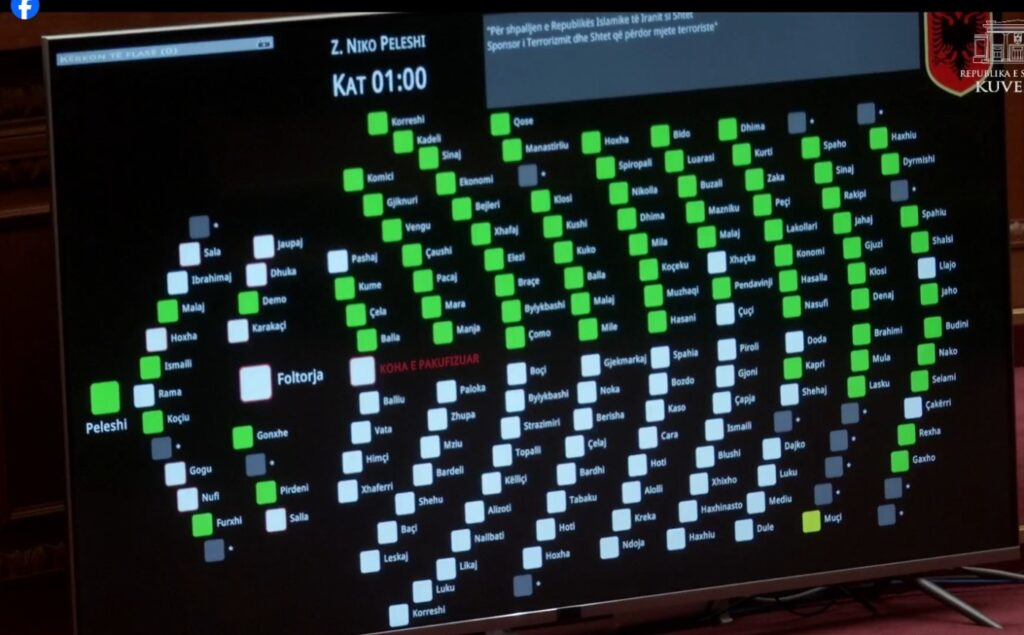
The resolution passed 79-to-one. It designated the Islamic Revolutionary Guard Corps and Hezbollah as terrorist organizations alongside the state-sponsor declaration. The vote was procedurally unusual, politically fractured, and geopolitically well-timed — arriving four days before a deadline the U.S. State Department had set for allies to do precisely this.
The Democratic Party boycotted the session entirely, with parliamentary group leader Gazment Bardhi arguing that the plenary had been convened without a properly approved agenda and that the resolution amounted to “the Prime Minister’s personal agenda” rather than a parliamentary one. Only two opposition deputies broke ranks: Erald Kapri, who voted with the governing Socialists, and Redi Muçi, who abstained.
The procedural complaint was not entirely without basis — the conference of parliamentary group leaders met the same morning and added the resolution to the agenda, which the opposition read as bypassing standard parliamentary procedure. But the substantive objection was weaker. Socialist parliamentary group leader Taulant Balla was direct: Albania is a NATO ally and EU candidate; Iran had just carried out a second cyberattack on parliament weeks after the U.S.-Israeli air campaign began; and the country had already weathered a severe Iranian cyberattack in 2022. In Balla’s framing, the Democratic Party had chosen a protest march on March 22 over a moment of national positioning.
What the Socialists did not say — but what the timing makes clear — is that the vote also landed squarely within a window Washington had opened. A State Department cable dated March 16 and signed by Secretary of State Marco Rubio directed U.S. diplomats at every post worldwide to press their host governments, at the highest appropriate level, to designate the IRGC and Hezbollah as terrorist organizations — with a deadline of March 20. The cable explicitly called for coordination with Israeli counterparts and argued that collective designation would reduce Tehran’s capacity to sponsor terrorism more effectively than any unilateral action.
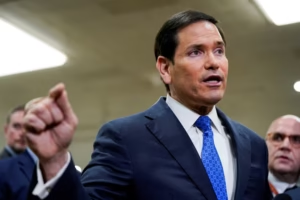
Albania acted the following morning.
Whether Tirana received a specific démarche under the Rubio cable is not public. But the alignment requires no inside information to interpret. Albania has been navigating a delicate period in its relationship with Washington — EU accession talks are ongoing, the Guilfoyle visit in early March raised expectations around strategic investment, and Tirana has been consistent in demonstrating its value as a small NATO ally willing to absorb political costs that larger members avoid. Expelling the Iranian embassy in 2022 after the MEK relocation controversy was one such moment. Tuesday’s vote — taken without opposition cover, on an accelerated parliamentary schedule, four days before a U.S. deadline — follows the same logic.
The resolution’s practical effects are partly symbolic. Both the IRGC and Hezbollah are already designated by the United States and several European states. Albania’s designation adds political weight to the collective posture Rubio’s cable was designed to build, rather than introducing new financial or legal penalties of immediate consequence. What it does do is give Tirana a visible position in an ongoing Western effort to coordinate pressure on Tehran at a moment when the broader U.S.-Israeli campaign has struggled to rally reluctant allies — including on the more tangible question of the Strait of Hormuz.
The opposition’s procedural argument — that the agenda was added without proper advance approval — gives the DP a defensive line, but not a position. There is a meaningful difference between the two. A party with strategic instincts would have recognised that a vote aligning Albania with Washington on Iran, days after a cyberattack on the parliament they sit in, inside a State Department-coordinated multilateral push, was not a session to skip over a scheduling dispute. Instead, the DP handed the Socialists something they rarely receive cleanly: sole ownership over Albania’s Euro-Atlantic commitments at a moment of genuine regional salience.
The boycott exposes a costly confusion between obstruction and opposition. The DP has spent recent months in near-total obstruction — tactically coherent as domestic mobilisation, strategically ruinous when international alignment votes arrive on short notice. Opposition parties in serious democracies show up for the moments that define the country’s place in the world. The DP chose a protest march scheduled for March 22 over a vote Washington had specifically asked allies to take before March 20.
Bardhi’s framing of the session as a “parliamentary façade” will age poorly. The resolution is now Albanian law. And Tirana will take the credit in Washington for moving fast — alone.