Tirana Examiner
Sali Berisha’s full endorsement of the Kushner-linked coastal investment removes the last partisan obstacle to a development model neither major party will now contest. The fight has not ended. It has moved to where votes cannot reach it.
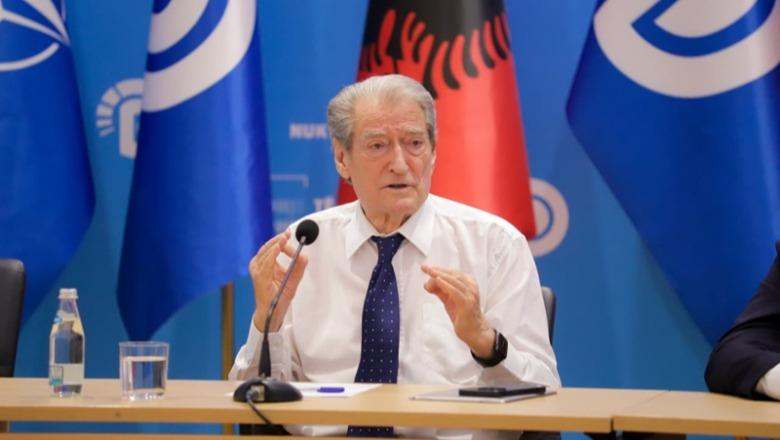
On Wednesday, before his parliamentary group, Sali Berisha settled the question of where Albania’s two largest parties stand on Zvërnec. He supports the foreign investment, fully, and he added that a government led by his Democratic Party would have done the same. The qualifications followed in the expected order: develop the coast without disfiguring it, respect property to the last square meter, compensate the residents. But those are conditions on how the thing is done. The endorsement itself carries no condition.
The sentence that matters is not the praise. It is “we would have acted the same way.” For weeks the protests at Zvërnec have been read through the only lens Albanian politics keeps polished, the government against its opposition. Prime Minister Edi Rama has defended the project as a generational opportunity and cast the resistance, in part, as foreign in origin, telling his own supporters that the Greeks have their finger in the agitation of the self-described true Albanians. The expectation was that Berisha would take the opposite shore, that a coastline carrying the names of Jared Kushner and Ivanka Trump and a valuation in the billions would become the season’s partisan weapon. He declined to pick it up.
What remains, once the leader of the opposition has endorsed the government’s flagship investment, is not a quarrel between parties. It is a consensus about a development model, and the model is the part neither bench wants examined.
The mechanics are a matter of public record. On December 30, the Strategic Investment Committee, chaired by Rama, granted strategic-investor status to a company tied to Kushner’s Affinity Partners for the forty-five-hectare project on Sazan, a former military island, at a declared value near 1.4 billion euros, with the state entering through a joint entity built around the Albanian Investment Corporation. The mainland half of the plan, the stretch of the Vjosa-Narta protected landscape near Zvërnec, runs through a vehicle reported to draw on Qatari capital alongside the Kushner interest, with figures of roughly ten thousand hotel rooms and villas attached to it. According to reporting on the terms, the investor would pay no tax during the construction phase while the state underwrites the water, the power, the sewage. The reclassification of the protected zone and the deal that followed were settled between the state and the investor; the residents learned the scope of it afterward.
Each of those facts is the kind that a functioning opposition exists to interrogate. Berisha interrogated none of them. He contests, at most, the manners of the thing.
Where he did break from Rama, the break does not hold. He rejected the Prime Minister’s claim that the protest is a Greek attempt to provoke a reaction, and he went further, taking up the dual-identity position himself and repeating with approval a protester’s line, that a man may be Albanian and Greek at once, full stop. Then, almost in the same breath, he spoke of those interested in driving the investor out of Albania. That phrase carries the contradiction. “Interested” names a motive, and a motive belongs to someone. The most visible parties with a motive already on the record are the ones Berisha had just declined to name: Athens, which has called for a full investigation and pressed the matter of minority rights. He refused Rama’s Greek framing in one sentence and gestured back toward its address in the next. The grievance, he would have it, is legitimate; the hand behind it is foreign and interested. The two claims cannot stand together without the second swallowing the first. That is not a position. It is a man keeping two exits open.
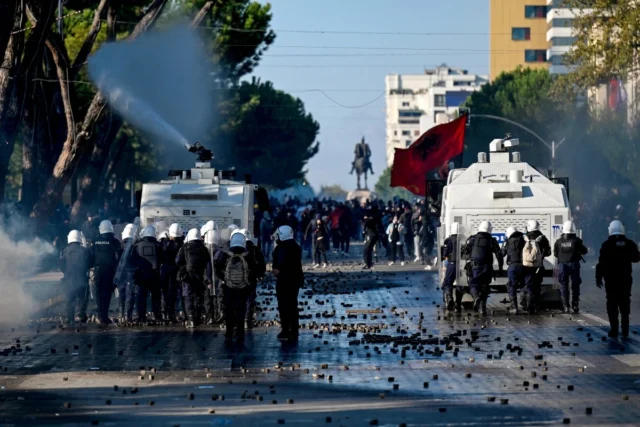
The people actually doing the resisting are not hard to name, because they have been naming themselves since January, when some forty environmental organizations called for the project’s suspension. They are residents of Zvërnec who once crossed a wooden bridge to the island monastery before private men with covered faces fenced the path. They are the thousands who marched in Tirana under four words, “Albania is not for sale,” and a fifth aimed higher, “Ivanka, go home.” Not one of them speaks for a party, because the parties have already agreed.
The timing deserves a colder look than it has been given. On the same day Berisha delivered his endorsement, the Special Prosecution Against Corruption, having frozen one hundred ninety-five million dollars tied to the land transactions, released the funds of the investor’s company. Rama has welcomed the prosecution’s entry, predicting it will confirm the land returns to its rightful owners. A freeze that holds for three days and lifts on the day the opposition falls into line proves nothing on its own. It is, all the same, a sequence, and sequences in Albanian institutional life rarely assemble themselves by accident.
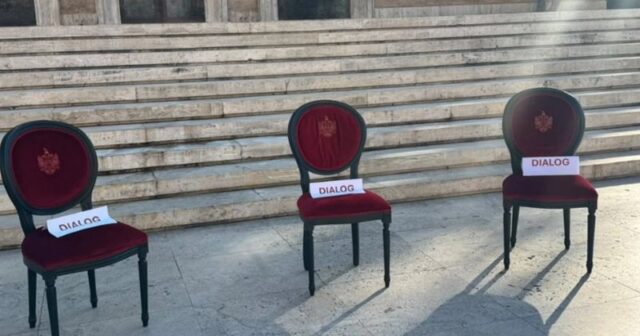
The lesson of Zvërnec is not that the resort will be built, though it likely will. It is what the country’s politics did when handed a choice. Offered a coastline, a foreign name, and a model that spares the investor its taxes while the state digs the trenches, the two parties that agree on almost nothing agreed. When the government and the opposition reach the same answer, the disagreement does not vanish. It migrates to the streets, to the courtrooms, to the lagoon where the flamingos still stand, to every place a citizen can be heard and none where a citizen can vote. A consensus is meant to be the end of an argument. This one is the argument, carried off to where the ballot cannot follow.