Albania gains a clearer role in advancing Kosovo’s EU bid — provided it can convert coordination into sustained diplomacy.
the Newsroom (Tirana)
Albania has an opportunity to translate political alignment with Kosovo into something more operational. Whether it can do so is now the central question.
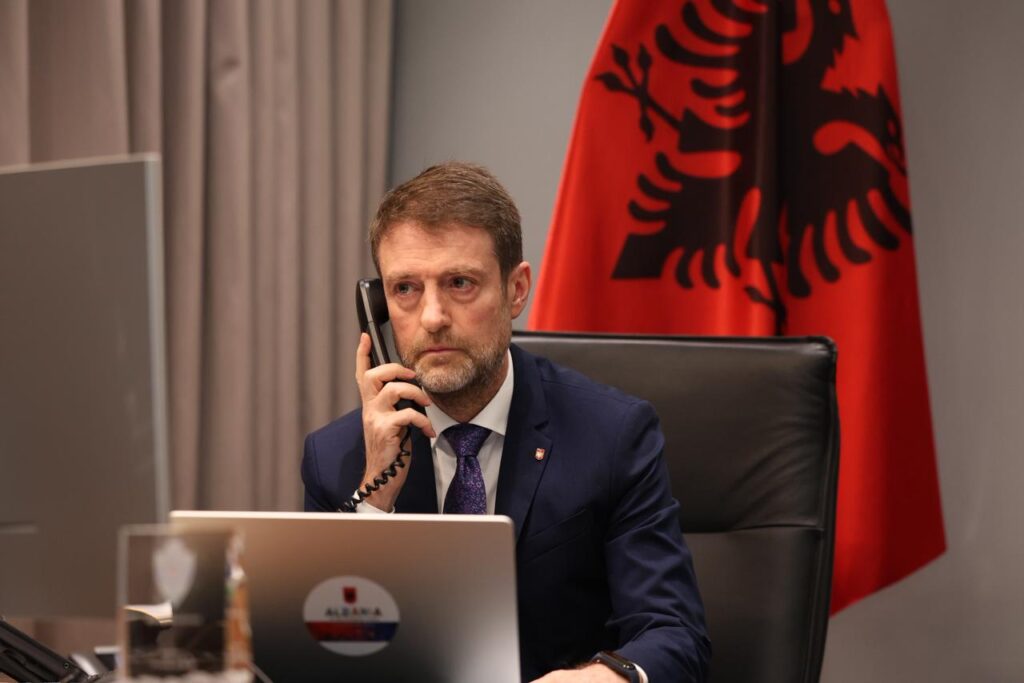
In a March 19 phone call with Kosovo’s First Deputy Prime Minister and Foreign Minister Glauk Konjufca, Albania’s Foreign Minister Ferit Hoxha reaffirmed that Kosovo remains a permanent priority of Albanian foreign policy and agreed on the need to reactivate joint institutional mechanisms between the two countries. Both sides framed the moment as a new phase, shaped by the European Union’s decision to lift restrictive measures on Kosovo imposed in 2023.
The substance of the call was familiar: support for Kosovo’s international subjectivity, commitment to expanding recognition, and alignment on advancing its European and Euro-Atlantic trajectory. The shift lies in timing — and in emphasis.
With EU measures now lifted, Kosovo re-enters a more permissive diplomatic environment. Its application for EU membership, submitted in December 2022, remains blocked at the candidate stage, primarily due to the position of five non-recognizing member states. But the removal of sanctions changes the tone in Brussels. It also creates space for more active advocacy by partners.
For Albania, that space is not abstract. It is functional.
Tirana is already embedded in the EU accession process, engaged in negotiations across multiple chapters, and maintains regular political contact with the capitals that will ultimately shape Kosovo’s trajectory. Its value to Kosovo at this stage is not symbolic endorsement — that is already established — but coordinated diplomacy: sustained lobbying, aligned messaging, and the ability to move conversations inside the EU system.
This is where the “reactivation” language becomes consequential. Albania–Kosovo cooperation has long been structured through a dense network of agreements and joint mechanisms — over a decade of intergovernmental meetings and more than 100 bilateral accords across sectors ranging from energy to foreign policy coordination. The problem has not been design. It has been execution.
Joint structures have operated intermittently. Agreed frameworks have often stalled at the level of declaration. Political friction — most visibly the deterioration of relations between Prime Ministers Edi Rama and Albin Kurti in 2022–2023 — translated directly into institutional slowdown, culminating in the cancellation of a joint governmental meeting and a broader cooling of bilateral coordination.
The March 19 call suggests an attempt to move past that phase, at least at the level of foreign policy management. Hoxha and Konjufca are operating in alignment, and both sides are signaling a preference for functional cooperation over rhetorical positioning.
A credible shift would be visible. It would mean a reactivated intergovernmental track, defined coordination mechanisms, and a sustained, targeted push in EU capitals on Kosovo’s candidate status — with named interlocutors, repeated engagement, and measurable outcomes. It would also require insulation of institutional cooperation from the political volatility that has previously disrupted it.
The cautiously optimistic reading is that conditions now favor such a shift. The EU constraint has been lifted. Kosovo’s diplomatic objective is clearly defined. Albania has both access and incentive to act.
The harder reading is that this alignment has existed before — and has not always translated into results.
Albania’s role is now clearer than at any point in recent years. So is the standard it will be measured against.
The opening is real. Whether it is used will be evident quickly.