Prime Minister invokes Ismail Qemali, cites EU accession record, and calls on diaspora to invest in mountain property
the Newsroom (Tirana)
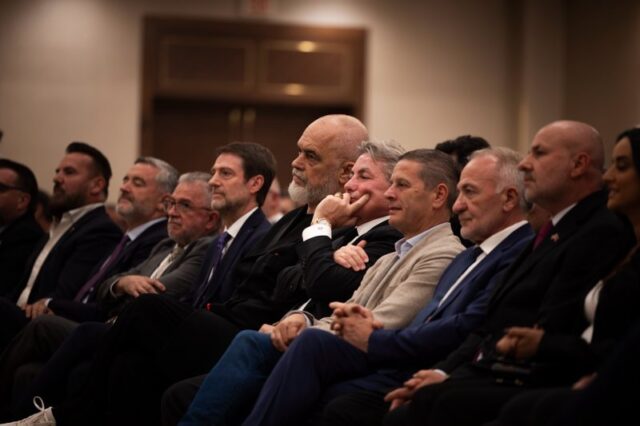
The fourth edition of the Albanian Diaspora Summit opened its working sessions in Tirana on Tuesday, with Prime Minister Edi Rama and Foreign Minister Ferit Hoxha delivering the keynote addresses to an audience of diaspora representatives, ministers, mayors, academics, and writers gathered from across the Albanian-speaking world and its global communities.
The summit, held at the Congress Hall, runs across two days and includes eight thematic panels covering democratic representation, health, innovation, language standardisation, scientific research, and rural development. A welcome ceremony was held Monday evening at the National Theatre of Opera and Ballet, where President Bajram Begaj decorated several prominent diaspora figures and called on them to regard Albania not as a place to leave traces but as a shared home under construction.
The invisible thread
Rama opened by rejecting the premise that diaspora is peripheral to national life, framing it instead as the country’s most consequential strategic resource.
“Albania does not end where its territory ends. It lives everywhere Albanians live. Beyond your individual stories of success, you kept an invisible thread, a thread no distance can sever, made of the language spoken at home, the traditions and memories passed from father to mother, to daughter and son. This thread is not nostalgia. It is our strategic asset. It is the challenge Albania and Albanians face today: to preserve it, to transmit it from generation to generation in an interconnected world.”
He added: “This summit is not a ceremonial gathering. It is a declaration of high conviction. The diaspora is not on the periphery of Albania’s life, it is at the heart of it.”
Rama continued: “There was a time when Albanians fled the homeland carrying their hearts like stones on their backs, taking with them the courage of those who have nothing to lose and the pain of separation from everything. But what history until yesterday called an inconsolable departure, time has transformed into an irreplaceable connection. What once appeared as a chasm has today become a bridge. The Albanian diaspora is not the history of departure but of the multiplication of Albanian forces and the added value of Albania in the world.”
From 300 million to 1.2 billion
In a passage that drew an implicit contrast with his predecessor’s record, Rama cited investment figures to quantify the transformation he attributes to his government’s tenure.
“When we began thinking about the first diaspora summit, it was above all a moment of reunion in a country full of hope and open wounds. It was the first step in calling on the strength of the diaspora, to feel stronger facing the steep climb we had to make, on which we are closer to the summit than ever. My predecessor, every time he entered Albania, counted himself as a tourist. At that time foreign investment stood at 300 to 400 million euros per year. Today it has passed 1.2 billion euros per year.”
He framed the summit series as the opening of a conversation that had been interrupted for a generation: “This is the beginning of a dialogue broken between Albania and her sons and daughters beyond the sea and the mountains. Today we are in the construction phase of what has been the axis of centuries of discussion, the connection with that side of the world where the sun rises from where it sets.”
The impunity myth
Rama devoted a substantial passage to Albania’s judicial transformation and its EU accession trajectory, citing the digital modernisation of public services as concrete evidence of state reform.
“Today you receive all services, around 95 percent of state services, wherever you are, with a click on your smartphone or computer. When we gathered for the first time, Albania was known worldwide and was branded by the European Union as the homeland of impunity, where the law operated only against the weak and where every powerful person ruled the law. Today impunity is a myth of the past in Albania. No one today is above the law, and justice is independent as it has not been since the very beginning, from 1912, until the moment when we with full will handed it the sword that belongs only in its hands, to deliver equal justice for all and to spare no one.”
He then drew a parallel between the experience of diaspora Albanians facing rejection abroad and Albania’s own persistence in European institutions: “Just as you persisted, waiting, being ready for when the door opened, Albania also persisted and was ready when the door opened, and for that reason it opened all accession chapters faster than any other country.”
Citing Ismail Qemali, the father of Albanian independence, Rama placed the EU membership objective within a longer arc of national becoming: “What Ismail Qemali said no longer sounds like a wishful proclamation in the air but settles as an everyday word: Albania will come into being. In the mouth of that immortal father, that sentence was not a description but a belief that passed through generations amid difficulties, failures, and recoveries, a belief that today has taken the concrete form of Albania’s European state-building, to bring Albania to the European table as an equal among equals in 2030.”
He noted that all accession chapters had been opened within eleven months, which he described as a record pace for any candidate country.
The mountains programme
Rama presented a specific economic initiative directed at diaspora members with family land in rural and mountainous areas, framing it as a policy instrument for reversing depopulation and generating income for those who left.
“Mountains have always been the place where Albanians withdrew to defend themselves, to hide from those who sought them out to take them prisoner or to assimilate them. But today the day has come when the mountains can become part of the sources of Albanian wellbeing. I say to Albanians who have land in the mountains and hills: take in hand the mountains package and turn that land, that house, into a source of wellbeing. What Albania today, which attracts twelve million tourists a year, is able to do for them, through the investment of the state and the support of the government, is that from that new source of wellbeing they will earn at the end of the month more than they earn working for others outside the homeland.”
Kosovo and the pan-Albanian frame
Rama closed with a geographic expansion of the summit’s scope, naming Kosovo explicitly as a co-reference point.
“The future of Albania is not written only in Tirana, Rome, Athens, or London. It is written in every country where Albanians live, work, and dream. The future is written everywhere Albanians live around the borders of Albania, beginning from the other independent Albanian state, Kosovo, and continuing with the Albanians of North Macedonia, who must never be forgotten, who are a state-forming people of that friendly republic, and continuing with Albanians in Montenegro and elsewhere.”
Hoxha: Language as DNA
Foreign Minister Ferit Hoxha, who opened the proceedings, framed the diaspora in identity rather than economic terms, with a passage on the Albanian language that carried a note of urgency.
“This summit comes at a key moment. Albania is moving toward its European future, and the same can be said for Kosovo. The diaspora is not simply abroad, not an address we turn to when we have need, but a complementary dimension of our national identity. The Albanian language is our DNA. It is memory, identity, continuity. Without the language, only the body would remain. If our language, which has resisted centuries, weakens today when we are more educated and more connected, the responsibility is ours alone.”
Format and agenda
The summit’s eight panels address democratic representation and diaspora voting rights, business and innovation partnerships, the health system, a book and identity panel under the title “The book as a bridge of identity,” pan-Albanian diaspora coordination, digital education and Albanian language standardisation, scientific research, and local and rural development.
Former football captain Lorik Cana, decorated by President Begaj on Monday evening, said that elevating the Albanian name across the world had been his greatest source of pride.
The summit will close on Tuesday evening with a gala at the Congress Hall.