A fast-moving negotiation meets a slow-moving Union — Albania’s progress now hinges less on preparation than on political permission.
By Ardit Rada (Tirana)
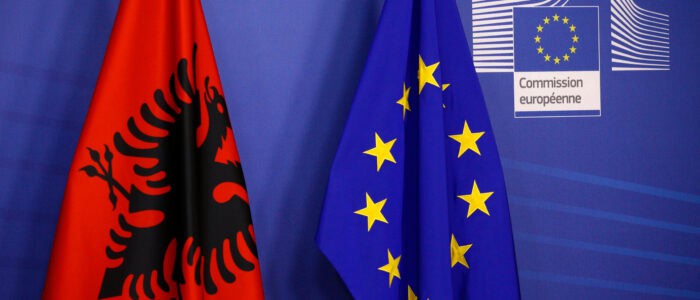
Albania’s government convened an open-format review of EU accession negotiations on Monday, presenting what chief negotiator Majlinda Dhuka described as a technically mature and politically supported process moving toward a concrete milestone: readiness to close up to sixteen of the thirty-three negotiating chapters before the end of 2026.
The session, held with Prime Minister Edi Rama present, was notable not only for its substance but for its format. The government chose to make the presentation public, an unusual decision for a process that typically unfolds in technical working groups and bilateral exchanges with member states. Rama’s explanation for this was direct: public understanding of accession has remained shallow, reduced to either basic talking points or commentary that has little connection to the actual mechanics of what is being negotiated.
The numbers
Dhuka’s technical briefing carried the clearest headline figures. Of the thirty-three negotiating chapters, Albania currently considers twenty-seven to be either well-prepared or at a moderate stage of maturity. Three chapters, numbered 30, 25, and 26, are described as nearly fully matured. A further set including chapters 6 (company law), 7 (intellectual property), 32 (financial management), 20 (industrial policy), and 5 (public procurement) are being pushed toward readiness by June.
The target Dhuka set for this calendar year is technical readiness for closure on sixteen chapters. Seven to eight of those are expected to reach that threshold by the end of the second quarter. The broader aspiration, closing the full negotiation, remains anchored to the end of the decade, with 2027 cited as the next significant internal benchmark.
That timeline is ambitious by any regional measure. No Western Balkan state has sustained a comparable pace of chapter closure without interruption from either internal reform slippage or external political obstruction. Whether Albania can is the central empirical question the process will answer over the next eighteen months.
The European Commission issued a positive assessment of Albania’s progress in February. Member states have been discussing compliance with intermediate conditions throughout March. Dhuka indicated that Albania expects to respond to any remaining member state requirements on reform and security conditions in the coming weeks.
The regional frame
The ambition of Albania’s timeline only becomes legible against the condition of the rest of the Western Balkans accession field. Serbia has opened chapters without closing them, its rule of law trajectory moving in the wrong direction for long enough that the Commission has begun to say so explicitly. Montenegro, once the regional frontrunner and still the only Western Balkan candidate with fourteen provisionally closed chapters, has stalled despite that structural advantage. Albania has none provisionally closed yet, but Commissioner for Enlargement Marta Kos has described its pace of opening as unprecedented, and Albania completed the opening of all negotiating clusters in under three years, against Montenegro’s eight. North Macedonia has faced political obstruction from a member state on grounds that have nothing to do with its compliance record. The pattern across the region is consistent: technical readiness has repeatedly proven insufficient. What has blocked progress is political permission, withheld by individual member states for bilateral reasons the accession framework was not designed to accommodate.
Albania is not immune to this dynamic. Dhuka’s briefing acknowledged that some member states are still working through their assessments of Albania’s intermediate condition compliance. The diplomatic coordination she described between the foreign ministry, the two ministers of state on the accession file, and the negotiating team reflects an awareness that the technical track and the political track require separate management. Holding both simultaneously, without allowing one to lag and create leverage for obstruction, is the operational challenge that has defeated more advanced candidates before. A further variable is Iceland, whose candidacy remains formally valid after a 2013 freeze, and whose government has announced a referendum for August 29 this year on whether to resume negotiations. Iceland is already inside the European Economic Area, Schengen, and EFTA, applies a substantial share of EU law, and had provisionally closed eleven chapters before the freeze. If the referendum produces a mandate to re-engage, the accession queue reconfigures in ways that affect every Western Balkans candidate’s timeline, including Albania’s.
The weak points
The briefing did not obscure the gaps. Two areas were flagged explicitly as lagging. Public procurement received the most pointed attention from Rama, who noted that Albania has made substantial progress relative to its own baseline and relative to the region, but has not yet reached the threshold of good progress as defined by EU standards. He called for the ongoing work on AI-assisted modernisation of public procurement to continue with greater intensity, setting 2027 as the year by which Albania should be able to hold itself up as a model in this area.
The second lagging area is financial control, where progress was also characterised as limited. Rama described the reform of financial control as necessary and noted it is already underway. Food safety and consumer protection were mentioned as the most demanding challenge remaining in the overall process.
These are not incidental weaknesses. Public procurement and financial control sit at the intersection of the rule of law and economic governance, two domains that have historically drawn the most sustained scrutiny from member states and from the Commission. Naming them openly in a public session is a signal of institutional self-awareness; closing them will require sustained administrative output over a compressed timeline.
Rama’s argument
The more consequential contribution from Monday’s session may not be the chapter count. It is the argument Rama constructed around what EU accession is actually for.
The conventional framing of accession treats membership as the objective and the negotiation as the cost. Rama inverted this. In his presentation, the negotiation process itself is described as historically significant because of what it does to Albanian state institutions independent of the final outcome. The process forces institutions that have gained judicial independence to now earn professional credibility. It compels administrative modernisation across domains from infrastructure to agriculture to finance that would otherwise proceed at a slower, less accountable pace. It creates channels that prevent corruption from operating in what he called grey spaces and in the absence of secure institutional pathways.
This is not a new argument in EU enlargement discourse. The transformative effect of the accession process on candidate state institutions has been documented extensively in academic and policy literature on Eastern enlargement. What is notable is its deployment here as a central political message, delivered publicly, in a format designed for general audiences.
It is also worth asking what work the argument is doing. A narrative that locates value in the process rather than the outcome is well-suited to managing expectations in an environment where the outcome remains contingent on decisions that Tirana cannot fully control. That does not make the argument wrong. Institutional transformation through accession conditionality is real and measurable. But it does mean the argument functions simultaneously as a political frame for a domestic audience that is watching a decade-long timeline and asking what it is waiting for.
What Monday’s session established
The government entered Monday’s session with a credible technical position: twenty-seven chapters at varying stages of readiness, a defined near-term target of sixteen closures by year’s end, a positive Commission assessment in hand, and a process that the chief negotiator described as proactive rather than reactive.
It also entered with two acknowledged weaknesses in economically significant chapters, a regional environment in which technical readiness has historically been necessary but not sufficient, and a diplomatic calendar that will test whether the coordination between Tirana’s political and technical tracks holds under the pressure of member state politics.
The institutional transformation Rama described is real. It is also reversible if the political conditions for closure fail to materialise. The field Albania is playing on is more crowded and more contingent than Monday’s session conveyed. A Montenegro that still leads on provisionally closed chapters, an Iceland that could re-enter with deep integration already banked, and member states whose bilateral calculations remain opaque are all live variables in a process Tirana can shape but cannot control. The question is not whether Albania has done the work. It is whether the field will allow the work to count, and on what timeline, and in what order.
Ardit Rada is a Tirana-based journalist covering Albanian politics, governance, and institutional developments. His work focuses on the intersection of domestic political dynamics and Albania’s European trajectory.