by the Newsroom (Tirana)
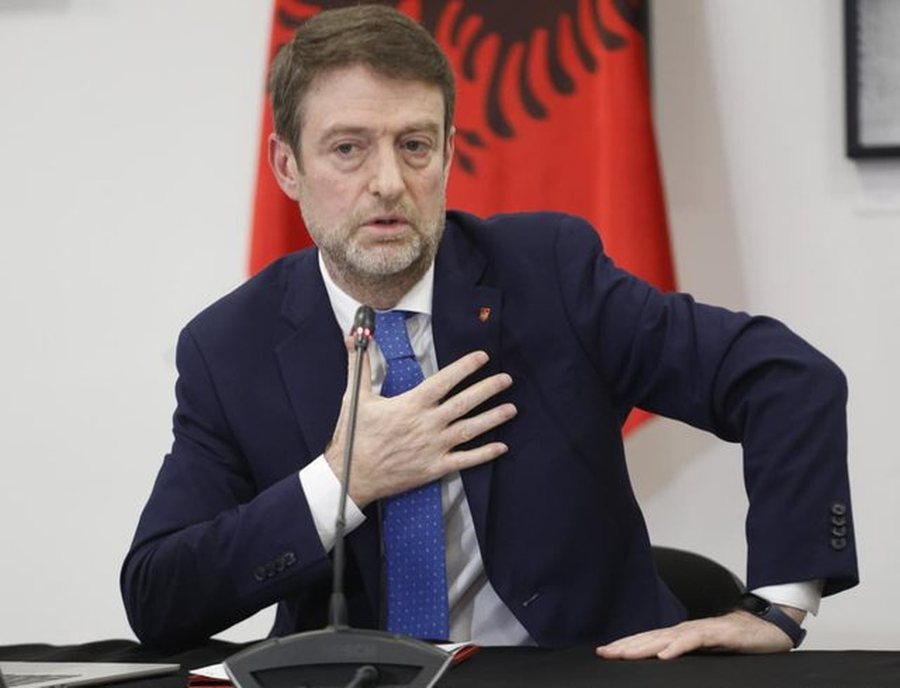
Albania’s foreign minister used his first extended press conference in office to draw a firm line under what he described as a “manufactured fog” around the country’s EU accession process, insisting there is no blockage in Brussels and framing current delays as routine scrutiny rather than political resistance.
Five weeks into the job, the minister struck a notably technocratic tone, positioning himself less as a political actor and more as a custodian of process — one determined to recalibrate both the language and expectations around Albania’s path to the European Union.
“The correct term is not integration,” he said. “It is membership.”
That semantic shift is not incidental. It reflects a broader effort by Tirana to project that Albania has moved beyond aspirational alignment and is now operating within the final, procedural stages of accession — even as uncertainty persists in EU capitals over enlargement.
No Blockage, Only Process
At the center of the minister’s intervention was the Interim Benchmark Assessment Report (IBAR), a key milestone under the EU’s revised accession methodology for rule of law chapters.
Opposition figures and some commentators in Albania have suggested that the report is being stalled by member states. The minister rejected that outright.
“There is no freezing, no blockage, no slowdown,” he said. “There is a normal, professional, highly demanding process.”
The distinction he drew is procedural but politically significant.
Under the new methodology, the European Commission drafts the report, while member states review it through the Council, often raising questions before reaching consensus. Albania, crucially, is not present at that stage of deliberation.
“What is happening now is a relationship between the Commission and the Council,” he explained. “Questions are asked, clarifications are given. This can take weeks. That is the process.”
The number of questions raised — reported in Albanian media as evidence of concern — is, in his view, irrelevant.
“It could be 42 questions or 142. That does not change the nature of the exercise.”
Transparency vs Confidentiality
The minister acknowledged that the perception of opacity around accession talks has political traction at home, but attributed it less to secrecy than to communication failures.
“I do not believe there has been a lack of transparency,” he said. “There has been a lack of good communication.”
At the core of the controversy are Albania’s negotiating positions — documents that remain confidential under a 2015 law adopted by parliament.
“These are not public by design,” he said, pushing back against calls for full disclosure. “That framework was decided years ago.”
Still, the admission points to a structural tension in Albania’s accession narrative: the need to demonstrate openness domestically while operating within a closed, intergovernmental EU process.
Greece, Courts and ‘One Basket’ Diplomacy
On bilateral issues, the minister signaled a pragmatic and notably calm approach toward Greece, describing relations as being at their “most positive” stage in years.
After failed attempts at a bilateral resolution, Tirana and Athens have agreed in principle to refer their maritime dispute to an international court — a move that aligns Albania with a growing trend of legal arbitration in the Eastern Mediterranean.
“This is the most honest way forward,” he said.
More broadly, he framed relations with Greece through what he described as a “one basket” approach — bundling all outstanding issues, from minority rights to property disputes, into a single negotiation track.
The underlying message: no selective escalation, no public confrontation — and no deviation from the EU track.
Kosovo, Serbia and Strategic Ambiguity
If the tone toward Greece was measured, the minister’s positioning on Serbia and Kosovo reflected a more delicate balancing act.
He reaffirmed what he called Albania’s “unconditional and irreversible” support for Kosovo, while simultaneously defending continued engagement with Belgrade — a line that has drawn criticism in both Tirana and Pristina.
“There is no alliance with Serbia,” he said. “There are interests.”
That formulation — deliberately stripped of ideological framing — reflects Albania’s attempt to operate within a regional diplomatic architecture where engagement with Serbia is unavoidable, even as political positions remain diametrically opposed.
The minister was explicit: normalization between Kosovo and Serbia remains a prerequisite for the region’s EU future.
“It is difficult to imagine full European integration of the region without resolving this issue,” he said.
Asked about repeated statements by Serbian President Aleksandar Vučić that “Kosovo is Serbia,” the minister was dismissive.
“That has been said many times. It is not new,” he said, contrasting it with what he described as the “historic” nature of Albanian leadership statements recognizing Kosovo in Belgrade itself.
A Foreign Service Under Pressure
Beyond immediate geopolitical questions, the minister used the platform to signal a broader internal reform agenda — particularly within Albania’s foreign service.
His diagnosis was blunt.
“The world does not wait for us,” he said. “There is no room for mediocrity.”
He described a diplomatic corps operating under increasing pressure, often in difficult environments, and called for a shift toward faster decision-making, deeper analysis and full professionalization.
That includes the use of artificial intelligence — though with caution.
“It is not intelligence,” he said of AI tools. “It is a technical instrument.”
The government is developing a national AI strategy, he added, including a closed system for administrative use to ensure data control and reliability.
From Words to Action
The minister’s first press conference was as much about tone-setting as it was about substance.
There were no headline announcements. No timelines. No definitive breakthroughs.
Instead, the message was one of controlled confidence:
- the process is intact
- the trajectory is positive
- the outcome is not in doubt
- Whether that message holds will depend less on Tirana’s framing than on decisions still to be made in Brussels.
For now, Albania’s strategy appears clear:
reduce political noise, emphasize technical progress, and present accession not as a question of “if,” but of “when.”