A record shop in Cannes says something about where the country thinks it is going
by the Editors (Tirana)
The Albanian Riviera has long attracted visitors who preferred to keep it to themselves. Unspoiled precisely because it lacked the infrastructure that spoils places, the coastline running south from Vlorë toward the Greek border was, until recently, the kind of discovery that travellers reported in lowered voices. That is changing, deliberately and at considerable expense — and the people driving that change have decided the world’s property investors should know about it.
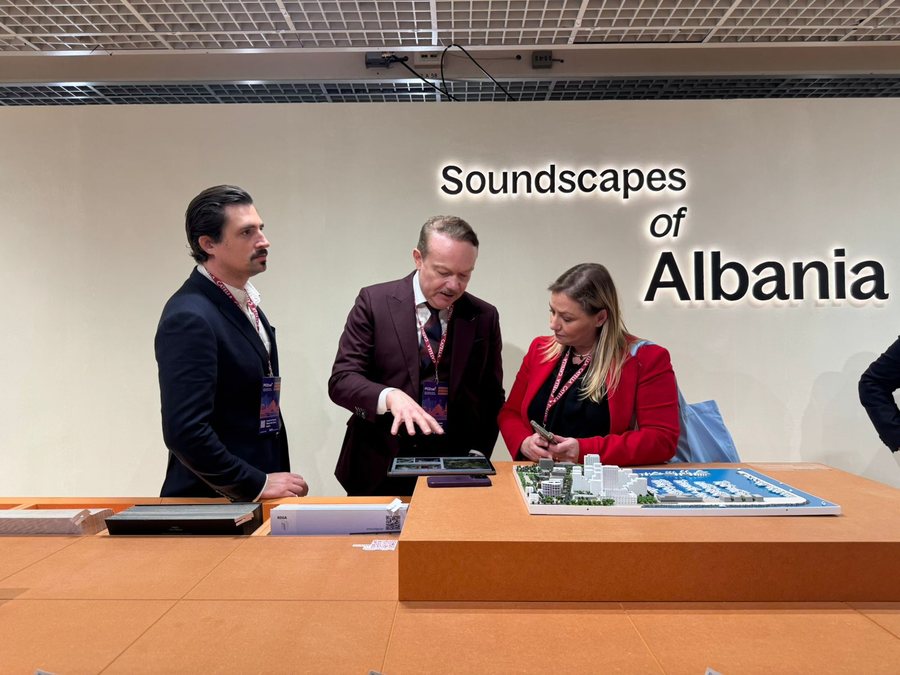
MIPIM, held annually in Cannes, is where serious money goes to meet itself. Sovereign wealth funds, pension managers, and the developers who court them converge on the Palais des Festivals each March for four days of deals, panels, and the particular theatre of nations competing to look investable. Albania’s entry into that theatre this year was, by wide acknowledgment, among the most accomplished. The government’s territorial development agency commissioned a pavilion designed to resemble a record shop. The shelves held vinyl sleeves; inside each, instead of a record, was a description of an architectural project. A DJ was flown in. Monocle, which has covered MIPIM for over a decade, singled the stand out as proof that hiring an architect to design your exhibition space is strategy, not vanity.
The conceit worked because it was doing real argumentative work. The some 80 projects displayed — by Herzog & de Meuron, Diller Scofidio + Renfro, Bjarke Ingels Group, Stefano Boeri, and others — were chosen to make a specific case: that Albania has moved beyond the phase of raw opportunity into something more legible to sophisticated capital. Not a frontier market to be explored by the brave, but a curated, architect-stamped destination that serious money can enter on familiar terms.
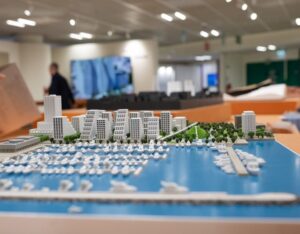
The development that drew the most attention within the pavilion was Vlora Marina, and it illustrates both the strength of that case and its limits. A €350m mixed-use scheme on the Vlorë waterfront, it combines over 800 sea-view apartments, a marina managed by D-Marin — which operates berths across the Mediterranean — and a 34-floor Marriott tower with branded residences. The Belgian architect Xaveer De Geyter designed it; the International Finance Corporation has certified it for energy and water efficiency. Each of those choices is a signal aimed at a particular audience: investors who will not move without a recognised operator, a bankable brand, and a sustainability framework underwritten by an institution they trust. Buyer interest has come from Italy, Switzerland, Germany, and Sweden. The signals, it seems, are being received.
What they cannot yet resolve is the gap between a convincing story and a proven market. Albania’s judicial and regulatory environment has improved markedly, but institutional investors do not approach it without hesitation — and for good reason. Infrastructure outside the headline projects remains patchy. The legal certainty that long-term capital requires is still being assembled rather than taken for granted. Vlorë is not Dubrovnik, and the distance between the two is not measured in kilometres.
None of that makes the pavilion’s ambition misplaced. Most emerging markets get the sequencing wrong: they build capacity before credibility, and find that serious money has gone elsewhere by the time the concrete is poured. Albania, whether by design or instinct, is attempting the reverse — constructing a story first, in the language that sophisticated capital speaks, and betting that the delivery will follow. Vlora Marina, with its phased construction running to 2031, is the wager made tangible.
Whether it becomes the proof of concept for that story, or merely its most photogenic chapter, will depend less on what happened in Cannes than on what happens on a waterfront in southwestern Albania over the next five years. The vinyl was a clever touch. The development now has to earn it.