For the first time since Albania’s justice reform created SPAK, the ruling Socialist Party has used its parliamentary majority to block an arrest request from the special anti-corruption prosecutor. The case concerns Deputy Belinda Balluku, former Deputy Prime Minister and Minister of Infrastructure, who has been under a travel ban since November 2025 while investigated for alleged violations of public tender procedures. SPAK sought to upgrade that measure to detention; the majority Committee found the grounds insufficient. The full report follows.
by the Tirana Examiner
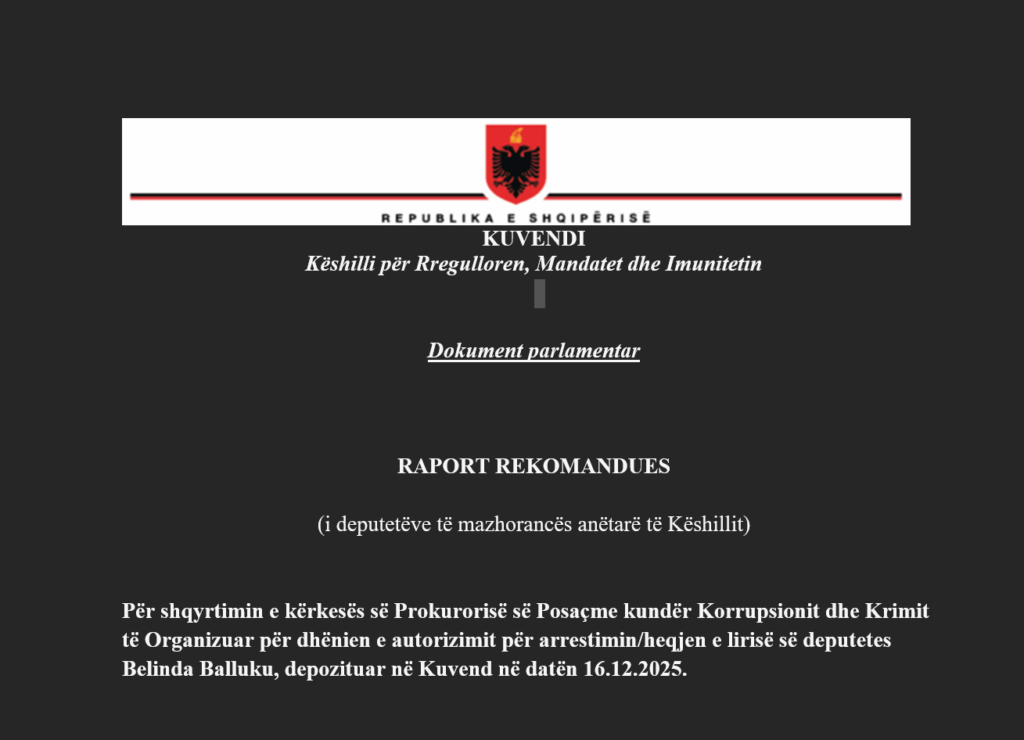
ASSEMBLY OF ALBANIA
Committee on Rules, Mandates and Immunity
Parliamentary Document
RECOMMENDATORY REPORT
(of the majority deputies, members of the Committee)
On the review of the request of the Special Anti-Corruption and Organized Crime Prosecutor’s Office for authorization to arrest / deprive of liberty Deputy Belinda Balluku, filed with the Assembly on 16 December 2025.
INTRODUCTION
Dear colleague deputies,
On behalf of the parliamentary majority I represent in this Committee, allow me to emphasize at the outset that the presentation of this recommendatory report before the Assembly of the Republic of Albania takes place in a factual and institutional context that has undergone fundamental changes. These changes directly affect the manner in which the Assembly must assess the request submitted by the Special Prosecutor’s Office.
A new legal and institutional reality exists today: Deputy Belinda Balluku no longer exercises executive functions as a member of the Council of Ministers. This is a public and institutional fact, resulting from changes in the composition of the government in accordance with Articles 95, 96, 98, and 102 of the Constitution of the Republic of Albania.
Consequently, the personal security measure of suspension from duty as a member of the Council of Ministers no longer produces any real legal consequence. By the same line of reasoning, the narrative upon which the Special Prosecutor’s Office has constructed its request for the application of heavier personal security measures — such as the risk of destruction of evidence, risk of flight, or risk of commission of another criminal offense — remains fundamentally hypothetical insofar as it is directly tied to the exercise of executive functions that the deputy in question no longer performs.
This does not mean, however, that the presentation of this report before the Assembly is a merely formal procedure.
On the contrary, it represents a direct constitutional responsibility of the Assembly of the Republic of Albania. It is an expression of institutional respect for justice, but above all it is an obligation toward the Albanian citizens who have entrusted us with their representation.
All the more so in a situation where this matter — which at its core should remain a question of justice and justice alone — has been unfairly transformed into an excessively politicized debate in the eyes of the public.
Instead of a calm and orderly legal process, we have frequently witnessed attempts to shift this matter into a public trial, into a media tribunal that conflicts with the standards of the rule of law and with the fundamental principle of the presumption of innocence.
It is precisely for this reason that it is essential for the Assembly today to speak clearly: to separate politics from justice, noise from facts, and public judgment from legal process.
Dear colleagues,
For the reasons I have set out above, the Assembly of the Republic of Albania today is not confronted with an ordinary procedural vote.
We are confronted with a decision that directly touches the personal liberty of a deputy, the exercise of the representative mandate, and the constitutional balance between the branches of power.
The request of the Special Anti-Corruption and Organized Crime Prosecutor’s Office (hereinafter: the Special Prosecutor’s Office) seeks the replacement of the security measure of “prohibition of departure from the country” with the heavier measure of “arrest in prison or under house arrest” against a member of this Parliament, Ms. Belinda Balluku, who is under investigation for the criminal offense of “Violation of the equality of participants in public tenders or auctions,” as provided for by Articles 25 and 258(2) of the Criminal Code.
The Assembly is not called today to adjudicate guilt or to substitute itself for the court. It is called to exercise a constitutional filter. And this filter is not — and cannot be — formal. It is an essential mechanism for preserving institutional balance and for respecting the role the Constitution has assigned to the legislative branch in relation to the other branches of power.
I. JURISDICTION AND COMPETENCE
The Assembly of the Republic of Albania, in reviewing the request of the Special Prosecutor’s Office to replace the personal security measure of “prohibition of departure from the country” with the heavier measure of arrest in prison or under house arrest against Deputy Belinda Balluku, exercises its competence in accordance with Article 73(2) of the Constitution of the Republic of Albania, Articles 260, 288, and 289 of the Code of Criminal Procedure, and Articles 13 and 118 of the Rules of Procedure of the Assembly.
Under Article 73(2) of the Constitution, a deputy may not be arrested or have their liberty restricted in any form without authorization from the Assembly. This constitutional provision establishes an institutional guarantee for the exercise of the representative mandate and for the independent functioning of the legislative branch.
Correspondingly, Article 288 of the Code of Criminal Procedure provides that when a security measure of arrest in prison or under house arrest, deprivation of liberty in any form, personal search, or search of residence is to be imposed against a deputy, the prosecutor must request authorization from the Assembly. The request for authorization must be accompanied by a reasoned report and the evidence supporting the request.
Article 289 of the Code of Criminal Procedure further provides that the refusal of authorization under Article 288 does not prevent the prosecutor from requesting a different security measure under Article 244, nor from proceeding against the deputy or other persons under investigation for the same act.
As for the parliamentary procedure for reviewing the prosecutor’s request for authorization to arrest or deprive of liberty, Articles 13, 118, and 119 of the Rules of Procedure of the Assembly, implementing Article 73 of the Constitution, establish that the prosecutor’s request is submitted to the Speaker of the Assembly, who immediately forwards it for review to the Committee on Rules, Mandates and Immunity, and notifies the relevant deputy. The Committee reviews the request while guaranteeing the deputy’s right to defense, and upon completion of its review prepares a report that is submitted to the plenary session for decision. The Assembly decides by open vote whether to grant or deny authorization. If the Assembly does not act within three months of submission, the request is deemed rejected. In cases of flagrant arrest for serious crimes, the Committee convenes within 48 hours under the same procedural rules.
Within this normative framework, the competence of the Assembly in reviewing the request of the Special Prosecutor’s Office is procedural-constitutional in nature, not judicial. The Assembly does not adjudicate guilt or the soundness of criminal evidence — that attribute belongs exclusively to the competent court.
Parliamentary oversight in these cases is limited to verifying: compliance with the procedural requirements for replacing the security measure; the existence of new and concrete circumstances; whether there has been a genuine deterioration of security needs; whether the interference with the mandate is proportionate; and whether arrest is genuinely necessary as an exceptional measure.
In framing this recommendatory report to the Assembly, it is appropriate to emphasize that this act is presented at a moment when a number of factual circumstances have changed, directly affecting the Assembly’s decision-making approach to the request of the Special Prosecutor’s Office. Specifically, of direct relevance to the nature of parliamentary oversight is the fact that Deputy Belinda Balluku no longer exercises executive functions as a member of the Council of Ministers — a publicly known fact, following changes in the composition of the Council of Ministers in accordance with Articles 95, 96, 98, and 102 of the Constitution. In this respect, the personal prohibitory security measure of suspension from the duties of Deputy Prime Minister and Minister of Infrastructure and Energy no longer produces any legal consequences, though it will be analyzed for the purpose of assessing the proportionality of the interference with the mandate.
II. THE CONSTITUTIONAL ROLE OF THE ASSEMBLY
The report recommending the granting of authorization rests on the thesis that the Assembly should be limited to a formal verification of the Prosecutor’s request and should not engage in an assessment of the necessity of the security measure. This reductive approach does not in fact conform to the spirit and function of Article 73 of the Constitution. Addressing the request of the Special Prosecutor’s Office in the spirit and letter of this constitutional norm constitutes the very essence of the matter currently before the Assembly of Albania.
Article 73 of the Constitution grants the Assembly of the Republic a role that is not merely formal in deciding whether to authorize the deprivation of liberty of a deputy. Authorization is an act of constitutionally relevant will, carrying both political and legal responsibility. More plainly: if the granting of such authorization were obligatory whenever requested by the Prosecutor’s Office, the constitutional provision would be superfluous and the Assembly would be reduced to a formal organ with no real balancing role.
The Constitutional Court has emphasized that procedural immunity is not a personal privilege but an institutional guarantee for the protection of the free functioning of the Assembly. This means the Assembly has an obligation to verify whether the interference with personal liberty is real, necessary, and proportionate. This important role of the Assembly is made clear with reference to the case of flagrant detention or arrest of a deputy, where Article 73(3) of the Constitution states:
“A deputy may be detained or arrested without authorization when caught in the act of committing a serious crime or immediately thereafter. The Prosecutor General or the Head of the Special Prosecutor’s Office immediately notifies the Assembly, which, when it finds that there are no grounds for proceeding, decides to lift the measure.”
This constitutional provision makes clear that the Assembly’s role in reviewing a request for authorization to arrest one of its members is not formal but substantive in nature. When the Assembly finds that the procedural conditions and criteria protecting the personal liberty of one of its members have not been respected, it assumes attributes normally reserved to the judiciary — and this is entirely in keeping with the spirit of Article 73(3) of the Constitution. If, by contrast, the Assembly were to vote formally on the basis of the prosecuting authority’s request alone, it would be abdicating its constitutional function and undermining the principle of separation of powers.
Immunity from investigation and criminal prosecution in Albania no longer exists following the 2012 constitutional amendments. A deputy is investigated and prosecuted like any other citizen. Security measures ranging from prohibition of departure to house or prison arrest may be imposed against them.
However, the Constitution has preserved a limited procedural immunity for measures that directly affect personal liberty, requiring prior authorization from the Assembly for arrest. This is not a personal shield but an institutional balancing mechanism.
The obligation of the Prosecutor’s Office to approach the Assembly is enshrined in Articles 288 and 289 of the Code of Criminal Procedure. This procedural obligation on the prosecution would be meaningless if the Assembly did not exercise genuine scrutiny of the legal conditions and proportionality of the measure.
Final competence for granting or denying authorization rests with the plenary session, following the recommendatory report of the Committee on Rules, Mandates and Immunity. This process guarantees a balance between the parliamentary majority and minority and cannot be reduced to a mechanical procedure.
Claims that the Assembly obstructs justice when it acts to guarantee the principle of legality, the principle of legal certainty, the separation of powers, equality before the law, and the principle of independence of investigation — as guaranteed by Articles 4, 7, 18, 42, and 148(2) of the Constitution — have no constitutional or legal basis; they are political in nature. On the contrary, the establishment of clear limits for respecting each of these principles itself strengthens the criminal process as regards due process of law. The investigation against Deputy Belinda Balluku continues and the personal security measure of prohibition of departure from the country, imposed by the Special Court Against Corruption and Organized Crime, remains in force. The question before the Assembly today is therefore not whether justice should be supported — the parliamentary majority has demonstrated its political will in this regard by supporting the new justice system without reservation — but whether interference with the personal liberty of a member of this parliament is necessary and proportionate. The Assembly is not and cannot be an obstacle to justice. It is the guardian of the Constitution. And it is precisely for this reason that the authorization sought today is not a formal act but an act expressing the highest constitutional responsibility.
III. APPLICATION OF PARLIAMENTARY PROCEDURE
The request of the Special Prosecutor’s Office was filed with the Assembly of Albania on 16 December 2025.
The Committee on Rules, Mandates and Immunity, pursuant to Articles 13 and 118 of the Rules of Procedure of the Assembly, convened on 19 December 2025 and 23 February 2026 and examined, behind closed doors on account of investigative secrecy, the request of the special prosecutors for authorization to arrest Deputy Belinda Balluku.
The subsequent session was held following the procedural decision of the Constitutional Court of 6 February 2026, by which the Court failed to reach a decision on the merits of the request filed by the Prime Minister on 21 November 2025.
That request concerned the resolution of a competence dispute between the executive branch and the judiciary — specifically between the Prime Minister and the Council of Ministers on one side and the Special Court Against Corruption and Organized Crime (GJKKO) on the other. The dispute concerned the suspension from office of a member of the Council of Ministers and the consequences of that measure for the exercise of his or her constitutional functions.
In this context, pursuant to Decision No. 118 of 19 November 2025 of the Special Court Against Corruption and Organized Crime, Ms. Belinda Balluku was suspended from the duties of Deputy Prime Minister and Minister of Infrastructure and Energy, thereby raising the question of the relationship between the competences of judicial authorities and the constitutional order governing the functioning of the Council of Ministers.
The request also sought an interpretation of Article 103(3) of the Constitution regarding the procedural guarantees enjoyed by a member of the Council of Ministers in the exercise of constitutional functions, particularly in cases where interventions by other state authorities may directly affect that exercise.
IV. FACTUAL CIRCUMSTANCES OF THE CASE
The Special Prosecutor’s Office initially registered criminal proceedings No. 167 of 9 August 2024, filed by former Democratic Party chairman Lulzim Basha, and subsequently criminal proceedings No. 181 of 12 September 2024, filed by Deputy Gazmend Bardhi, currently chairman of the Democratic Party’s Parliamentary Group.
These two sets of proceedings were consolidated with criminal proceedings No. 136 of 16 June 2025, initiated ex officio by the Special Prosecutor’s Office based on a referral from the National Bureau of Investigation (BKH), into a single set of proceedings — No. 136/2025 — concerning the criminal offense of “Violation of the equality of participants in public tenders or auctions” under Articles 25 and 258(2) of the Criminal Code.
On 20 October 2025, Deputy Belinda Balluku’s name was registered as a person under investigation, and she was subsequently notified of charges for the criminal offense under Articles 25 and 258(2) of the Criminal Code.
By Decision No. 118 of 19 November 2025, the Special Court Against Corruption and Organized Crime imposed on her the security measure of “prohibition of departure from the country” pursuant to Article 233 of the Code of Criminal Procedure, which was subsequently upheld by the Special Court of Appeal.
By the same decision, the prohibitive measure of “suspension from the exercise of duties” was also imposed pursuant to Article 242 of the Code of Criminal Procedure. Due to the constitutional competence conflict between the Prime Minister and the Council of Ministers on one side and the Special Court on the other, implementation of this measure was stayed pending a decision from the Constitutional Court. That decision was issued on 6 February 2026, confirming the validity of the measure by procedural ruling, although the measure has since automatically lapsed as a result of Ms. Balluku’s replacement in the post of Deputy Prime Minister and Minister of Infrastructure and Energy.
On 16 December 2025, the Special Anti-Corruption and Organized Crime Prosecutor’s Office (SPAK), pursuant to Article 260(3) of the Code of Criminal Procedure, filed with the Assembly of Albania a request to replace the security measure of “prohibition of departure from the country” with the heavier measure of “arrest in prison or under house arrest” pursuant to Articles 237 or 238 of the Code of Criminal Procedure, alleging a deterioration of security needs, a risk of destruction of evidence, a risk of flight, and a risk of the commission of further criminal offenses.
V. REVIEW AND ASSESSMENT BY THE COMMITTEE ON RULES, MANDATES AND IMMUNITY
The Committee on Rules, Mandates and Immunity, acting in its capacity as the responsible parliamentary body pursuant to Articles 13 and 118 of the Rules of Procedure, convened on 19 December 2025 and 23 February 2026 and examined, behind closed doors to preserve investigative secrecy, the Special Prosecutor’s Office’s request for authorization to arrest / deprive Deputy Belinda Balluku of her liberty by replacing her existing personal security measure.
The Committee first heard submissions from both parties.
Special prosecutors Klodian Braho, Dritan Prençi, and Dorina Bejko presented the Special Prosecutor’s Office’s request for the Assembly’s authorization to arrest Deputy Belinda Balluku by replacing the security measure of “prohibition of departure from the country” with the heavier measure of arrest in prison or under house arrest pursuant to Articles 237 and 238 of the Code of Criminal Procedure. In support of their request, the special prosecutors invoked Articles 228, 229, 230, and 260 of the Code of Criminal Procedure, claiming that security needs had intensified as a result of developments in the investigation and specific circumstances of the case.
In their submissions, the prosecutors emphasized that the criminal investigation of Deputy Belinda Balluku had expanded to encompass additional criminal facts connected to other public procurement procedures and her actions in a concession procedure.
According to them, there are significant grounds placing at risk the collection or reliability of evidence, arguing that the accused’s freedom could create a real risk to the gathering of evidence in view of the high public functions she had exercised. In this context, the prosecutors claimed a possibility that the accused could interfere in the evidence-collection process, influence witnesses, or create circumstances that could complicate the administration of evidence.
The prosecutors also claimed a risk that the accused might leave the territory of Albania, citing the high sentencing range provided by law for the offense under investigation, as well as the fact that the offense is suspected to have been committed on more than one occasion and in collaboration with others. They further argued that there is a risk that the accused, by reason of the factual circumstances and her personality, might commit serious crimes or crimes of the same type as that for which she is being prosecuted.
The Committee then heard submissions from Deputy Belinda Balluku’s defense counsel, Mr. Ardian Kalia and Ms. Pamela Qirko, who requested that the Committee recommend, in its final report to the plenary, the rejection of SPAK’s request for authorization to arrest Deputy Belinda Balluku by replacing the existing security measure.
In their submissions, the defense argued that the Prosecutor’s request fails to meet the conditions and standards required by criminal procedural law for the intensification of personal security measures. According to them, the existence of new concrete circumstances that would by law allow for an intensification of security needs is not demonstrated. They further noted that, notwithstanding the defense’s position that no security measure at all was necessary in this case, the existing measure of “prohibition of departure from the country” already satisfies the existing security needs.
The defense also argued that the specific criteria under Articles 229 and 230 of the Code of Criminal Procedure for the imposition of heavier coercive measures are not met, and that neither the constitutional nor procedural standards justifying the authorization of a deputy’s arrest by the Assembly are satisfied.
After fully hearing the submissions of both parties and following deliberations held behind closed doors without their presence, Committee members proceeded with the review and assessment of the arguments submitted, for the purpose of drafting the final report.
COMMITTEE’S ASSESSMENT
In reviewing the submissions of the Special Prosecutor’s Office and the deputy’s legal representatives, the Committee notes that the Assembly’s competence in this procedure is not judicial in character and does not consist in assessing the guilt or innocence of the person under investigation. The assessment of criminal responsibility and of the evidence gathered in the proceedings is the exclusive competence of the justice organs and the court that will adjudicate the case on the merits.
The analysis below is accordingly limited to verifying whether the constitutional and procedural standards relating to the restriction of a deputy’s personal liberty have been met, in accordance with Article 73 of the Constitution and the relevant provisions of the Code of Criminal Procedure. The Committee does not conduct a re-evaluation of evidence in the judicial sense; it examines whether the materials submitted with the Special Prosecutor’s request, within the meaning of Article 288(2) of the Code of Criminal Procedure, reveal concrete and current circumstances justifying the replacement of the existing personal security measure.
i. ON THE CLAIM OF DETERIORATION OF SECURITY NEEDS
The Special Prosecutor’s Office states in its request that security needs with respect to Deputy Belinda Balluku have intensified because, in its view, the investigation has identified a greater number of episodes and new indicia beyond the original two criminal facts, and that the possible sentencing sanction and economic damage to the state have increased.
In examining this claim, the Committee has applied the legal standard under Article 260(3) of the Code of Criminal Procedure for the replacement of a personal security measure. This provision requires the existence of new objective circumstances rendering the existing security measure insufficient to guarantee the orderly conduct of the criminal proceedings.
In this sense, the expansion of a criminal investigation does not in itself constitute a new procedural circumstance. It constitutes a normal development in criminal proceedings, particularly in cases involving multiple public procurement procedures.
Accordingly, the mere expansion of the investigation or the addition of suspected episodes cannot automatically be regarded as a new procedural circumstance justifying the intensification of the security measure.
If it were accepted that every expansion of an investigation automatically constituted a new circumstance justifying arrest, then every complex criminal proceeding would necessarily end in pre-trial detention — a result incompatible with the principle of proportionality and the exceptional nature of arrest as a security measure.
It is widely accepted in criminal procedural jurisprudence and doctrine that pre-trial detention is a measure of last resort (ultima ratio), available only when the existing measure has proved insufficient to guarantee the objectives of the criminal proceedings. Pre-trial detention is not a response to the gravity of the charge or the severity of the potential sentence, but solely a procedural instrument to ensure the normal conduct of proceedings.
Replacement of a personal security measure under Article 260(3) requires an objective change in the factual situation since the time the first security measure was imposed. Without such a change, intensification of the measure cannot be considered justified.
From the materials submitted to the Committee, it appears that the investigation of Deputy Belinda Balluku has come to encompass procedures relating to the Great Ring Road project in Tirana. However, these procedures appear to have been subject to verification by the prosecuting authority already at the time the first security measure was imposed, and the relevant documentation was available to the investigation at that point.
In these circumstances, a change in the legal assessment of those procedures by investigators and prosecutors does not in itself constitute a new factual circumstance within the meaning of Article 260(3) of the Code of Criminal Procedure.
Accordingly, the materials submitted do not clearly demonstrate the existence of a new, concrete, and current fact showing that the existing security measure has become insufficient.
Even with the addition of the alleged episodes, the nature of the criminal offense remains unchanged: “Violation of the equality of participants in public tenders or auctions” under Articles 25 and 258(2) of the Criminal Code.
The materials and information submitted by the Special Prosecutor’s Office therefore do not present any new, concrete, and current circumstance, arising after the imposition of the existing security measure, that would indicate that measure has become insufficient for the purposes of the criminal proceedings.
In these circumstances, the claim of deterioration of security needs does not satisfy the required procedural standard for replacement of the personal security measure.
ii. ON THE CLAIM OF RISK OF DESTRUCTION OF EVIDENCE
The Special Prosecutor’s Office claims the existence of a risk of interference in the criminal proceedings, citing the possibility of influence through persons of influence, influence through officials of the administration, and attempts to pressure witnesses.
However, neither the report accompanying the request for authorization to arrest within the meaning of Article 288(2) of the Code of Criminal Procedure, nor the submissions of the special prosecutors at the Committee session, present any concrete element indicating that Deputy Belinda Balluku has exercised pressure on witnesses or interfered in the investigation. The materials submitted to the Committee also do not show that she has been charged with any new offense of obstruction of justice, nor that any judicial decision has found such a violation.
The jurisprudence of the European Court of Human Rights has consistently emphasized that procedural risk must be concrete, current, and grounded in objective elements. Pre-trial detention cannot be justified on the basis of suppositions or abstract risk.
In support of this claim, the Prosecutor’s Office submitted a transcript of a conversation between a state official formerly subordinate to ex-Minister Belinda Balluku and another individual who at the time did not have procedural standing in the proceedings. During the Committee’s deliberations, it emerged that the person claiming intimidation holds the status of defendant in these proceedings, not witness.
In this context, the Committee notes that the ultimate assessment of statements and other elements of the criminal proceedings is the competence of the justice organs and the court that will adjudicate the case on the merits.
Furthermore, during the Committee’s deliberations, no element was presented indicating the existence of direct or indirect contacts between the individuals involved in this communication and former Minister Balluku for the purpose of influencing the investigation.
The materials submitted also show no new development since Decision No. 118 of 19 November 2025 of the Special Court that would render the existing security measure insufficient. The conversation transcript, obtained through special investigative means, was in the possession of the prosecuting authority and the court already at the time the first security measure of “prohibition of departure from the country” was imposed.
In these circumstances, the materials and information submitted to the Committee do not demonstrate concrete, objective, and current circumstances indicating the existence of a real risk of destruction of evidence, including evidence relating to witnesses.
The claim of risk of destruction of evidence therefore does not rest on a basis sufficient to justify the replacement of the existing security measure with a heavier liberty-restricting measure.
iii. ON THE CLAIM OF RISK OF FLIGHT
In its submissions, the Special Prosecutor’s Office has raised the claim of a risk of flight, linking this risk primarily to the high sentencing range provided by law for the offense under investigation and to the fact that the offense is suspected to have been committed multiple times and in collaboration with others.
Assessment of this claim must take into account elements such as: permanent residence, family and social ties, profession, financial situation, prior conduct toward the authorities, and any other circumstance indicating the degree of the person’s rootedness in the territory of the state.
In assessing this claim, the Committee notes that the risk of flight — as one of the criteria that may justify the imposition or intensification of personal security measures — must be evaluated to a concrete and individualized standard, in conformity with the constitutional principles of personal liberty and proportionality, and with the consolidated standards of European Court of Human Rights jurisprudence.
According to the consolidated case law of that Court — expressed, among others, in Neumeister v. Austria, Letellier v. France, Smirnova v. Russia, Panchenko v. Russia, and the more recent cases against Albania in Hysa v. Albania and Gëllçi v. Albania — the risk of flight cannot rest solely on the severity of the possible sentence provided by criminal law.
Under this standard, judicial authorities are obliged to base their assessment on concrete, individual, and verifiable circumstances of the person in question, specifically analyzing their real ties to the state where the proceedings are conducted — residence, family, professional activity, and social integration. Courts must also specifically reason why lighter security measures are insufficient to guarantee the normal conduct of criminal proceedings, since restriction of personal liberty cannot rest on suppositions or abstract reasoning.
Against these standards, the Committee finds that the materials and information submitted by the Special Prosecutor’s Office do not present concrete elements indicating the existence of a real and current risk of departure from the territory of Albania in the case of Deputy Belinda Balluku.
The materials submitted show that Deputy Belinda Balluku was fully aware of the criminal proceedings and of the charges against her. Yet even so, she traveled abroad in connection with official engagements (Bucharest, 26–27 October; Athens, 6–8 November; Rome, 13–14 November) and returned to Albania on each occasion, reflecting regular and non-evasive conduct toward the prosecuting authorities.
The materials also show that she has complied with the security measure of “prohibition of departure from the country,” has submitted the relevant documents as required by the prosecuting authority, and has appeared before the authorities whenever required.
Nothing in the information administered to the Committee indicates any attempt to evade justice, to undermine the proceedings, or to obstruct the normal conduct of criminal proceedings.
The claim of risk of flight thus appears to rest primarily on the abstract element of the severity of the potential sentence and a hypothetical assessment of the behavior of the person under investigation, unaccompanied by concrete circumstances demonstrating that such risk is real, current, and individualized.
In these circumstances, and in conformity with the standards of European jurisprudence, this claim does not provide a sufficient basis for replacing the existing security measure with a heavier liberty-restricting measure.
The Committee concludes that the materials submitted do not demonstrate the existence of a real and current risk of flight within the meaning required for the imposition or intensification of a personal security measure.
iv. ON THE CLAIM OF RISK OF REPETITION OF THE CRIMINAL OFFENSE
The Special Prosecutor’s Office has also claimed that a risk exists that the accused, by reason of the factual circumstances and her personality, might commit serious crimes or crimes of the same type as that for which she is being prosecuted. As elaborated in the Committee’s session, this claim is linked primarily to the public function that Deputy Balluku has exercised and to the fact that in connection with that function she has been involved in decision-making relating to the administration of public funds.
In assessing this claim, the Committee notes that the risk of repetition of a criminal offense — as a ground capable of justifying restriction of personal liberty — requires an assessment grounded in concrete, individual, and current circumstances, and cannot be built on abstract suppositions or on the general nature of a public function.
The jurisprudence of the European Court of Human Rights has emphasized that authorities must base such an assessment on concrete individual circumstances showing the existence of a real and current risk of the commission of further criminal offenses. In Clooth v. Belgium, the Court stressed that the risk of repetition cannot be justified solely by the social or professional position of the person under investigation but must rest on concrete elements relating to their conduct, the particular circumstances of the case, and verifiable indicia of a genuine propensity to commit further offenses.
In the present case, the materials and information submitted to the Committee do not reveal any such concrete analysis. The charge against Deputy Belinda Balluku remains unchanged, and no new circumstances have been presented indicating the existence of ongoing criminal activity or a real risk of repetition of the offense.
Furthermore, the Committee takes note of the factual circumstance that Ms. Balluku no longer exercises an executive function in the state administration. In these circumstances, the claim relating to the possibility of using a public function to commit further criminal offenses lacks direct factual support and remains at the level of hypothesis.
The Committee finds that an interpretation under which the mere fact of having exercised a public function and administered public funds would suffice to justify a risk of repetition of a criminal offense would transform personal security measures from procedural instruments for ensuring the orderly conduct of proceedings into a form of institutional sanction against public officials — a result incompatible with the fundamental principles of the rule of law and the nature of security measures.
Indeed, every public official in the exercise of their duties administers or decides on the use of public funds. That general circumstance cannot serve as a sufficient basis for replacing the existing measure with a heavier one absent concrete circumstances demonstrating the existence of a real and current risk.
The claim of risk of commission of further criminal offenses is therefore hypothetical and unsupported by concrete elements. It does not satisfy the standard required by Article 228(3) of the Code of Criminal Procedure, under which restriction of personal liberty may be justified only in the presence of concrete circumstances indicating the existence of a real and current risk.
The Committee concludes that the materials submitted do not demonstrate the existence of a real and current risk of repetition of the criminal offense and that, consequently, this claim does not constitute a sufficient basis for replacing the existing security measure with a heavier liberty-restricting measure.
V. CONCLUSIONS AND RECOMMENDATION
On the basis of the review of the materials submitted by the Special Prosecutor’s Office, the submissions of the defense, and the institutional and constitutional assessment of the circumstances of the case, the Committee on Rules, Mandates and Immunity concludes that the request for the Assembly’s authorization to replace the personal security measure of “prohibition of departure from the country” with the measure of arrest in prison or under house arrest against Deputy Belinda Balluku does not satisfy the standard required by criminal procedural law and by the constitutional principles governing the restriction of a deputy’s personal liberty.
The review of the procedural risks provided for in the Code of Criminal Procedure has not revealed concrete circumstances justifying the imposition of a heavier security measure. The claim of risk of flight is not grounded in factual elements indicating concrete conduct of evasion from justice. On the contrary, the information administered to the Committee shows that the deputy has been available to the justice organs and has fully complied with the existing security measure.
Equally, the claim of risk of destruction of evidence or interference with the investigative process is not supported by concrete and current circumstances. The materials submitted do not present new acts indicating attempts to obstruct the investigation or to undermine the reliability of evidence. Given that the relevant documentation has been secured and the investigative procedure has been underway for a considerable time, this risk remains at the level of an abstract supposition rather than a concrete circumstance capable of justifying the maximum restriction of personal liberty.
Similarly, the claim of deterioration of security needs is not grounded in new circumstances rendering the existing measure insufficient. The expansion of the investigation or the addition of suspected episodes constitutes a normal development of criminal proceedings and cannot in itself be regarded as a new procedural circumstance justifying the imposition of a heavier security measure.
The Committee also takes note that the criminal offense of inequality in tenders, under Article 258(2) of the Criminal Code, is an offense of an administrative-criminal nature, connected to public procurement procedures and consisting primarily of documentary elements arising from the administration of those procedures.
The Committee further takes into account data presented in the annual reports of the Special Prosecutor’s Office to the Assembly of Albania, which show that the investigation and adjudication of this type of offense has in practice proceeded without the imposition of security measures of a pre-trial detention character. These data reflect indicators reported in the context of prior investigative and judicial practice in the treatment of this category of offenses.
In this framework, the proportionality analysis — in conformity with the spirit of Article 17 of the Constitution, and in the light of Constitutional Court jurisprudence, the standards of the European Court of Human Rights, and the Venice Commission — acquires decisive importance in assessing whether the restriction of fundamental rights is necessary, appropriate, and proportionate in a democratic society.
The principle of proportionality requires that any restriction of personal liberty be the last and necessary resort for guaranteeing the objectives of the criminal proceedings. Arrest constitutes the heaviest security measure and may be used only when lesser measures prove insufficient.
In the present case, the existing measure of “prohibition of departure from the country,” imposed by Decision No. 118 of 19 November 2025 of the Special Court Against Corruption and Organized Crime, has proved effective and has been fully respected by Deputy Belinda Balluku. No breach of this measure has been identified, nor any circumstance suggesting that it has failed to ensure the deputy’s appearance before the justice organs.
Accordingly, replacing it with a significantly heavier measure such as arrest in prison or under house arrest is not shown to be necessary and, consequently, does not satisfy the proportionality test required by criminal procedural law and by European jurisprudential standards for the protection of personal liberty.
This analysis must also take into account the constitutional dimension of the matter. Article 73 of the Constitution provides a special protection regime for deputies — not as a personal privilege but as an institutional guarantee designed to protect the free and independent exercise of the parliamentary mandate.
In this sense, the Assembly’s decision on the request for authorization of arrest does not constitute a judgment on the guilt or innocence of the deputy, which is the exclusive competence of the justice organs.
The role of the Assembly is to assess whether the serious restriction of personal liberty is shown to be necessary and proportionate in relation to the concrete circumstances presented and to the functioning of the parliamentary institution.
This role is also consistent with the standard set out in the opinions of the Venice Commission, according to which parliaments should not conduct a criminal trial on the merits of the charge, but have the obligation to assess whether the requested measure is necessary and whether it would disproportionately affect the exercise of the parliamentary mandate and the functioning of the representative body.
In the absence of concrete circumstances demonstrating the necessity of arrest, authorizing such a measure would constitute an unnecessary restriction of personal liberty and a disproportionate interference with the exercise of the parliamentary mandate.
In a state governed by the rule of law, the fight against corruption and the guarantee of the functioning of justice are legitimate and necessary objectives. However, these objectives must always be pursued in conformity with constitutional principles and with the procedural guarantees that protect fundamental rights and liberties.
For these reasons, on the basis of the legal, procedural, and constitutional examination of the case, the request to replace the existing personal security measure with the measure of arrest is not shown to be grounded in concrete and verifiable circumstances and, consequently, does not satisfy the standard of necessity and proportionality required by the Constitution of the Republic of Albania, criminal procedural law, and European standards for the protection of personal liberty.
In these circumstances, pursuant to Article 73 of the Constitution of the Republic of Albania, Articles 260, 288, and 289 of the Code of Criminal Procedure, and Article 118 of the Rules of Procedure of the Assembly, the Committee on Rules, Mandates and Immunity recommends to the Assembly of the Republic of Albania:
The rejection of the request of the Special Anti-Corruption and Organized Crime Prosecutor’s Office for authorization to arrest / deprive Deputy Ms. Belinda Balluku of her liberty.
The denial of authorization to arrest / deprive Deputy Ms. Belinda Balluku of her liberty, given that the review of the materials and circumstances submitted to the Committee has not demonstrated the necessity of imposing such a measure in relation to the exercise of the parliamentary mandate and the functioning of the institution of the Assembly.